


This spring, Abraham González Pacheco’s monumental series of murals, collectively titled Orogenic (2026), engulfs the façade of the Carnegie Museum of Art in Pittsburgh, Pennsylvania. These concrete, metal, and pigment depictions of a maelstrom of archaeological objects take inspiration from the museum’s collection and introduce viewers to the 59th edition of the institution’s Carnegie International. The newly commissioned work suggests a key theme of the show: the ways in which museums and history itself have assigned value to certain civilizations, acquiring and displaying their objects in fraught ways.
Carnegie International is the longest-running contemporary art survey in North America. Industrialist Andrew Carnegie established the annual show in 1896 with a vision to boost the city’s cultural footprint. Though it initially centered on European painting and Gilded Age art, the exhibition has evolved over the past century to become a research-driven project that enlivens the city every four years. Different curatorial teams take the helm each time, bringing diverse, global art practices to Pittsburgh in order to consider timely sociopolitical questions.
This edition of the exhibition, which opened on May 2 and will be on view through January 3, 2027, is its most expansive to date. It features over sixty artists and collectives, as well as more than thirty commissions. Curators Ryan Inouye, Danielle A. Jackson, and Liz Park have chosen the title “If the word we,” from an essay by the Egyptian writer Haytham el-Wardany, which considers collective experience and connection in the face of global challenges. The curators propose that the world “cannot be fully understood from a single point of view or universal framework,” but rather through ongoing inquiries that help us “navigate [the] contradictions of life while being receptive to the frequencies of our surroundings.”
Their ideas unfold in the museum and sites across Pittsburgh, from the Kamin Science Center to the Mattress Factory. Throughout, artists consider themes ranging from geopolitics to diasporic and Indigenous histories, often through immersive, site-responsive installations and architectural interventions. During the opening days, Artsy was on-site to discover standout works. The following five newly commissioned projects offer compelling entry points to the show:
Cinthia Marcelle, Green Hall Annex (2026)
B. 1974, Belo Horizonte, Brazil. Lives and works in São Paulo.
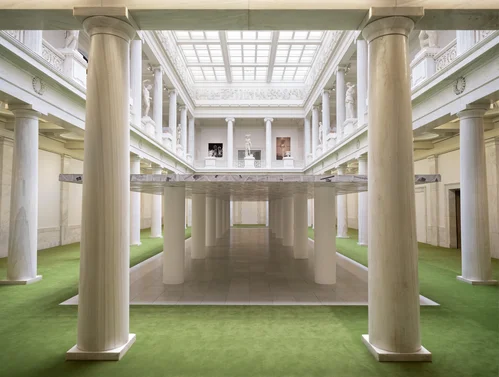
A centerpiece of the exhibition, Cinthia Marcelle’s monumental installation reflects on political and cultural parallels between the United States and Brazil. Its subject is the aftermath of the far-right attacks on the U.S. Capitol and on federal buildings in Brasília, Brazil’s capital city, on January 6, 2021, and January 8, 2023, respectively, and the subsequent processes of renovation and repair.
The work takes the form of a flat-roofed pavilion with minimalist pillars, which evokes the targeted government buildings in Brasília, designed by Brazilian modernist architect Oscar Niemeyer. The curators have installed the piece in the museum’s striking Hall of Sculpture, which features white marble pillars sourced from the same quarries used for the Parthenon. Here, the curators reference the Neoclassical architecture of the U.S. Capitol.
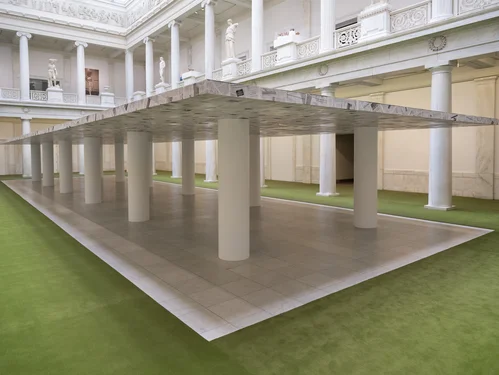
Marcelle has blanketed the gallery and structure of her roof with green carpet. It’s sourced from the same manufacturer responsible for the green carpet removed from Brazil’s government buildings following the attacks. On the underside, the artist collaged newspaper clippings in English and Portuguese from the Pittsburgh Post-Gazette, the New York Times, and Brazilian publications that address political events and legal proceedings. In one corner of the room, the carpet is slightly lifted, revealing fragments of these newspaper clippings beneath. The work prompts reflection on how we record, interpret, and circulate history and current events.
The installation furthers Marcelle’s larger project to explore how political systems are organized and dismantled. It expands on her 2023 exhibition “Blue Hall Annex” at Galeria Luisa Strina in São Paulo, which similarly took blue carpet—which replaced the damaged carpet in the Brazilian government buildings—as a metaphor.
Dineo Seshee Bopape, Fiela, fiela (I’ve come to take you home) (2026)
B. 1981, Polokwane, South Africa. Lives and works in Johannesburg.
Dineo Seshee Bopape aligns with the exhibition’s larger theme of “we” as she continues her research into the relationship between land, memory, and healing. Her immersive, multimedia environment in the Carnegie Museum’s lobby gallery references Yoruba cleansing rituals. The circular structure, made of clay and soil, invites visitors to gather and pause; jute mats and plastic chairs encourage respite and extended viewing. Bopape produced an ambient soundtrack that loops from various speakers suspended throughout the space. Mounds of dirt, rocks, cowrie shells, and crystals are dispersed throughout alongside several projections onto the walls and floor that show nature scenes and snippets of Yoruba rituals. One, projected onto a stone, features a figure who rhythmically sweeps the earth.
The artist says that sweeping, a recurring motif in her work, is a metaphor for spiritual cleansing and a meditative gesture with a mantra-like potential. The artist also noted in a catalogue interview with curator Danielle A. Jackson that the “vibrations and rhythms of the strokes” collectively resemble waves and currents. The theme of “waves” also connects to various drawings on display from Bopape’s series “Master Harmoniser” (2020), in which the artist used soils from various sites related to the transatlantic slave trade to render water-like forms. These pieces suggest the metaphysical properties of water and earth and their capacity to hold memory.
Claudia Martínez Garay and Arturo Kameya, La ceniza ya no recuerda qué causó el incendio. / The ash no longer remembers what caused the fire. (2026)
B. 1983, Ayacucho, Peru. Lives and works between Amsterdam and Lima.
B. 1984, Lima. Lives and works in Amsterdam.
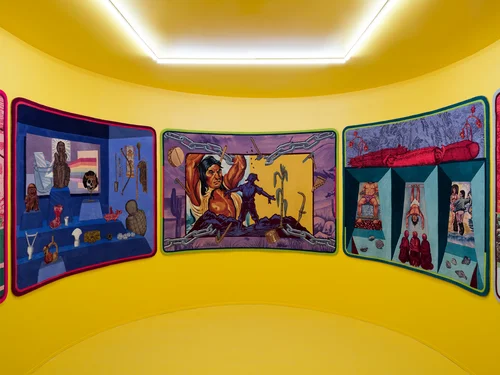
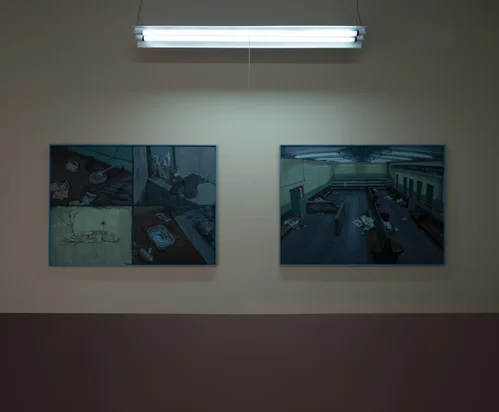
This dual presentation by the Peruvian artists Claudia Martínez Garay and Arturo Kameya, whose practices both engage with colonialism and national identity, brings together sculptures, multichannel videos, paintings, and other works. It takes over three floors of a building within the Mattress Factory complex in Pittsburgh’s North Side and examines how state power shapes history and collective memory.
The artists take inspiration from Túpac Amaru II, an Indigenous chief and descendant of the last Inca ruler, who led an Andean rebellion against the Spanish in Peru in the 1780s. He became a lasting symbol of anti-colonial resistance and emancipatory movements. The installation of nine interconnected rooms unites mythic narratives with such political history. Martínez Garay presents psychedelic sculptures and acrylic paintings that reference contemporary Peruvian and ancient Andean visual traditions, often marked by distinct symmetry and geometric patterning. Kameya assembles a sprawling amalgamation of found and sculptural objects, from iPhones looping the news on social media to everyday domestic materials. They are strewn across debris-filled galleries that appear dilapidated or in a state of construction, evoking the plastered adobe houses of the artist’s childhood and reflecting on fragmentation and reconstruction.
Torkwase Dyson, Tomorrow Was Yesterday (2026)
B. 1973, Chicago. Lives and works in Beacon, New York.
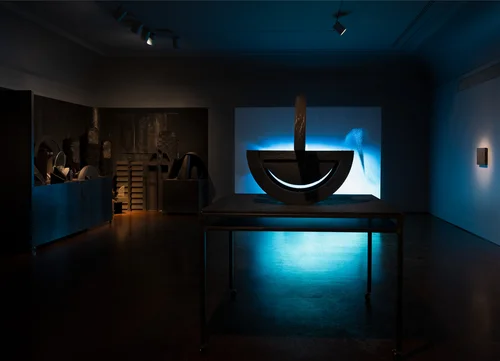
Torkwase Dyson presents an approximately eight-minute animation in the Kamin Science Center’s Buhl Planetarium on select days throughout the run of the exhibition. The work continues the artist’s research into the effects of oil and gas drilling in the Caribbean, particularly off the coast of Trinidad and Tobago. The film immerses viewers in an underwater environment, where a robotic figure taps and chips at the seabed until the bedrock collapses. Before the animation begins, we see the artist in her studio creating abstract sculptures from fragments of stone that aim to evoke the broken bedrock. Dyson anchors her practice in broader questions about the pervasive effects of colonization and the slave trade in the Caribbean, and how the degradation of the environment will disproportionately affect Black diasporic communities in the region.
The artist works across disparate media to consider how the Black diaspora exists within and resists extractive systems of power. At the Carnegie Museum, she presents a series of drawings, paintings, and sculptures that expand this inquiry, using abstract spatial compositions to evoke underwater topographies and infrastructural systems such as pipelines and drilling sites. The project addresses urgent themes of environmental depletion, infrastructure, and architecture in contemporary life.
G. Peter Jemison, Across the Crick (All Roads Lead to Irving) (2026)
B. 1945, Silver Creek, New York. Lives and works in Victor, New York.
G. Peter Jemison’s newly commissioned, multi-panel painting is part of a larger reimagining of Iroquois and Native American art. The artist organized the touring show in 1975 to display the work of artists from the six tribes that make up the Haudenosaunee Confederacy in the northeastern United States and Canada. An enrolled member of the Heron Clan of the Seneca Nation, the artist has been a lifelong advocate for Native American art. He has served as a curator for many pioneering institutions including the Institute of American Indian Arts in Santa Fe, New Mexico, and the Ganondagan State Historic Site in New York, while maintaining his studio practice.
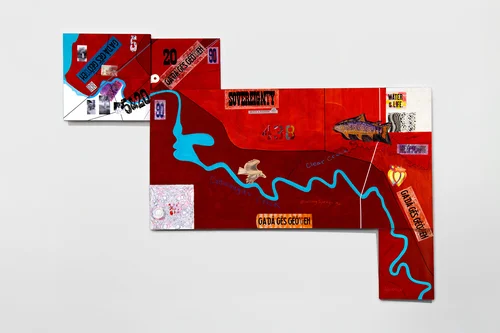
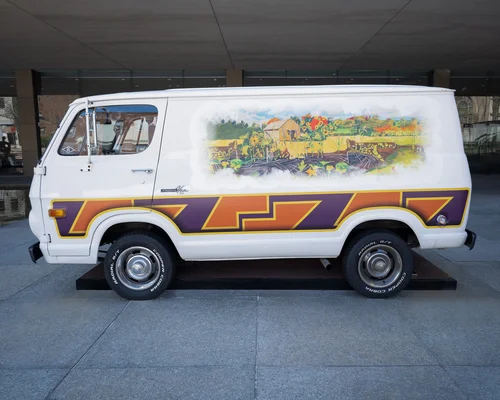
Across the Crick (All Roads Lead to Irving) depicts a map of Cattaraugus Reservation, where Jemison was born. His motifs, such as wildlife and rivers, speak to themes like the displacement of Native Americans, persistent colonial policies, land and water rights, and the preservation of Native knowledge and culture. Alongside his canvas, Jemison has mounted works by the artists Jay Carrier, Tom Huff, Craig Marvin, Diane Schenandoah, and Randee Spruce, whose works were in the original exhibition. These pieces, which range from beadwork to stone and animal bone carvings, demonstrate other contemporary expressions of Haudenosaunee art. Jemison transported all these artworks to the museum from his studio in upstate New York in a vintage van that is parked in the museum’s plaza. It’s splashed with a painting of the Ganondagan State Historic Site, where he established the Seneca Art and Culture Center in 2015, a Native American–led arts and education institution dedicated to preserving and sharing Seneca and Haudenosaunee history and culture.
