


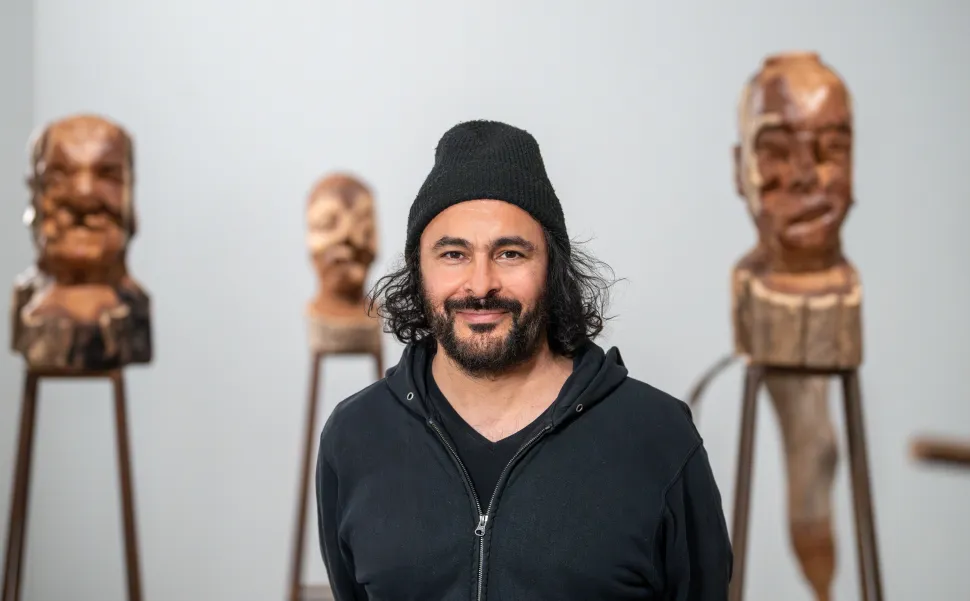
Kader Attia, an acclaimed artist whose work is currently included in Koyo Kouoh’s main exhibition of the Venice Biennale, has been selected to curate the 2027 edition of the Kochi-Muziris Biennale, India’s top biennial.
Attia, a winner of France’s Prix Marcel Duchamp, may be best known for his sculptures and installations that seek to rectify the violence of colonialism in North Africa, but the Berlin- and Paris-based artist has curated at least one notable biennial previously.
That show, the 2022 Berlin Biennale, was celebrated in some corners for its emphasis on artists of the Global South. But it was denounced in others after a group of Iraqi artists pulled out of the show, protesting a French artist’s work that featured graphic images of tortured Abu Ghraib detainees.
His selection continues a tradition of artists helming the Kochi-Muziris Biennale. The most recent edition, which opened at the end of last year, was organized by artist Nikhil Chopra, who worked on the show with HH Art Spaces, an artist-run space based in Goa. And in 2018, Anita Dube, an artist with an art history background, curated the show.
Jitish Kallat, himself a prominent Indian artist, led the committee that selected Attia, whom Kallat praised for his “artistic depth, curatorial openness, and a strong pedagogic sensibility.”
In a statement, Attia, who showed in the biennial’s 2014 edition, said in a statement, “Ever since I visited Kochi for the first time, I have dreamed of coming back and building connections between the many intertwined influences that are at the core of this culturally multi-layered city. I am thrilled to have the opportunity to bring this desire to life on the scale of a [biennial], together with the fantastic team of the Kochi-Muziris Biennale, for its seventh edition. Dreams repair us, like art… and the Biennale, as well as Kerala, will give us the space-time to reclaim our sovereignty over our dreams.”
He joins the biennial at a tumultuous time. Bose Krishnamachari, a cofounder of the show, stepped down as the leader of the foundation that runs the exhibition in mid-January, though it did not emerge until March that he had been facing a sexual harassment complaint. Venu Vasudevan, the foundation’s chairperson, said that the complaint was only “one of the reasons” for his resignation, however. Krishnamachari denied the allegations, saying that they were “misleading, unverified, and taken out of context.”
In a statement, Venu said that Attia’s appointment marked “an exciting new chapter” for the biennial.
