







The 2026 Venice Biennale opened to the public last weekend, weighted with politics and emotion. The main exhibition, “In Minor Keys,” was conceived by the late Cameroonian Swiss curator Koyo Kouoh—the first African woman appointed to lead the Biennale—who died unexpectedly in May 2025. Her curatorial team, including Rasha Salti, Marie Hélène Pereira, and Gabe Beckhurst Feijoo, carried forward her vision, which reflects Kouoh’s belief in art as a “shared and sustaining force.”
Throughout opening week, angry protestors filled the paths of the Giardini and Arsenale, distributing flyers that called for the exclusion of Russia and Israel from the national pavilions. The Golden Lion jury resigned, refusing to judge a contest among several countries whose leaders face charges at the International Criminal Court.
And yet, the art insisted on being seen. Across the main exhibition, the national pavilions, and the collateral exhibitions winding through Venice’s palazzos and churches, distinct aesthetic and material threads emerged. As artists engaged the defining pressures of our moment—ecological collapse, social division, the horror of war—several visual obsessions surfaced again and again. Here are the trends that define the 61st edition.

Birth and fertility
Wangechi Mutu’s gigantic sculpture of a pregnant belly emerged from the floor of the Giardini while her video, exploring a matriarchal creation myth, played nearby. Rising artist Buhlebezwe Siwani showed naturalistic sculptures of contemplative pregnant women made with green Sunlight soap, a comment on purity and gender.
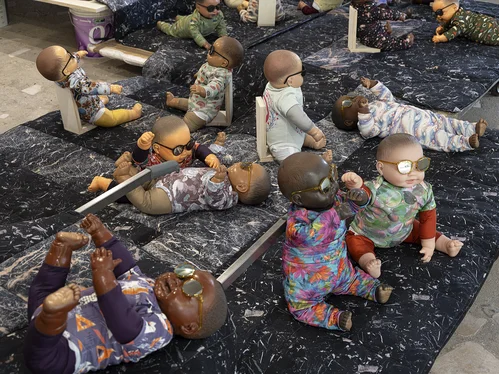
Japan’s pavilion featured a more literal representation of child rearing. Visitors were handed a baby doll and asked to care for it. If they changed its diaper, these proud parents would be rewarded with a QR code leading to a poem (drawing a link between artistic and biological creation). The attention-grabbing pavilion is by queer artist Ei Arakawa-Nash, who became a parent of twins in 2024. Foisting these 11-pound babies (about the weight of a four-month-old) on the new “parents” is an undeniably humorous way to have them experience the burden and joy of new life.
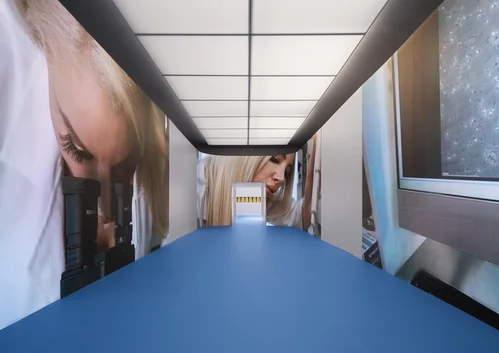

Declining birthrates form a backdrop for this artwork, lending anxiety to Arakawa-Nash’s play-pretend. Society-wide fertility crises also inform Maja Malou Lyse’s work at the Danish pavilion, where a line of tombstone-like, cryogenic sperm containers comprise the work Stars in My Pocket (2026). They’re embedded with tiny video screens that show a new phenomenon: “sperm races.” On the other side of the pavilion, a “musical” of sorts plays out across a new, multichannel video work in which porn performers act as sexed-up sperm bank employees. As male fertility declines worldwide, the piece references research that watching sex on screens can increase sperm motility. Equal parts grotesque and salacious, it’s a crazed futuristic vision of where fertility science could take us.
—Josie Thaddeus-Johns
The unphotographable

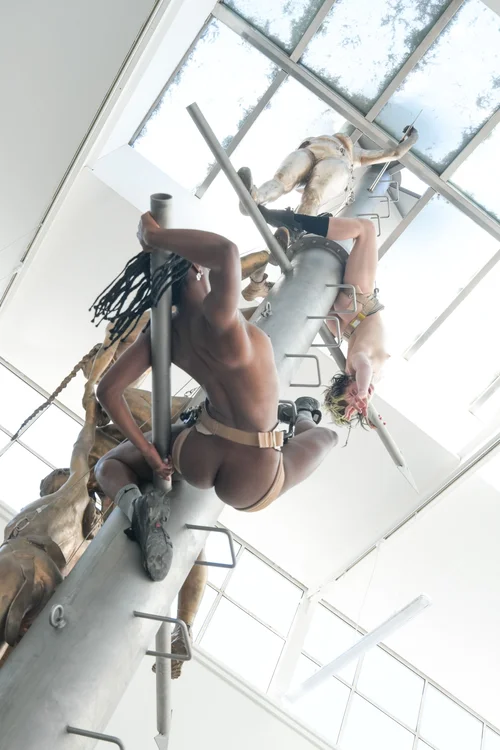
Yes, there are naked women in harnesses spinning around a pole; but no, you can’t take a photo. Florentina Holzinger’s Austrian pavilion may have been one of the most-talked-about shows of the opening week, but staff asked visitors to put away their camera phones for the performances. It was one of many Biennale moments that rejected the “instagrammability” of contemporary art.
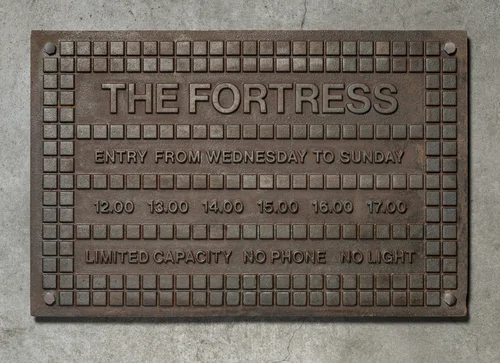
At Egypt’s pavilion, artist Armen Agop also asked for no photos (as well as silence) as a way to move away from “speed and spectacle.” At the Dutch pavilion, Dries Verhoeven similarly prohibited photography and asked all visitors to turn off their phones. His choreography was all the more powerful for it: A single performer in plain clothes enters the space as if a regular visitor. She half-retched, half-yelled a series of jarringly uplifting mantras, while the pavilion’s shutters slowly enclosed the space in pitch darkness (try taking a sneaky pic of that).
At the Holy See pavilion, some of the world’s foremost musicians—Patti Smith, FKA twigs, Brian Eno—have created a soundwalk through a monastery’s garden. Visitors put on special headphones and enter an interactive journey where each artist’s sound blends gently into one another, creating something quite beautiful, and completely unphotographable.

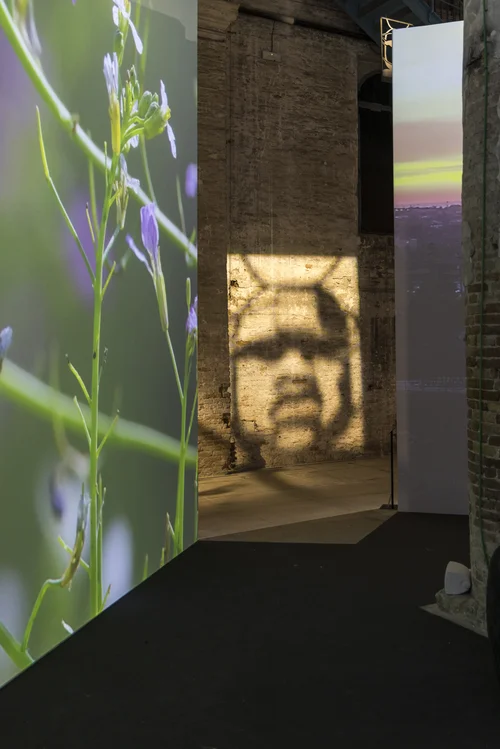

In the main show, too, sound was everywhere. Kamaal Malak created a synth-laden soundtrack to accompany Maria Magdalena Campos-Pons’s magnolia-influenced display. Even less capturable on phones: scent. A casual visitor could lose track of the number of signs reading “this artwork contains natural aromas and fragrances.” There was one at Cauleen Smith’s video installation work (which evoked an L.A. park), Carsten Höller’s scent based on his parents’ accoutrements, and another waft of patchouli and vetiver coming off Manuel Mathieu’s video installation Pendulum (2023). The latter was also available for purchase in the form of a candle, a quirky way to take home a small piece of the Biennale.
Meanwhile, at the acclaimed collateral event “Official. Unofficial. Belarus,” from Belarus Free Theatre, sensorial details remind visitors of the plight of political prisoners in Belarus. They can light candles, made in collaboration with Ukrainian studio ol.factory, that smell like a prison office, or taste a one-bite offering from Chef Rasmus Munk that incorporates tongue-numbing herbs and evokes the despair of incarceration. Social media managers everywhere, watch out. The next wave of art might be impossible to share on our phone screens.
—Josie Thaddeus-Johns
Water

Unsurprisingly, many artists exhibiting across the “floating city” incorporated water—literally and as a conceptual framework—in their presentations. In an area that bears the brunt of climate change, evidenced by the worsening acqua alta that submerges Venice annually, water is a useful metaphor for humans’ relationship with nature and the fragility of the environment.
On a street between the Giardini and the Arsenale, Melissa McGill’s installation “Marea” presents nearly 100 canvases painted like the waves of the lagoons. They flutter from clotheslines and raise awareness of the impact of rising sea levels on the locals.
In “Matriclysm: An Archeology of Connections Lost,” American singer-songwriter turned visual artist Jewel included a cocoon-like cast resin sculpture. The piece, Heart of the Ocean (2024), features a display of LED lights that change color based on live-streamed ocean warming data. Likewise, at Ocean Space, a group show called “Tide of Returns” explores how Indigenous groups have served as stewards of water.
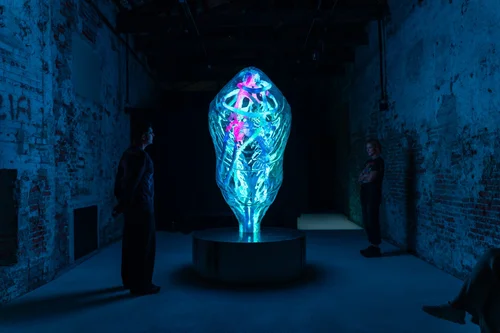

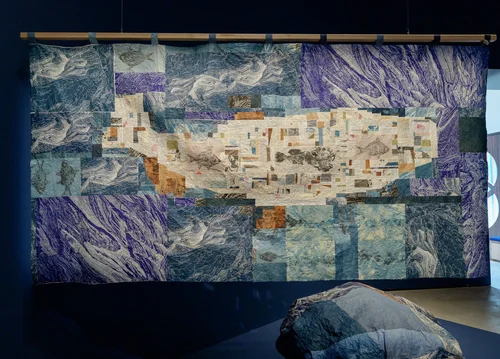
Inside the Biennale, artists also explore the vicissitudes of water. Michael Joo’s Noospheres: Expanded (2026) video and sculptural installation includes weathered tubing and pylons used to support the Venetian waterways, while Alexa Kumiko Hatanaka’s patchwork prints and flags depict snowdrifts, fish, and tsunamis. “The linocut prints represent both snow and water,” the artist told Artsy. “Snow and ice are melting at alarming rates, [as I experienced firsthand]…water is what connects us.”
Water is itself a material at Canada’s pavilion, which artist Abbas Akhavan filled with a pool and glow lights. Giant water lilies will grow in Akhavan’s installation, a nod to a plant that fascinated Victorian-era Brits.
But the buzziest display is Florentina Holzinger’s flooded Austrian pavilion. In one water-filled room, a nude performer spins on a jet ski, splashing visitors. In the pavilion’s courtyard, another nude woman in scuba gear is submerged in a tank of purified urine filled by visitors relieving themselves in two porta potties. Holzinger hopes to convey the urgency of rising sea levels. It’s also hard not to think about ocean health and access to clean water. The disturbing presentation and purified-urine-filled tank may indeed offer a view into our resource-limited future.
—Annabel Keenan
Raw materials
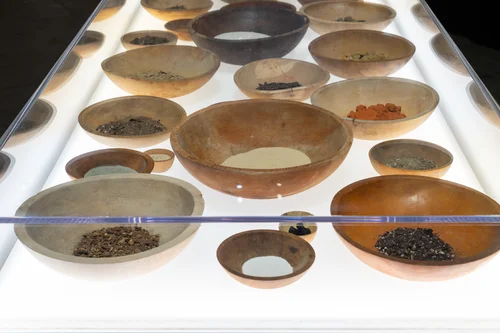
Raw materials like earth, salt, and sand, which bear associations with national identity and the environment, play a major role for many Biennale artists. In the main exhibition, American artist Dawn DeDeaux’s Dirt Bowl Table (2021) features 64 wooden bowls of varying sizes filled with ash and earth. Nearby, Lebanese artists and filmmakers Joana Hadjithomas and Khalil Joreige’s sculptures contain geological samples from an archaeological site discovered at the war-torn Nahr el-Bared refugee camp in Lebanon. The work points to the endurance of waste, which will far outlast the societies that produce it.
Elsewhere, artist Matías Duville filled Argentina’s pavilion with white salt that contains a monumental drawing in charcoal, a nod to the fragility of the natural world and humanity’s role in altering it. In Oman’s pavilion, visitors find an expanse of sand brought in from the Omani desert under metal shapes hanging from the ceiling. The installation by Haitham Al Busafi draws inspiration from the traditional practice of al-zaanah—adorning horses with metal decoration as a sign of respect, as Omani culture reveres the animals for their utility and companionship.
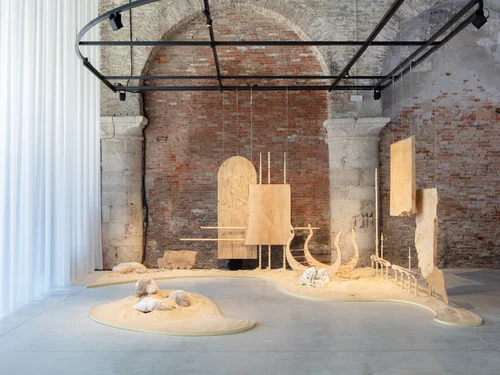

Likewise, Uzbekistan’s “The Aural Sea” pavilion features sand underneath Zulfiya Spowart’s sculpture resembling a boat, and Zi Kakhramonova’s interactive work consists of a large pit of salt (the material now a pervasive remnant of the country’s dried-up Aral Lake). In a time of contested territories, ecological collapse, and nationalist spectacle, it’s no surprise that some artists bring a physical piece of their homelands to the Biennale.
—Annabel Keenan
Hair
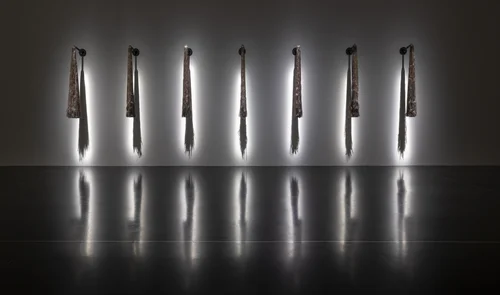

Hair occupies a liminal space between self and object, and artist Marina Abramović uses it often in her work. She further explored this tension in “Transforming Energy,” her major show at the Galleria dell’Accademia di Venezia, where an installation of long ponytails extends along a wall. They’re made of fake hair, symbolizing horse hair and its rumored healing qualities. They swing when visitors stand before them, tickling their backs and creating a sensation that is unnerving for some and soothing for others.
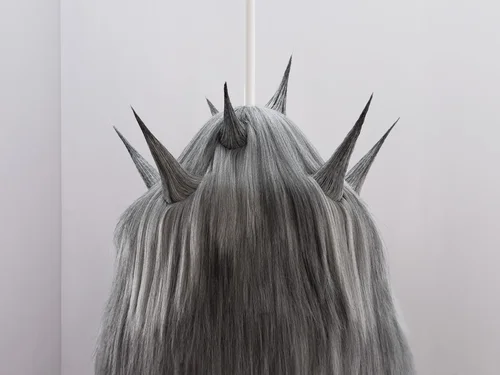
In Finland’s pavilion, Jenna Sutela uses large gray wigs to give a physical form to the five Venetian winds, caused by the interactions between the warm Adriatic water and the cool Alpine air. Different hairstyles give the wigs distinct personalities, and they’re accompanied by a soundscape of wind moving the synthetic hair. “The fuzzy sculptures are also humorous and I hope will offer a sense of joy,” Stefanie Hessler, curator of the pavilion, said.
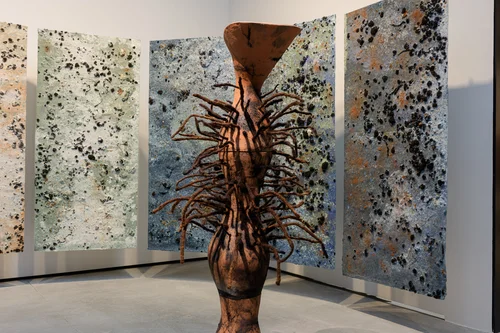
Hair also appears throughout “In Minor Keys,” including in an installation of drawings, paintings, and furniture by Nigerian artist Temitayo Ogunbiyi. The artist depicts plants in the style of colonial botanical illustrations, incorporating patterns and techniques of traditional African hairstyles. In these hybrid images, she explores how diasporic movement and tradition shape contemporary multiculturalism. Elsewhere, Alice Maher’s drawings depict mythical Sibyls in tangled coils of hair. And Kenyan artist Wangechi Mutu combines human hair and tree branches in her kinetic piece Sweeper (2023), a broom that spreads red earth and coffee grounds in circles on the floor, as if tending a garden.
Elsewhere in the Giardini, Marcia Kure turns synthetic braids into a series of imposing, sculpted jackets that hang from mannequins. Each shoulder and bust appears like a disembodied head. Nearby, Adebunmi Gbadebo’s fired ceramic sculptures include human hair, most notably Afro locs, within their multimedia surfaces. The artist mixes it with soil and rice to evoke her ancestors’ experience of forced labor under slavery. Here, the artist reclaims the history and politics of hair for the African diaspora for her own creative expression.
—Annabel Keenan


