


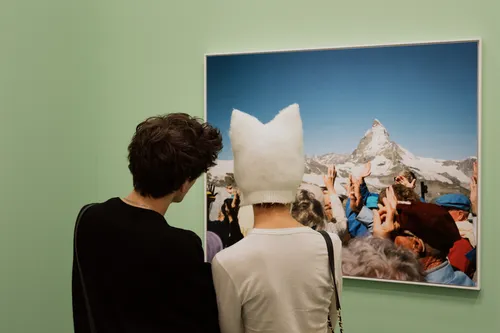
British photographer Martin Parr spent more than fifty years traveling the world capturing how people live, relax, shop, and move through public space. Rather than producing idealized images, Parr used bright color, on-camera flash, and a sharp sense of humor to reveal the contradictions and absurdities of everyday life.
Paris’s Jeu de Paume recently opened “Global Warning,” a major retrospective featuring around 180 works that Parr made between the 1970s and the 2020s. Curator Quentin Bajac positions the British photographer as a careful and critical observer of life in consumerist society. In the wake of Parr’s December 2025 passing, the exhibition offers a timely opportunity to look back at a career that reshaped how documentary photography could approach the ordinary.
Parr was born in Surrey, England, in 1952 and began taking photographs in the early 1970s. He initially worked in black and white. During these early years, he characterized his work as more observational and celebratory in tone. After switching to color in the early 1980s, his work took on a sharper edge. His frames became more openly critical as he turned his attention to what he called “the leisure pursuits of the Western world.”
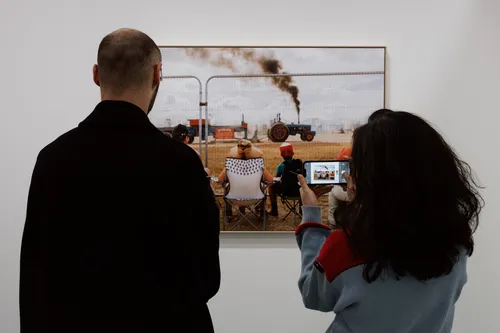
In Britain, Parr focused his lens on working- and middle-class communities. His images captured British social habits and class strictures amid seaside towns, tourist destinations, and shops. These home scenes remained central to his practice, even as his camera later moved across Europe and beyond.
While Parr’s images asked broad questions about class, taste, and social behavior, he still described his work in terms of enjoyment. “l’m creating entertainment, which has a serious message if you want to read into it, but I don’t expect to change anyone’s mind—l’m just showing them what they think they may know already,” Parr said in 2021, according to the exhibition catalog.
Parr believed that many photographs intend to sell ideals—perfect holidays, perfect bodies, perfect products. His own images rebelled against this commercialism. Humor was central to his work, not a mockery but a strategy for dealing with a world shaped by overconsumption, mass tourism, and environmental strain. “Global Warning” gets at both the artist’s wry humor and serious message.
Artsy highlights seven iconic works in the Paris exhibition, which is on view through May 26, 2026.
Salford, England (1986)
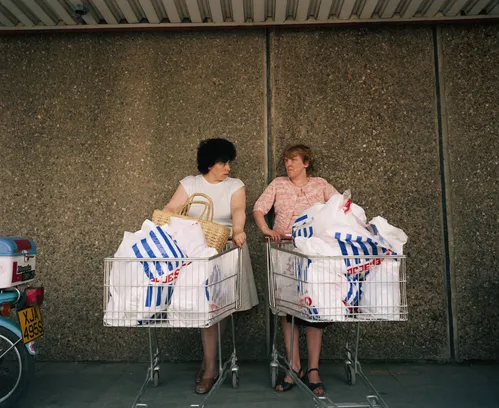
Throughout the 1980s during Margaret Thatcher’s conservative reign, Parr became increasingly interested in Britain’s consumer culture. As Parr’s documentary peers focused on industry, protest, and working-class subjects, he turned his camera toward supermarkets, malls, and high streets.
This photograph comes from Parr’s “The Cost of Living” series (1986–88), which reflects the rise of Britain’s middle class and subsequent shifts in cultural values. In the image, two women in Salford, England stand behind shopping carts piled high with goods. Their expressions and the sheer volume of their purchases turn an ordinary shopping expedition into a scene, a social moment.
In a 2021 interview with Louisiana Channel, Parr summed up his approach. “I have a certain responsibility as a documentary photographer to try and reflect the times that we live in,” he said.
Seagaia Ocean Dome, Miyazaki, Japan (1996)
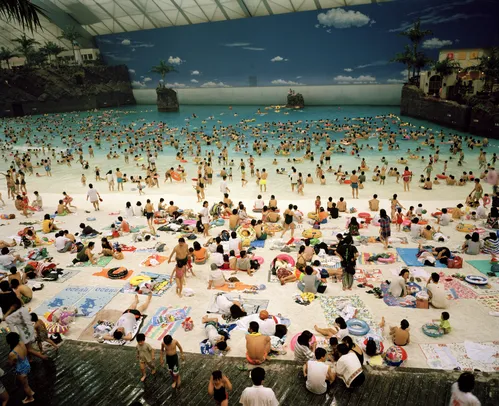
Parr shot this image inside the Seagaia Ocean Dome in the seaside town of Miyazaki, Japan. At the time, it was the world’s largest indoor water park and featured thousands of square yards of sand, a vast man-made “ocean,” and a wave machine. The space was kept at a constant temperature, allowing visitors to enjoy a beach holiday regardless of season. The structure was closed and demolished in 2017.
Parr was drawn to the strange contrast between nature and imitation. Palm trees, sand, and sky appeared convincing at first glance, yet everything was carefully controlled and manufactured. Visitors relaxed as if outdoors, despite the setting’s artificiality. The image reflects Parr’s interest in staged leisure and cultural differences. It also points to a broader global desire to design and perfect experiences.
Benidorm, Spain (1997)
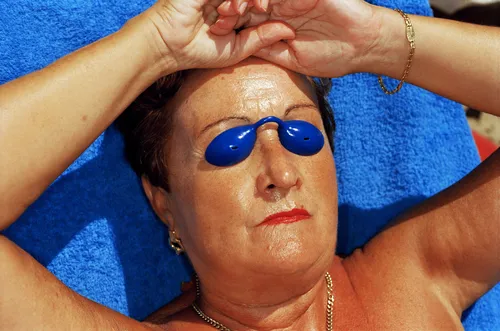
This photograph captures a woman asleep in the sun, wearing small blue eye shields that match her towel and make her look like an insect. Parr shot it at close range in a single exposure during his first experiments with a macro lens. He used ring flash and saturated color to exaggerate texture and detail, turning a casual holiday moment into something oddly exposed.
Parr took the picture in Benidorm, one of Spain’s largest and most crowded seaside resorts; the shore was a frequent subject. He often described the beach as a creative laboratory—a space where scale, repetition, and human behavior collide.
The image became one of the most recognizable works from Parr’s “Common Sense” series, which he developed throughout the mid-to-late 1990s. The series and an eponymous photobook move between kitsch and the grotesque, using vivid close-ups to document modern consumer culture. In his book, Parr later said that two people contacted him claiming the woman was their grandmother—both hoped to get a free print. When he asked where the photograph was taken, neither could remember. The woman herself has never come forward, adding to the image’s strange afterlife.
Zurich, Switzerland (1997)
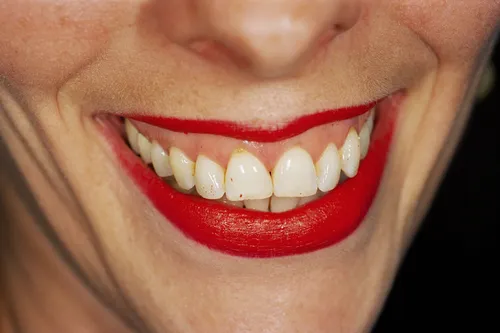
This close-up photograph, taken in Zürich in 1997, also belongs to Parr’s “Common Sense” series. The tight cropping around a painted mouth removes any sense of place or identity. The photograph borrows from the language of advertising, where lips often stand in for glamour. In Parr’s image, however, the mouth is not idealized but filled with teeth marked by yellow stains and smudged red lipstick.
Yet the image had a high-fashion afterlife. In 2019, Gucci collaborated with Parr on a series of ArtWalls installed in cities around the world. Parr recreated his close-up of red lips to promote the brand’s lipstick collection. The new iteration featured a giant, smiling mouth with crooked teeth.
What began as a critique of advertising imagery came full circle as the fashion industry embraced Parr’s visual language. He took on many more commissions. In a 2018 interview with Another Magazine, Parr said, “We’re trying to get away from the glamour, make it look more authentic. This trend for the real, the authentic, is of course right up my street. Suddenly, the fashion people are more aligned with me, rather than the other way around.”
Glasgow, Scotland (1999)

Parr began photographing food in the late 1990s, well before it became a favored social media subject. He was especially drawn to junk food, which he felt made for stronger images than fine dining. Bright colors, graphic shapes, and cheap decorations gave these foods a visual impact that polished restaurant dishes lacked.
In this image, four bright orange cupcakes decorated with candy eyes line up in a shop display. The image exaggerates their artificial appearance, turning a familiar snack into something playful and alive.
By focusing on processed snacks, the photographer quietly pushed back against idealized images of food. Photographs like this subverted the glossy language of food advertising, replacing elegance with excess and humor. In the 2024 documentary I Am Martin Parr, the artist noted that today, everyone photographs their food: “I can retire from food photography knowing that the general public have taken on,” he said.
As with much of his work, the image is entertaining while reflecting more deeply on fast food culture, taste, and changes in eating habits—and on the slick and superficial nature of desire in contemporary society.
Venice, Italy (2005)
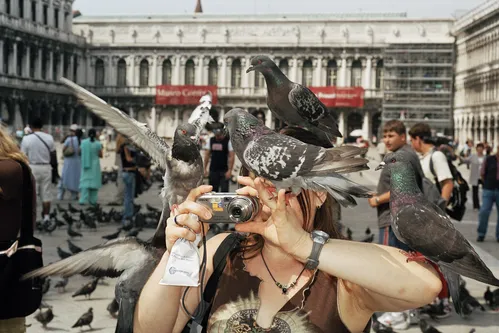
In this picture, birds crowd around a woman in Venice who attempts to take a photograph. The scene feels busy and chaotic—part spectacle, part performance—with the woman both observing and being observed.
Animals appear throughout Parr’s work, but never as untouched wildlife. Here, the pigeons are fully woven into the tourist experience: fed, coaxed, photographed, and used to create a memorable image. The birds become props in a familiar ritual, much like the city itself, shaped by cameras and crowds.
The photograph captures what happens when people, animals, and famous places collide. Venice appears less as a destination than as a frenetic, overexposed stage.
Musée du Louvre, Paris, France (2012)
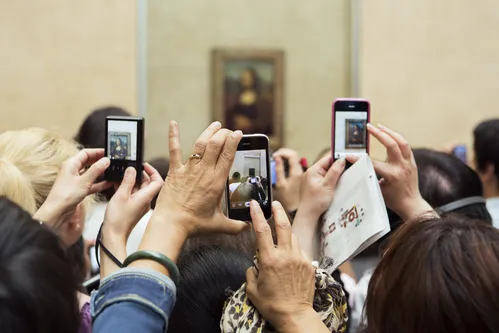
To get this shot, Parr turned his camera to the crowd gathered in front of the Mona Lisa at the Louvre. The painting itself is barely visible, hidden behind a sea of raised smartphones; visitors take pictures instead of looking at the artwork.
Technology fascinated Parr for decades. In the 1970s and ’80s, he photographed cars and roadside culture. In the 1990s and 2000s, mobile phones began appearing in his images. In more recent years, smartphones, screens, and digital devices took center stage, letting Parr observe shifting everyday behaviors.
Here, the phone is not the subject—people are. Parr focused on how technology has reshaped posture, attention, and movement, turning a visit to a historic artwork into a brief, screen-based interaction. During the exhibition’s press preview, curator Quentin Bajac described the image as balancing irony with critique, showing how even the most famous painting in the world becomes a backdrop. Towards the end of his career, Parr didn’t fight new technology, but brilliantly embraced its potential as subject matter.
