


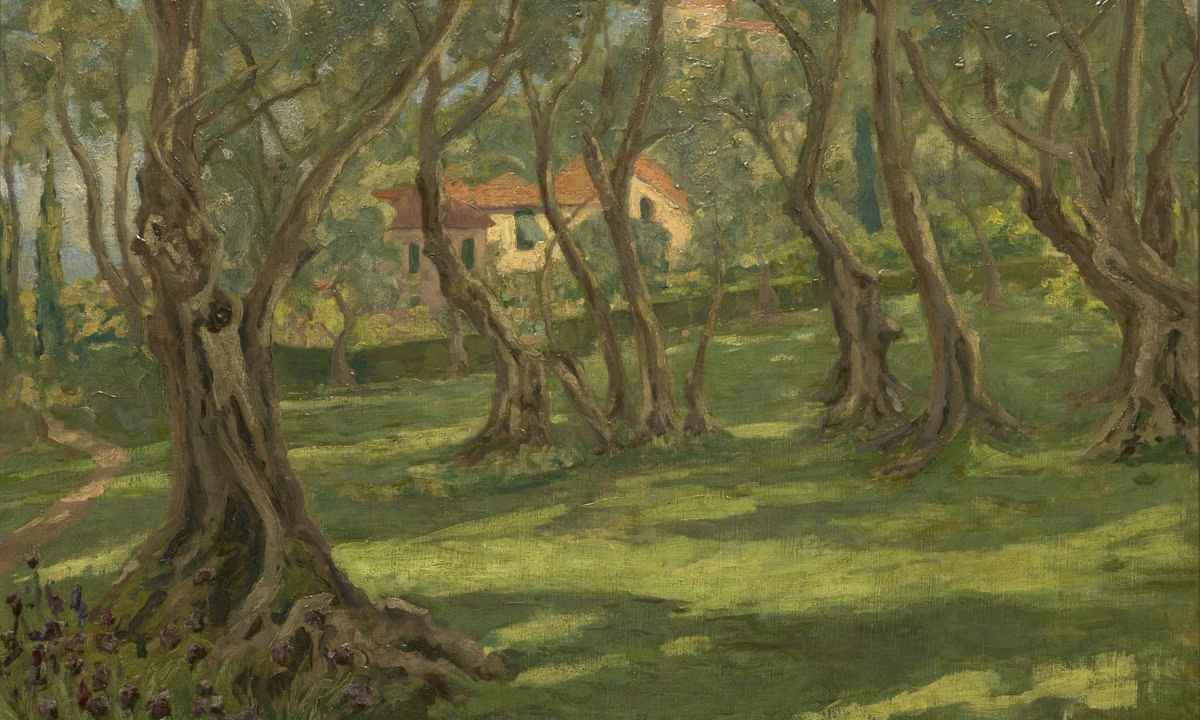
A painting by Winston Churchill that was lost during the Second World War may have been looted or stolen during the Nazi occupation of France. The landscape of olive trees, La Dragonnière, Cap Martin, disappeared in mysterious circumstances and was with a Paris dealer who had collaborated with the Germans. It recently went on show in Winston Churchill: The Painter (until 29 November) at London’s Wallace Collection.
The Churchill picture was once admired by no less than Pablo Picasso. After seeing La Dragonnière, Cap Martin in Paris, he is said to have exclaimed that its creator “could have been a professional painter if he didn’t have other things occupying his time”. This was in January 1945, when Churchill was leading the British war effort as prime minister.
Churchill, who painted for relaxation, had completed the landscape during a 1937 visit to the D’Estainville family, who lived in the villa La Dragonnière, at Cap Martin on the French Riviera, near Monaco. (The property had previously belonged to his friend Lord Rothermere, the owner of the Daily Mail.) In the picture, the villa appears in the middle distance, beyond the ancient olive trees.
But what is the provenance of La Dragonnière, Cap Martin? The Churchill catalogue raisonné by David Coombs and a Sotheby’s auction catalogue record that it came from the statesman’s wife, Clementine. But we can reveal quite a different story; it is a painting with a tangled wartime past.
A canvas caught up in conflict
In 1937 Churchill gave La Dragonnière, Cap Martin to the aristocrat René d’Estainville, in thanks at the end of his stay. No doubt it had been a convivial visit: D’Estainville worked as a representative of the Lanson champagne company, and the sparkling drink happened to be Churchill’s favourite tipple.
There are several slightly conflicting D’Estainville family stories about what happened after war broke out two years later. It was said that the picture was lent to a friend for an exhibition or for safekeeping after the German invasion in 1940. The recipient apparently died and somehow the Churchill work was acquired by a Parisian dealer. Another story is that the painting was sent over the border to Monaco, where it vanished. Yet another family tale holds that it was simply “stolen”.
Whatever occurred, the Churchill painting ended up with the Parisian dealer Martin Fabiani, who was accused of collaborating with the Nazis and had links with their Einsatzstab Reichsleiter Rosenberg task force, which looted art from Jewish owners in France during the occupation.
Fabiani’s name is regarded as a “red flag” when it comes to tracking down Nazi loot, although many of the pictures he handled were legitimately acquired (and, it should be noted, the D’Estainville family was not Jewish). Fabiani was a frequent visitor to Monaco during the war, patronising its casino, so this might provide a link with the D’Estainville picture.
The American art historian Emily Esser, who has helped research the painting, admits that what happened remains unclear. But the picture’s new owner during the wartime 1940s undoubtedly “benefited from the chaos and tumult”, and somehow it “fell into the hands of the corrupt Nazi collaborator and art dealer Fabiani”, Esser says.
La Dragonnière, Cap Martin appeared in an exhibition at Fabiani’s gallery in late January 1945, five months after the liberation of Paris. This show was held to benefit the Stage Door Canteen, an institution that provided America’s wartime troops with dancing and entertainment. It was in the Fabiani exhibition that Picasso, whose work was also included, admired the Churchill landscape.
At the time of the show, Fabiani apparently made the astonishing claim that a senior German officer had wanted to buy La Dragonnière, Cap Martin during the occupation—and had even suggested exchanging the Churchill for a painting by Adolf Hitler. According to Fabiani, he patriotically refused to allow the Churchill picture to go to a German owner.
Soon after the war, Fabiani was arrested on charges of having sold art for the benefit of the German occupiers. The French authorities then sequestrated his paintings, including the Churchill. Two unidentified claimants subsequently argued that they, not Fabiani, were the legal owners of La Dragonnière, Cap Martin. In unclear circumstances, the picture was later acquired by the Australian collector Edward Waterfield Hayward, whose wealth came from a Coca-Cola franchise in Adelaide.
Hayward sold the painting in 1961, putting it up at Sotheby’s in London. There, mainly by chance, it was spotted by René d’Estainville’s daughter, the socialite Anne-Marie Oppenheim. At that time it was difficult to make claims for art lost during the war, so she simply bid on the picture, buying it back for the family for a relatively modest £500.
After her divorce, Anne-Marie had to sell the painting in 1966, again through Sotheby’s in London, when it went for £2,000. La Dragonnière, Cap Martin changed hands most recently in 2018, once more at Sotheby’s in London, when it fetched £358,000, an indication that Churchill’s work had become much sought after. The picture is now owned by an international private collector with a number of major Churchill works.
Xavier Bray, the director of the Wallace Collection, says that “with different stories about where the painting was after it left the D’Estainvilles, and in light of Fabiani’s reputation, this certainly raises questions about how it ended up in his hands”. It should be stressed that, as the picture was bought back by the family in 1961, there is no suggestion that it could be subject to a restitution claim.
Bray believes that La Dragonnière, Cap Martin is “the finest painting” in the Wallace’s current Churchill exhibition, which he has curated. He hopes that our report may lead to more information about the picture’s wartime journey.
