


You know it’s going to be a different kind of group show right away: A wall decal detailing the exhibition budget greets visitors to “Performing Conditions: Artistic Labor and Dependency as Form” at the MIT List Visual Arts Center. Shaped like a receipt but organized like a spreadsheet, it lists artists’ honoraria—a nice $25,000 for 27 artists—alongside framing ($1,100, a steal), vinyl ($1,925), and more.
But the exhibition quickly expands to consider costs beyond the monetary. It reveals not just what the show spent, but those human costs that capitalism doesn’t count. The artists here illuminate the ways every one of us is indebted to others. Capitalism, though, renders this interdependency—life-sustaining, reproductive labor—invisible.
Blondell Cummings’s Chicken Soup, 1988, in the 2026 exhibition “Performing Conditions: Artistic Labor and Dependency as Form,” at the MIT List Visual Arts Center.
Photo Dario Lasagni
Such labor is so often gendered and raced—and accordingly, devalued. Blondell Cummings contributes one of the show’s earliest works: Her 1988 video Chicken Soup records a kind of kitchen choreography from 1981. This postmodern piece monumentalizes the pedestrian movements of Black women domestic workers. To a soundtrack by Brian Eno, Collin Walcott, and Meredith Monk (not included in the video version, which was re-scored), Cummings swings and swaddles paper grocery bags, mixes invisible recipes, and sews unseen threads—all with a deliberateness and pep that makes the ordinary engrossing, demanding your attention and respect.
Other works lay bare the kinds of debts that capitalism effaces in order to sustain a fantasy of frictionlessness. Next to Cummings’s contribution is Dread Scott’s Slave Rebellion Reenactment Performance Still 1–6 (2020), which revisits the largest organized uprising of enslaved people in US history. Returning to the 1811 rebellion some 200 years later, Scott leans into anachronism: His photographs include the oil refineries of Louisiana’s Cancer Alley, underscoring the continuity of racial capitalism.

Scene from Autumn Knight’s performance M_ _ _ ER, 2018–ongoing.
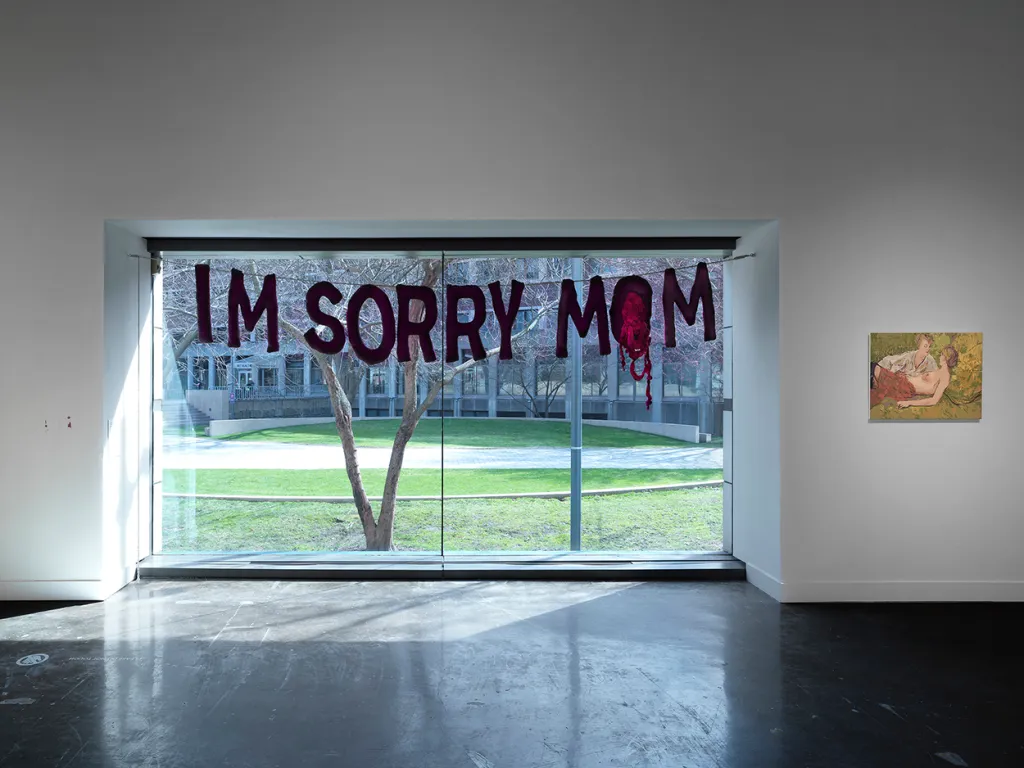
Nearby in the window hangs a tragicomic banner with stuffed letters spelling out I’M SORRY MOM. The 2026 installation, by Autumn Knight, echoes Knight’s performance this past April for the show, in which the artist played mother to audience members, treating them as children who had forgotten her birthday.
Some debts are unpayable. Still, gratitude, in Knight’s case, or reparations, in Scott’s, do help.
We’re all interdependent, but this isn’t always bad news. At the admissions desk, Constantina Zavitsanos has installed a “take a penny, leave a penny” container, reminding of a familiar ritual of communal goodwill. Visitors can choose either to give or take—a choice that, at this scale, probably has a lot to do with whether one needs or has.
A wall text calls out the “fantasy of art’s autonomy,” reminding that the art world, too, invisibilizes our inevitable debts and dependencies. A video by the Congolese Plantation Workers Art League (CATPC), titled The Judgement of the White Cube (2023), sees the group playfully put a white cube on trial in a story of museums working hand-in-hand with colonialism’s extractions.
Blink and you’ll miss other nods to invisible labor. Ghislaine Leung wrote a score the Center’s preparators fulfilled by withdrawing some of their work. Their interpretation looks like vinyl letters from a past show peeled off the wall but left on the floor, unpatched holes in the drywall, and accumulating dirt and dust. Similarly, an intervention in the forthcoming catalog makes a sly gesture: Instead of the customary Director’s Foreword, it will feature one by an assistant, nodding to the ghostwriting that has become industry standard.
Wall vinyl from a previous exhibition removed from the wall but left on the floor by MIT preparators, fulfilling a score by Ghislaine Leung.
Photo Dario Lasagni
“Performing Conditions” is a show whose argument unfolds in wall labels and in administrative gestures, more so than in aesthetic encounters. Fine by me: I like reading, and curators Natalie Bell and Ramona Ngin are concise and clear. Before consulting the label, for instance, you might not realize that three Post-Impressionist-style paintings of the same pair of lovers were made for the artist Reba Maybury, a dominatrix, by her submissives.
Looping back around to the budget wall after all this, it feels even more resonant: The show critiques our culture’s prevailing attitudes toward labor, debt, and dependency, honing in on how the erasure thereof exacerbates inqueties. Crucially, the museum does not exempt itself.
Notably, too, the exhibition is funded first and foremost by “endowed support” ($106,006), followed by annual membership fees ($75,000), and it is hard to imagine a show this conceptual, this critical of capitalism, at a museum more indebted to a board of billionaires. Thank goodness, then, for alternatives like university museums at research institutions: “Performing Conditions” takes a smart look at an essential subject too often swept under the rug.
The budget for “Performing Conditions: Artistic Labor and Dependency as Form,” a 2026 exhibition at the MIT List Visual Arts Center, displayed on the wall per a score by artist Glishlaine Leung.
Photo Melissa Blackall
The show is centered around performance, and some works land better as traces or documentation than others—as is to be expected with the medium. Anyway, the everyday erasure of the kinds of labor behind each work is part of the show’s point. I loved, for instance, the premise behind Joshua Schwebel and Camille-Zoé Valcourt-Synnott’s The Employee (2018–25), for which the artists used a Canada Council for the Arts grant to hire a part-time grant writer before turning that process itself into an artwork. I loved this caricature of the loop that is sustaining a practice—using a grant to hire a grant writer to get more grants—much more than I loved reading the emails on the wall.
Joshua Schwebel with Camille-Zoé Valcourt-Synott: The Employee, 2018–25.
Photo Melissa Blackall
The art-grant loop, in the end, was not an infinite, or even sustainable one. “I have a fantasy,” says Ghislaine Leung in a wall text, “that I should be unlimited.” The artist—whose score also prompted the museum to reveal its budget—adds: “Within that fantasy, limits are perceived as a hindrance—my financial ability, my need for stable employment, my commitment as a mother, my body, my political efficacy. But those limits, those dependencies could be turned around to become a resource for making an artwork.” That is exactly what she—like the curators—has done.
Correction 07/29/2026: A previous version of this article incorrectly characterized Autum Knight’s performance, describing it as a piece in “in which the artist challenged audience members to name their mothers’ birthdays.” It also conflated details of Blondell Cumming’s original 1981 choreography with the 1988 video version. We regret the error.
