


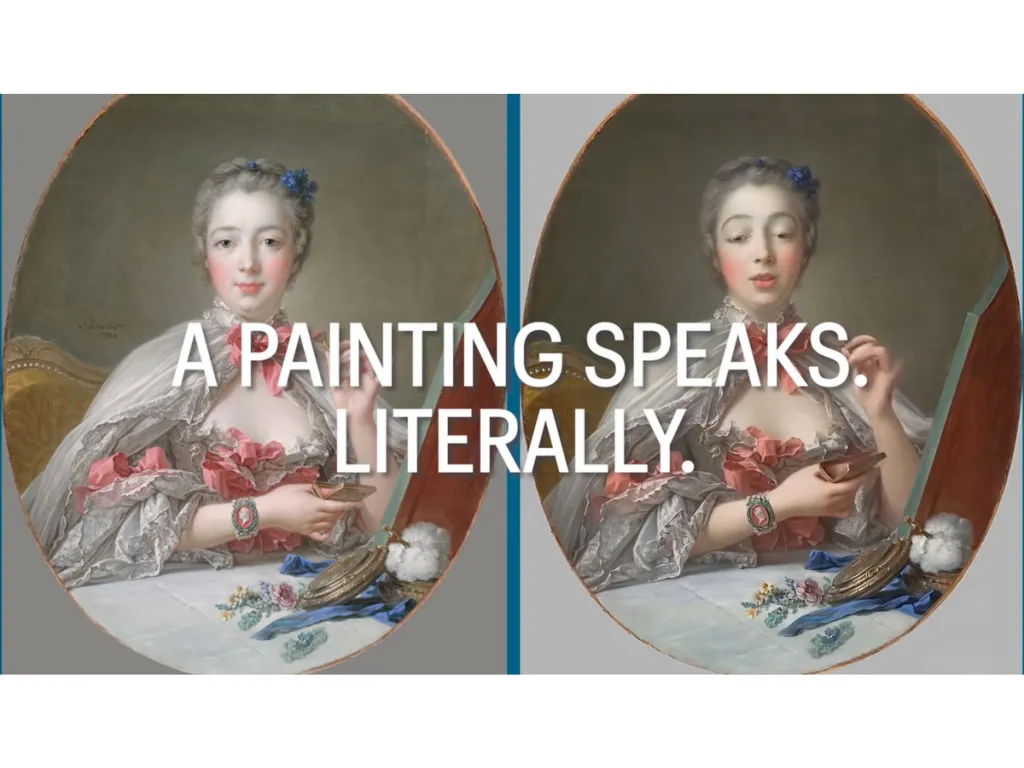
The Harvard Art Museums, a consortium of three institutions in Cambridge, Massachusetts, tested out a marketing campaign aimed at increasing visitor engagement and membership that makes use of generative AI in order to animate a 18th-century painting in its collection.
John Connolly, the director of marketing for the Harvard Art Museums, and Julian De Freitas, an assistant professor at Harvard Business School, recently spoke about the initiative on Open Call, a podcast produced by the Harvard Business Review and hosted by Brian Kenny HBS’s chief marketing and communications officer.
De Freitas’s research “addresses questions about how consumers perceive, adopt, and interact with AI systems,” Kenny says. For the case study, which De Freitas published earlier this year, he and his team created a talking video version of François Boucher’s Jeanne-Antoinette Poisson, Marquise de Pompadour, a 1750 portrait of one of French king Louis XV’s mistresses, as well as a chatbot that people could have a conversation with. The video version of the episode includes a short snippet of the animation.
Introducing the episode, Kenny asks if subjecting the Boucher portrait to this type of generative AI, “would it help people connect with art or distract from it? Could AI broaden engagement without compromising authenticity? And who gets to decide what an artwork would say?”
He adds, “This case is about far more than a marketing experiment. It’s about innovation versus stewardship, technology versus interpretation, and how institutions rooted in history navigate a rapidly changing future.”
In the interview, De Frietas says the campaign was beta-tested with some participants receiving one version of the AI instantiation, and others receiving the other. The museum hasn’t officially rolled it out as a public campaign, and it’s currently not accessible on the museum’s website or social media channels, though, as Connolly teases in the podcast, “It could suddenly drop.” ARTnews has reached out to Connolly for further comment.
And what did the participants make of the campaign? Connolly says, “There was some positive feedback. There was some negative. The negative feedback generally fell with the perception of AI out there. … That was the problem. But people did appreciate what we were trying to do and were blown away by the technology itself. And some people have found it funny, good old-fashioned humor.”
François Boucher’s original 1750 painting, Jeanne-Antoinette Poisson, Marquise de Pompadour, in all its glory—sans AI.
© President and Fellows of Harvard College
De Freitas says one main takeaway from working on this project was that, in the context of an art museum, a certain level of sensitivity toward people’s concerns around AI is required. “You can’t just assume that because it worked in that other domain, it’s going to work here,” he says, noting that people likely won’t respond to the use of AI if it comes off as performative or a cost-cutting measure. “What they want to see is that you’re doing something that you really couldn’t do without AI and that it’s adding some real value,” he adds.
He also says that initially they faced internal pushback from curators who were “concerned with representing the artwork accurately as the artist might have wanted it to be perceived”; conservators who “want to preserve the artwork exactly as it is”; and art historians who “are worried about this idea of losing the skill to be able to analyze art and talk about it, which is also resonating with broader societal concerns around how AI is going to lead to de-skilling.”
De Freitas explains that he first became interested in partnering with a museum because “I had a sneaking suspicion that by studying an organization that preserves history and tradition, we might learn something broader about these types of questions.”
For his part, Connolly says that from a marketing perspective he was interested in working with AI to “push and flip [people’s] perceptions” of museums as hushed environments that not everyone might easily feel welcomed at. He adds, “How do you engage without tipping over something else?”
With this marketing goal, Connolly says, “The goal here was to use AI to bring people closer to art basically. And to also maybe do something a little unexpected because Julian says museums are evolving, so we should evolve as [we] market the museums.”
The Harvard Art Museums’ collection holds over 250,000 objects, and it reopened in 2014 after a renovation that brought all three institutions under one roof. At that time, the museum also returned to being admission free. “There’s such pressure on museums to bring in visitors to generate revenue and also build a membership base, which is a challenge now for us because admission price was a membership benefit that went away. We face that now as a new healthy challenge that we’re embracing,” Connolly says.
“Price is a barrier when we’re talking about accessibility,” Connolly adds. “So that was a big move for us. And then from a marketing perspective, we had a new challenge of sometimes free can equate to lesser. So we were out there trying to beat the drum that we are not lesser.”
De Freitas adds, “Now this isn’t just an artwork that exists several centuries ago that’s stiff and unapproachable, but it’s talking to me in an accent and I can ask it questions. And so it makes it approachable. Related to that idea is more broadly this idea of democratizing art.”
One way to go about that, Connolly says, is that this AI approach could “deepen someone’s understanding that they will want to move to the next level of understanding with that object” and even turn them into a repeat visitor the museum. He adds, “I really subscribe to the whole Oscar Wilde thing that art should be playful. There’s a lot of truth telling in art, but it should be playful too.”
