


In the 1980s, two women—a German Jew and a Palestinian—met in Chile, where they were both born to families of immigrants. Together, they crafted some of the most powerful antifascist art of the era, collaborating on installations and documenting one another’s performances. One of those women, the artist Lotty Rosenfeld, is the subject of a revelatory retrospective at Columbia University’s Wallach Art Gallery, on view through March 15. The other, her close friend, the writer Diamela Eltit, is present throughout.
Highlighting female friendship was a feminist intervention on the part of the show’s curators, Julia Bryan-Wilson and Natalia Brizuela, but it would also have been difficult to tell Rosenfeld’s story any other way. Working in Chile during the Pinochet dictatorship (1973–90), Rosenfeld forged a community through art at a time when simply gathering was illegal and many artists were forced into exile.
She got around these constraints by crafting clandestine gestures she tactically rendered illegible, sending coded signals of solidarity and building coalitions in unconventional ways.
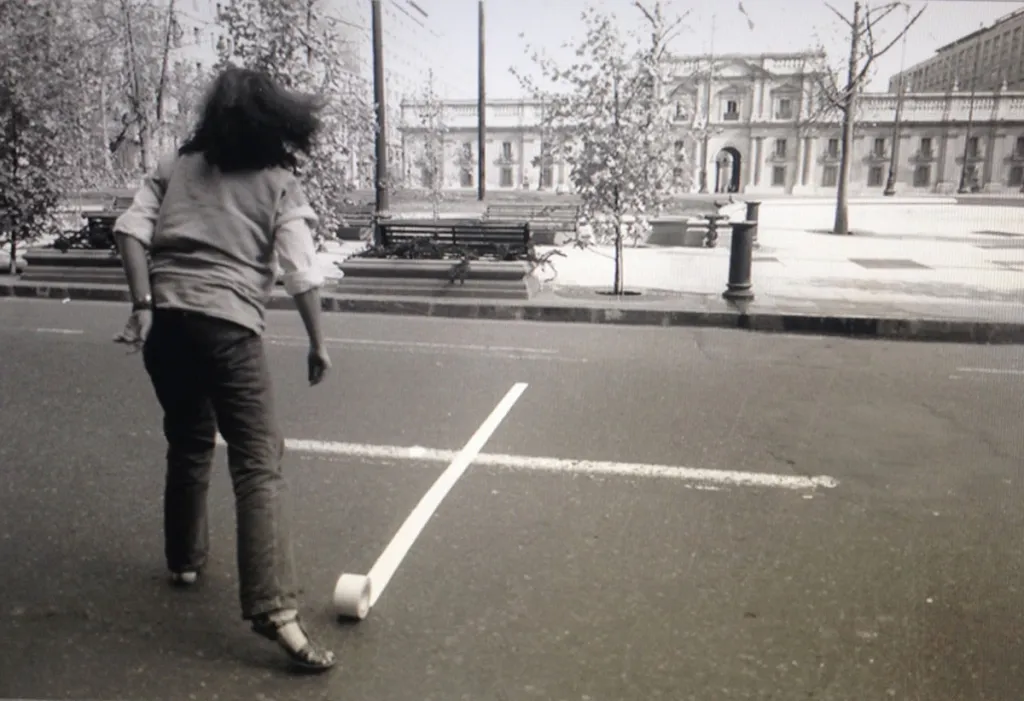
The show opens with one such gesture. Mural-sized photographs display dotted white lane dividers on city streets that Rosenfeld slashed, rolling tape and fabric bandages across them so that they become crosses, Xes, or plus signs. In the clear light of day, she laid down symbols that were deliberately vague, but that could be read as signs of mourning, of refusal, of wanting more. In 1979, she installed one right in front of Pinochet’s palace. That same year, she crossed the lines dotting a mile-long stretch of Santiago’s Avenida Manquehue, between streets named Los Militares and Avenida Kennedy.
View of the 2026 exhibition ‟Lotty Rosenfeld: Disobedient Spaces” at Columbia University’s Wallach Art Gallery.
Photo Olympia Shannon. Courtesy the Wallach Art Gallery.
The unit of distance, like the choice of streets, was symbolic: miles are a distinctly Anglo-American way of measuring, a nod to the US’s outside presence in Chile following Henry Kissinger’s aggressive Cold War intervention as a Marxist president was democratically elected. Rosenfeld wasn’t just protesting Pinochet but the US as well. In 1982, she slashed a line in front of the White House too.
The gestures were oblique enough that you could see what you wanted to see, and this kept her out of trouble. Still, plenty of people, relating to Rosenfeld’s frustration, saw what she saw.
After getting away with all this, Rosenfeld seems to have only grown bolder. Wanting to bring that White House intervention back to Chile, in 1982 she devised a risky plan to show footage of the action on TVs inside the Santiago Stock Exchange. She paired this with a recording of a similar intervention on a road in the Atacama Desert, home to the copper mines whose business interests US interference was designed to protect. Somehow, she finagled permission to install her work in the lobby. She was protesting, in part, the state of the economy, confronting the very men who controlled it. And to be sure, they were all men; no women worked as traders.
Soon, she got permission for something even wilder. Working alongside the artist collective she cofounded, CADA (Colectivo Acciones de Arte), she flew six small airplanes over Santiago and dropped 400,000 copies of a poem, all captured on a video that is utterly sublime.
She pulled this all off because her actions read as art instead of activism; the details of how, exactly, she made it happen warrant a whole biography. On view at Columbia is a copy of that poem, saved and loaned by Chilean artist-poet Cecilia Vicuña. It tells all who read it that they deserve a decent standard of living and advocates for a kind of art that is never elitist but instead permeates public life.
That may sound like a lofty goal, but permeate it did. Here, poetry and politics merge with real ramifications. Rosenfeld’s Xes, plus signs, and crosses evolved into a nationwide rallying cry, starting with CADA’s 1983 No + project, begun ten years into the Pinochet dictatorship. The group offered an open-ended slogan—no más (no more)—and invited everyone to fill in the blanks. Responses poured in. Photographs show the phrase graffitied on walls and emblazoned on signs throughout the country, demanding no more fear, no more hunger, no more torture, no more dictatorship. When Rosenfeld died in 2020, a Santiago skyscraper’s lights spelled out NO+ in her memory.
Elsewhere, a video of a 1986 feminist protest shows the elliptical meaning of Rosenfeld’s Xes coming full circle. Women from Mujeres por La Vida (Women for Life)—a group Rosenfeld also cofounded—chant their rallying cry that flips negation into solidarity: NO + PORQUE SOMOS + (No More Because We Are More). In many ways, women had by then, 13 years into Pinochet’s regime, become the face of the resistance. Grieving mothers, sisters, and wives spoke out as their loved ones were disappeared. And they protested at great personal risk: the footage shows peaceful demonstrators being tear-gassed and blasted with water cannons.

No+ Porque Somos + (No more because we are more), advertisement for International Women’s Day, Chile, 1986.
Copyright C.A.D.A. (Colectivo Acciones de Arte). Courtesy Museo de la Memoria y los Derechos Humanos.
I don’t need to spell out why this show feels chilling and resonant now, nor will I offer pat, prescriptive takeaways. But there are two details worth dwelling on. The first is that Rosenfeld’s earliest subversive strategies emerged a full six years into Pinochet’s rule. Impatient as we may be for answers—artistic or otherwise—and as excruciatingly long as six years can feel when lives are on the line, it is worth remembering that resistance and change are not always immediate even if they are, eventually, inevitable. Self-organizing takes time; all dictators die.
The second concerns Rosenfeld’s tactical illegibility. Her gestures often spoke not vertically to power—which would only have invited punishment—but laterally to the people. We see her early work oriented toward forming solidarities and her interventions growing larger in scale as her camaraderie (and frustration) did, too. And though it may be tempting to consider oblique gestures alienating and elitist, I can’t help but think of a tell snuck into the Trump Administration’s Smithsonian-related executive order. That order targeted “The Shape of Power: Stories of Race and American Sculpture,” a group show at the Smithsonian American Art Museum full of pointed, illustrative, figurative work with explicit wall texts. Yet on view in the same building, at the Smithsonian-operated National Portrait Gallery, was an exhibition by Felix Gonzalez-Torres, whose powerful, poetic art about love and loss—and also AIDS, governmental failure, and so much more—was simply illegible to them. Like Rosenfeld, Gonzalez-Torres addressed not power but the people who most craved his message. So we know, at least, that this option remains: placing proverbial piles of candy right under their noses.
