


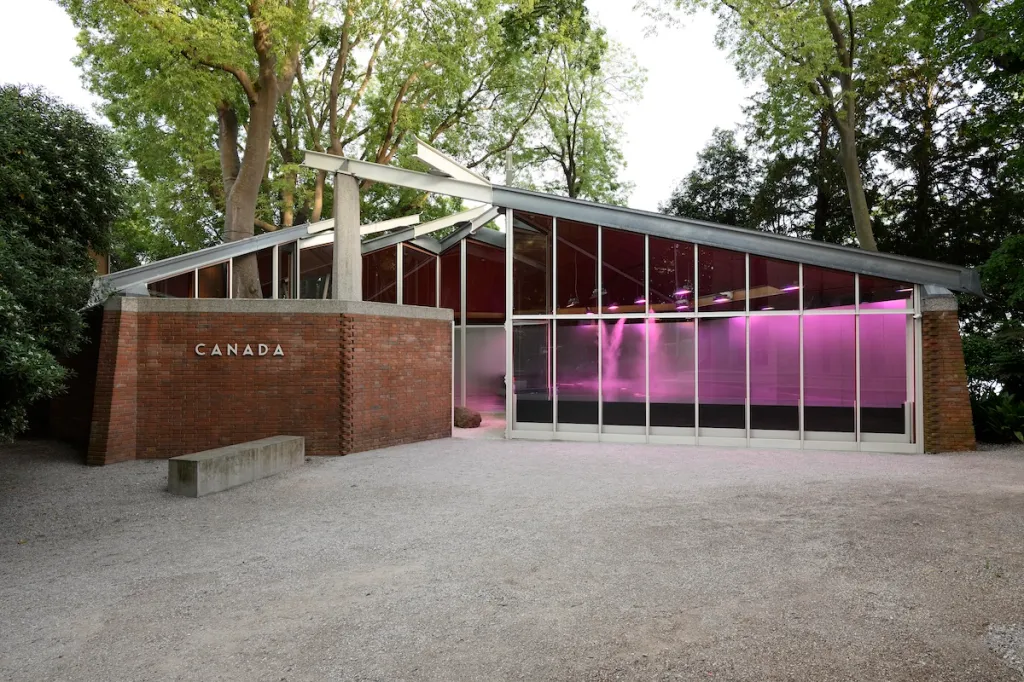
Step through the glass door of the Canada Pavilion—particularly amid Tuesday’s persistent rain—and you are likely to be taken aback by the humidity that greets you. That blast of warm air is just the first indication of the many adaptations made by artist Abbas Akhavan to transform the glass-and-brick structure into a literal greenhouse for “Entre chien et loup,” his presentation for this year’s Venice Biennale.
Among the alterations to the structure are a series of grow lights and water misters, a new ventilation system, a film across the wood ceiling to protect it from moisture, and various structural improvements to accomodate the 6,000-gallon water tank that encompasses over half the floorplan and weighs roughly 25 tons. The transformations are meant to render the pavilion into a building-sized Wardian case, a Victorian-era terrarium used to transport foreign plants across the British Empire. It also recalls London’s Crystal Palace, built in 1851 for that year’s Great Exhibition, in which a genus of water lilies named after Queen Victoria were displayed as a natural wonder. Inside the pavilion’s new pool is the exhibition’s centerpiece, a group of giant Victoria water lilies, which will grow and bloom and eventually die through the exhibition’s run, which happens to map to their life cycle.
If all of this seems laden with meaning of the kind that often attends conceptual art in 2026—colonialism, empire, fraught ideas of foreigness and exoticness—you, like me, will have read Akhavan’s intentions completely wrong. Things are rarely so pat for the beguiling artist.
Several of the water lillies in “Abbas Akhavan: Entre chien et loup.” They are expected to grow to as much as three feet in diameter.
Photo Francesco Barasciutti/©Abbas Akhavan
“I’ve been looking at these lilies for many years, and I was really interested in them,” Akhavan told me in a video call ahead of the opening. “I didn’t actually know the Queen Victoria connotation in the beginning. I think part of how we make work is through intuition.”
Akhavan said he is less interested in an anti-colonial or post-colonial reading of the exhibition. Rather, he wants viewers to “look at these objects that have been heightened through historical inheritance, politics, migration, import–export, currencies of many forms” and, perhaps, for a moment, let them become “unburdened.”
The exhibition at its core is a feat of collaboration. According to curator Kim Nguyen, who spoke with me at the opening on Tuesday, the water lily seeds came from Kew Gardens, and she and Akhavan worked closely with the Orto Botanico di Padova to cultivate the plants ahead of installation, and to create the ideal conditions for the plants to thrive once installed inside the pavilion. Nguyen and Akhavan also worked with architects and engineers to make the necessary alternations to Canada’s permanent building in the Giardini, while protecting the tree that it is constructed around. While past artists have often seen that tree as something to negotiate, according to Nguyen, Akhavan saw it as “the inspiration for everything.” The pavilion is already integrated with nature; he took it one step further and brought nature literally inside.
For Akhavan and Nguyen, the project has been a “leap of faith.” No one knows exactly how the lilies will fare over the next six months. In the best conditions, the lilies might take over the entire pool, growing to three feet in size each. If they do, pruning will be in order. They are, after all, known for being aggressive plants in the Amazon. But, inside, under grow lights, are not their ideal conditions. They might flower or they might wither. Surrendering to nature is core to the project.
“I have no choice. I didn’t even have to choose to surrender. I had surrendered,” he said.

Installation view of “Abbas Akhavan: Entre chien et loup,” 2026, Canada Pavilion.
Photo Francesco Barasciutti/©Abbas Akhavan
Working across installation, sculpture, performance, and video, Akhavan, who was born in Tehran and now splits his time between Montreal and Berlin, is no stranger to the loaded nature of certain materials, or identities. In Study for a Monument (2013), he created bronze casts of plant species native to Iraq, while cast for a folly (2019/2022) re-creates the lobby of the Iraq Museum in Baghdad, solely from a photograph of its looting during the 2003 invasion of Iraq. A follow-up work, 2021’s curtain call, variations on a folly, re-creates Palmyra’s 2,000-year-old Arch of Triumph, which was destroyed by ISIS in 2015, out of cob, a historic British building material made of soil, water, and straw. Akhavan has said that his work often has to do with “a defense of art” and his many works referencing the Iraq War came from his opposition to that war not from some allegiance to nationality, but as a politically active twenty-something living in Montreal. And yet, according to Akhavan, critics have repeatedly come up to him and said those works were about his “homeland” or in some other way working through his identity—he’s Iranian, by the way.
Akhavan is tired of the art world’s insistence that art must always be “critiquing” something, or that artists must only care about their own kind. “I’ve been thinking about how artists are only supposed to care about things that they benefit from,” he explained. “So I need to fight for Iranian-ness right now, or maybe atheist Iranians living in Montreal,” he added with a shrug. In the run-up to the Biennale, one journalist asked him if the goal of “Entre chien et loup” was to “unsettle the concept of Canada.”
“I’m not here to destabilize or unsettle or destroy the concept,” he said, exasperated. “But I can guarantee you that, as we’re talking about this, it’s as clear as daylight—because of the way I look and where I come from, there are more flammable connotations that arise inevitably.”
A stack of birch branches cast from bronze in “Abbas Akhavan: Entre chien et loup,” 2026, Canada Pavilion.
Photo Francesco Barasciutti/©Abbas Akhavan
The title of the exhibition comes from a French phrase that means literally “between dog and wolf,” recalling the time of twilight, when those animals might be mistaken. It’s a fitting title. Like the waterlillies, there are multiple objects in the show that are not what they seem. A stack of birch branches are revealed as bronze casts upon closer inspection. Two boulders outside the entrance seem to have always been there, and yet they are volcanic rocks sourced in Italy and placed for the show. An old fur coat doubles as a water fountain. In each case, Akhavan dares the viewer to look closer, and perhaps, for a moment, let an object become more than our preconceptions.
“They’re 100 million years old,” Akhavan says of the water lilies. “There’s a historical lineage that is outside of our entire comprehension of what time is. As much as Queen Victoria is part of that, they go way further back to the Amazon rivers. Maybe that’s the timeline we should be thinking about—how fleeting these markers are in the history of this thing that’s before us.”
As Akhavan speaks, the absurdity of reading the lilies as emblems of colonialism is impossible to ignore. It’s often said that human history is a mere blip in the 4.5-billion-year existence of the Earth. Perhaps, he seems to be saying, we might all do well to approach the world, its materials, and its people with a little more humility and openness, as one does when meeting a stranger.
