


Art history has been punctuated by debates over what a square can mean or do. For Kazimir Malevich, the black square was, in a sense, painting’s building block—a way to strip art down to its most fundamental form. For Ad Reinhardt, it marked an endpoint: He described his black canvases as the last paintings that could be made, as though abstraction had reached its logical conclusion. Of course, his was not the final word. Josef Albers continued the inquiry, nesting colorful quadrilaterals in his “Homage to the Square” series to reveal unexpected interactions of color and the ways they generate depth and space.
Rutherford Chang took this conversation a step further in the 21st century. His work, which was recently on view in a survey at UCCA Center for Contemporary Art Beijing, centers on squares—but his are not abstract. Rather, they are insistently social. Chang—who died last year at the age of 45—undermines the cool detachment so often associated with the form: its equal sides, its 90-degree angles.
View of the exhibition “Rutherford Chang: Hundreds and Thousands,” UCCA Center for Contemporary Art, 2026.
Photo Sun Shi. Courtesy UCCA Center for Contemporary Art, Beijing.
His best-known piece, “We Buy White Albums” (2013–25), was the heart of the exhibition. Over the course of more than a decade, Chang acquired as many copies as he could of the first pressing of the Beatles’ “White Album,” ultimately amassing roughly one percent of the original three million copies before his death last year at age 45. The album’s cover is famously white—not empty but, instead, as an artwork by the Minimalist Richard Hamilton.
While some copies remain in pristine condition, their plastic sleeves intact, the majority bear marks of use. Many seem to have been treated as blank canvases, covered with butterfly stickers, hand-painted Beatles portraits, notes from a friend (“I hope you enjoy this as much as I enjoy your company”). Whether these are doodles or damage depends, in part, on one’s system of values.
Questions of value, indeed, lie at the center of Chang’s work. In another project, For CENTS #1—#10,000 (2017–24), he collected 10,000 copper pennies—minted before the US switched to zinc in 1982, after the value of a penny’s copper had come to exceed one cent. Then, he registered each coin on the blockchain using the least valuable currency. Eventually, he melted all 10,000 down into a copper cube. The work moves between material and virtual economies, asking what, precisely, gives an object its worth.

Rutherford Chang: For CENTS #1—#10,000, (2017–24).
Photo Sun Shi. Courtesy UCCA Center for Contemporary Art, Beijing.
Chang often worked with a near-ritualistic discipline, his systematic processes opening onto moments of wonder. For The Class of 2008 (2008–12), he assembled all the Wall Street Journal’s iconic stippled portrait illustrations published in 2008. Arranged into a grid across framed pages like a yearbook, the work appears dry at first glance, even bureaucratic. Moving through the images feels like a romp around a year of both crisis and hope, as the economy crumbles and Obama is elected. Organized alphabetically, absurdist mashups ensue: Cher appears next to Dick Cheney. This is history unfolding not through its monumental events, but at a daily cadence.
Circulation is another of Chang’s key themes: how do things change as they move through the world? What traces do global systems—finance, supply chains—leave on objects and on people? “We Buy White Albums” offers a clear example. These records passed through countless hands, accruing wear, annotations, and personal histories. Stripped of their “mint” condition, they lose one kind of value, only to gain another through Chang’s intervention.
Attention to systems formed a significant part of Chang’s life. He was an artist with a job—a traveling businessman working for his family’s technology company in Taipei. He was embedded in financial, technological, and global networks all the time. Through his art, he found a way to foreground humanity and humor within systems, imbuing warmth into forms—squares and cubes—that might otherwise read as impersonal and cold.
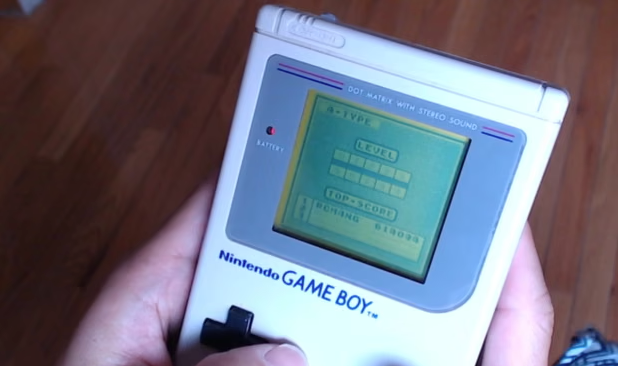
His deadpan humor comes through most brilliantly in Game Boy Tetris (2013–19), a parody of the logic of optimization that underpins capitalist culture. Responding to the pressure to constantly improve, compete, and become the best, he focused his effort on a deliberately trivial pursuit: mastering Tetris. Practicing relentlessly, he eventually ranked second in the world, just behind Apple co-founder Steve Wozniak. He became, in other words, a champion of the square—as his score, but also his show, boldly atttest.
