


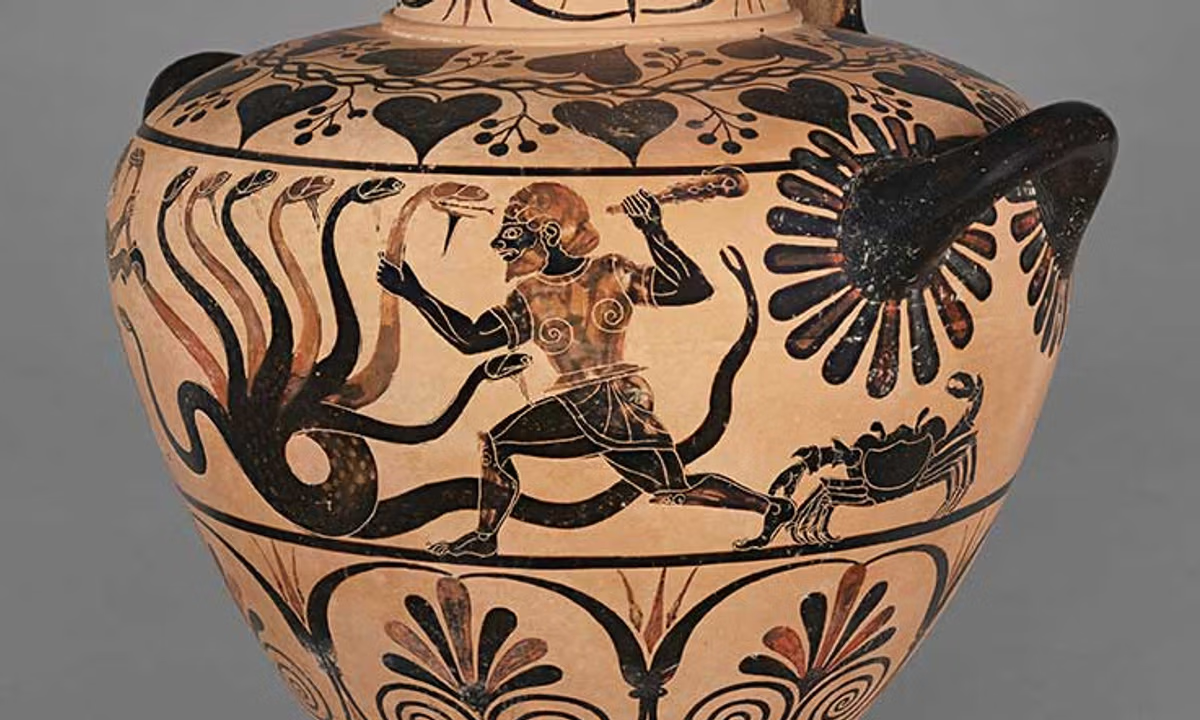
For roughly 800 years until the first century BC, the ancient Etruscan civilisation thrived in central Italy. Living in metal-rich Etruria, the Etruscans in their heyday established a lucrative trade network of resources including copper, iron and tin, engaging in international exchanges with groups like the Greeks and Phoenicians. Their commercial success led to a flourishing society, with communities of impressive temples and homes, as well as opulent jewellery, sculptures and vessels. Nearly 200 such objects will be on view in The Etruscans: From the Heart of Ancient Italy at the Legion of Honor in San Francisco. The show will explore the civilisation’s enduring influence long after it was forced to assimilate into the growing Roman Empire.
Though the Etruscans survived for generations and left a rich material culture in their wake, far less is known about them than other ancient societies like the Romans or Egyptians. Part of this lack of scholarship is due to the scarcity of extant histories written by the Etruscans themselves. “Accounts of the Etruscans in antiquity are mainly found in the works of Greeks and Romans, which, unfortunately, often portrayed them in a negative light,” says Renée Dreyfus, the exhibition’s curator and the museum’s curator of ancient art.
It’s all Etruscan to me
The exhibition hopes to correct this and build on increased interest in the Etruscans, including recent archaeological discoveries that offer insight into their social structures and beliefs. “One of the most important recent discoveries is a breakthrough in the understanding of their language,” Dreyfus says. “It has no known parent languages or modern descendants. This complicates the decipherment of Etruscan.”
The show will feature several noteworthy objects making their US debuts, including the third-century BC Liber Linteus Zagrabiensis (linen book of Zagreb), the longest surviving Etruscan text and the only known linen manuscript. While linen books rarely survive on the Italian peninsula, this ritual calendar was moved to Alexandria, Egypt, and survived in the drier climate. Research shows that linen from the book was cut into strips and repurposed as wrappings for an Egyptian mummy during the Ptolemaic Dynasty and later brought to Zagreb.
Other important pieces in the show will include elaborate grave objects from the Regolini-Galassi Tomb in Cerveteri being lent by the Vatican Etruscan Museum. Their quality and design illustrate the importance of religion and burial practices. The objects also signify that their owner was of high social status, likely part of the wealthy aristocratic class that emerged in the seventh century BC as international trade flourished.
Dreyfus will close the show with an exploration of how Etruscan innovations were adopted by the Romans, including hydraulic systems and city planning. Among the discoveries that illustrate this merging of cultures are bronzes from San Casciano dei Bagni, hollow-cast objects that were offered to the healing gods. “Despite the transition from Etruscan to Roman rule in the second and first centuries BC, the baths and thermal waters remained a shared sanctuary for healing and religious offerings,” Dreyfus says. “These discoveries reveal that the Etruscans were not simply conquered and their culture erased, but rather they persisted, adapted and influenced Roman religious practices.”
• The Etruscans: From the Heart of Ancient Italy, Legion of Honor, San Francisco, 2 May-20 September
