


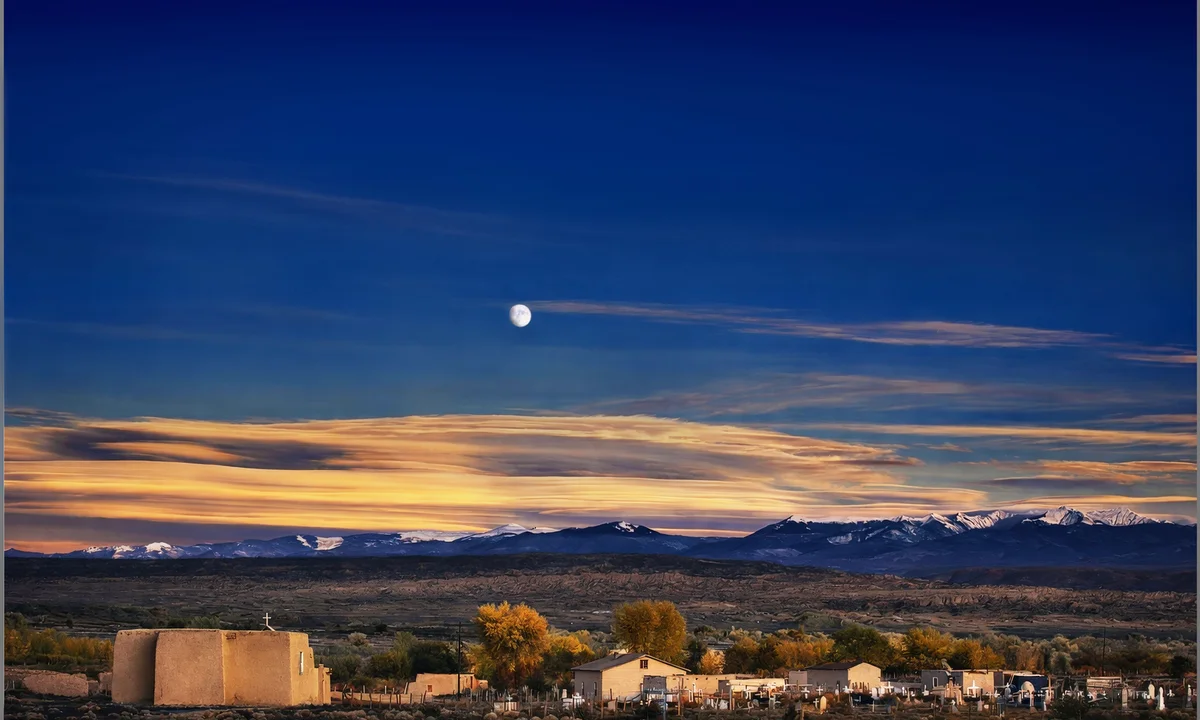
The artificial intelligence (AI) debate has reached the world of fine-art photography, and it is focused on an 85-year-old image by the celebrated artist Ansel Adams. Anger had been brewing on social media over the past month, after the New York gallery Danziger displayed a “colourised” version ofAdams’s Moonrise, Hernandez, New Mexico (1941) that was generated using AI at the Association of International Photography Art Dealers (Aipad) Photography Show in April. The work was offered for sale at the art fair in three differently sized editions of ten—for $6,000, $8,000 and $10,000. (The Ansel Adams Gallery, run by the artist’s grandson, offers prints of Moonrise for over $100,000.)
Photographers immediately noticed the piece, and questions arose whether the Ansel Adams Publishing Rights Trust, which manages the artist’s trademark and print production, had been involved. That was answered last weekend, when the trust published a statement on social media condemning Danziger’s AI copy.
“It exploited Ansel’s name, reputation and his most iconic image, while failing to identify any human artist responsible for its creation,” the statement reads. It adds that the trust “was not consulted or notified before the work appeared”, and once the trust learned about the AI copy, it reached out to gallery owner James Danziger and asked that the work be removed from display. Not only did Danziger keep the work up at the fair, however, the trust says it found out the dealer “leveraged Ansel’s name, Moonrise and the Aipad presentation” to push a commercial venture to colourise works from other artists’ estates using AI.
“Ansel was an innovator who expanded the expressive and technical possibilities of his medium. He was remarkably prescient about—and excited by—the potential of computers to transform photography. The trust’s concerns are not about AI or creative experimentation in the abstract,” the statement continues. “This is fundamentally about artists’ rights and moral rights—and respect for human dignity. No one should trade on another person’s name, reputation and labour for private commercial ends without consent and candour. The unauthorised exploitation of Ansel’s actively stewarded legacy reflects a gross failure of ethical and professional judgment.”
On Monday (25 May), Danziger released a defense of his decision to create and present the AI work on his gallery’s website. “As the image is in the public domain, I had every right to create a new and transformative work,” he says in his statement, adding that he hired “one of the most respected copyright lawyers in the country” to make sure he was on safe legal ground. “My interest in doing this was based on my love of the iconic image, my interest in seeing how AI could be used as a tool for creativity and to create an imagining of what Adams saw in real life as he was driving along US Highway 84 that made him stop his Pontiac station wagon and scramble to set up his bulky 8×10-view camera as the sun was setting on the adobe church and cemetery crosses while the moon appeared through the clouds. From my perspective, this was done with great respect to the image and the artist.”
Danziger adds that he used the AI prompt—described in the wall text for the piece as: “Make a realistic colour version of Ansel Adams’s iconic Moonrise Over Hernandez”—only as a starting point. He then worked on the resulting image using Photoshop and other digital tools and created several printed proofs. “My goal was to create an image that felt visually convincing and compelling on its own terms while remaining grounded in admiration for the original photograph. As far as I was concerned, I would only show or sell the image if I felt it was perfect.”
Since Danziger released the statement, hundreds of photography experts, industry figures and the general photo-loving public have weighed in. The former White House photographer Pete Souza posted on Threads: “Just because it’s ‘legal’ doesn’t make it morally okay.” David Kennerly, a friend of Adams and fellow photographer who now serves on the trust, said in a comment on Instagram that Adams “would have hated this rip-off of one of his most famous and revered photographs”. Kennerly also found a 2012 blog post by Danziger in which the dealer called colourising black-and-white photos “weird and disrespectful”. Kennerly added: “I totally agree with him on that.”
In a statement sent to The Art Newspaper, Aipad says that it is aware of the situation and that it is “a matter we are taking very seriously, and it is being addressed by Aipad’s board of directors and executive directors”. The statement adds that Aipad “holds our membership and those exhibiting at our fair to the highest ethical standards”.
“We are keenly aware of the issues surrounding the use of AI as a tool in the art-making process. The use of AI and how it is used in art practice or even as its own art form raises vital and multifaceted questions and ones we are working to confront conscientiously. As an organisation, we are committed to addressing these issues as we look to the future and the quickly evolving landscape, weighing concerns about artistic integrity and ownership,” Aipad’s statement continues. “In March, the organisation formed an ethics committee, and we are currently deep in the important process of updating and expanding the ethics and presentation sections of our bylaws and adding a new section addressing artificial intelligence. In addition, we are consulting with other arts organisations to discuss these pressing issues that affect not only the world of photography but the art world as a whole.”
Ansel Adams’s Moonrise, Hernandez, New Mexico (1941) Courtesy the Ansel Adams Publishing Rights Trust
Giuseppe Lo Schiavo, an artist whose work based on real-world 3D scans was displayed on Danziger’s stand alongside the Moonrise copy at the Photography Show, says he was not aware of the AI print before it was shown, so he could not speak to the gallery’s decision to present it. “What I can say is that I know James to be meticulous, and if he made it, I have no doubt he established his rights carefully,” Lo Schiavo tells The Art Newspaper. “More generally, I find AI-generated photography of little interest, and I rarely find it artistically rewarding. On another note, I think the amount of hate these topics generate is a bit scary, but also a sign of the uncertainty AI is creating for creators and artists.”
Petra Cortright, another artist whose post-internet work has been shown by Danziger, is more direct in her opinion: “I don’t believe in hysteria over art. James did nothing wrong.”
Joseph Mario Giordano, a photographer and journalist who first spotted and posted about the Moonrise copy on Threads, says he was “appalled at the laziness” of the prompt fed into AI to create the work, adding that colourising Adams’s work is “like taking Edward Weston’s peppers and making them oranges… it’s ridiculous”. He also wondered if Danziger’s foray into AI-generated prints of photographic classics was “some low-key way to gauge the market. One of the first things I thought of was that it had this whiff of NFT.” Giordano hoped the swift reaction against the AI work would send a clear message to others that “no one wants this in the photography industry”.
Joanie Lemercier, a French artist and environmental activist who also posted about the “fake” AI Moonrise on Threads, says that “unfortunately, what’s happening is very much aligned with where the tech is going in general. The big AI companies are basically harvesting [intellectual property] and work from creators, whether it’s photographers, musicians or visual artists.” By “ripping off the legacy of the artist to make derivatives”, Lemercier says Danziger is following a “classic move” of the tech giants of “extracting value to generate profit”.
Lemercier also notes that Adams was a staunch environmentalist, who used his art to push for federal protections of the US’s wilderness, and that AI is a notoriously damaging technology. “It sounds like a bad joke,” Lemercier says of using AI to re-create Adams’s Moonrise, which captures exactly the kind of landscape now at risk from data centers. “They’re building an infrastructure to extract data that will require huge amounts of resources,” Lemercier says of the AI industry’s largely unchecked push for more computing power.
Jim Krantz, a photographer who studied with Adams early in his career and has had his own brush with appropriation, says: “This whole thing has raised more questions than answers”, including issues over “authorship, ownership, copyright, appropriation, inspiration, personal expression”. As an artist, Krantz thinks AI could be a useful tool but in this instance, “it’s a sham, it’s smoke and mirrors, and I find that to be more destructive and invasive”.
“At this point in my life, I’m less interested in protecting what photography was than exploring what it can become,” says Krantz, adding that the medium “still has to hold on to integrity, humanity and some kind of a personal vision”.
Perhaps the best result of the current controversy, Krantz says, would be the understanding that “you don’t have to lean on an electronic box to make something beautiful, because if you open your eyes, you can go to the shittiest parking lot, and if you look real closely, you’ll see cracks in the pavement, then a piece of black tar here, and all of a sudden you’ve got an Aaron Siskind photograph in front of you”.
In the end, Krantz says, humans have an advantage over machines—creative imagination. “If you have ideas, and if you’re good at what you do, you know how to use your materials, your hands are in it, you get wet, and you get dirty,” he says, “who the fuck needs any of this [AI] stuff?”
