


The Chinese artist and activist Ai Weiwei will open his first exhibition in India this week at the New Delhi gallery Nature Morte.
Running from 15 January to 22 February, the as-yet-untitled show includes works from across four decades of Ai’s career. Among them are his large-scale Lego works based on famous artworks, including versions of Surfing (After Hokusai) and Water Lilies, a reinterpretation of Monet’s triptych of the same title. To mark his India debut, he will also show new Lego works based on Pichwais, intricate cloth paintings depicting devotional Hindu subjects, as well as homages to the country’s storied Modernist painters V.S. Gaitonde and S.H. Raza.
All works in the show are for sale, with a number having been pre-sold, Nature Morte’s co-director Aparajita Jain tells The Art Newspaper.
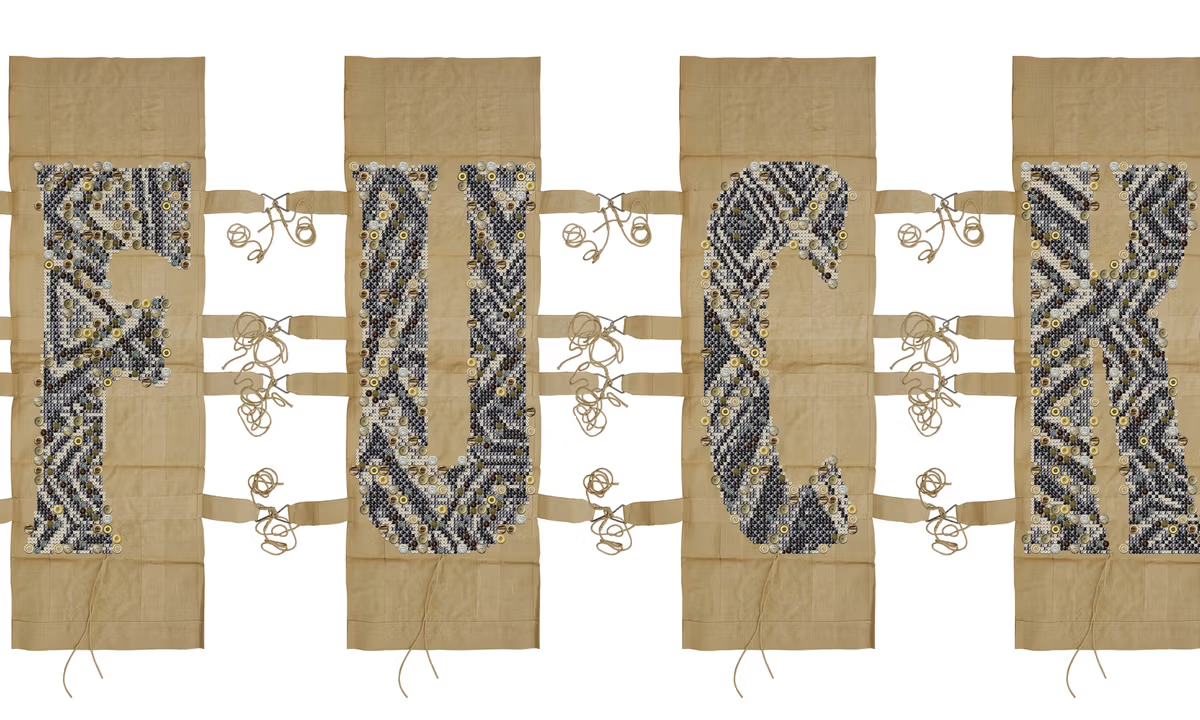
On show for the first time is the installation Whitewashed Remnants of History of the State of Emerging Future Works, for which the artist has painted over locally sourced antiques including chairs and vases. F.U.C.K. (2024), for which Ai has sewed metal buttons onto four military stretchers to spell out the titular expletive, is also being exhibited. This work was the centrepiece of his show at Lisson gallery in London last year.
“This is my first exhibition in India… although there are only a dozen of my artworks, it covers several key points that trace more than 20 years—and almost 30 years—of my creative activity,” Ai said in a statement.
Although this is Ai’s first solo exhibition in the country, his work has previously been shown at India Art Fair in New Delhi, by his galleries Lisson, Continua and Neugerriemschneider. Nature Morte, which does not represent Ai, is collaborating with Continua to stage the exhibition at its Dhan Mill location in southern New Delhi.
Work that ‘speaks to the present moment’
Throughout his career, Ai has been vocal against instances of censorship and repression. His criticism of the Chinese government saw him arrested in Beijing in 2011 and held captive for 81 days.
India is presently witnessing a rising tide of censorship from its far-right government, which is primarily targeting journalists and activists. A recent report by the independent media watchdog Free Speech Collective notes the “alarming disintegration of free speech protection in India”, and records more than 11,000 instances of censorship last year.
“Bringing Ai’s work to India isn’t about creating a spectacle—for us, it is about urgency,” Jain says. “His work speaks to the present moment with total clarity: history, power, borders, memory. India is a place where these questions are lived, not abstract, and this exhibition invites that conversation without flinching.”
Peter Nagy, co-director of Nature Morte, adds: “Ai Weiwei has an unmatched ability to hold the ancient and the contemporary in the same frame—craft and critique, beauty and blunt truth. Presenting his first solo show in India feels both overdue and essential, especially now, when the politics of images, movement, and belonging are shaping lives everywhere—including here.”
