


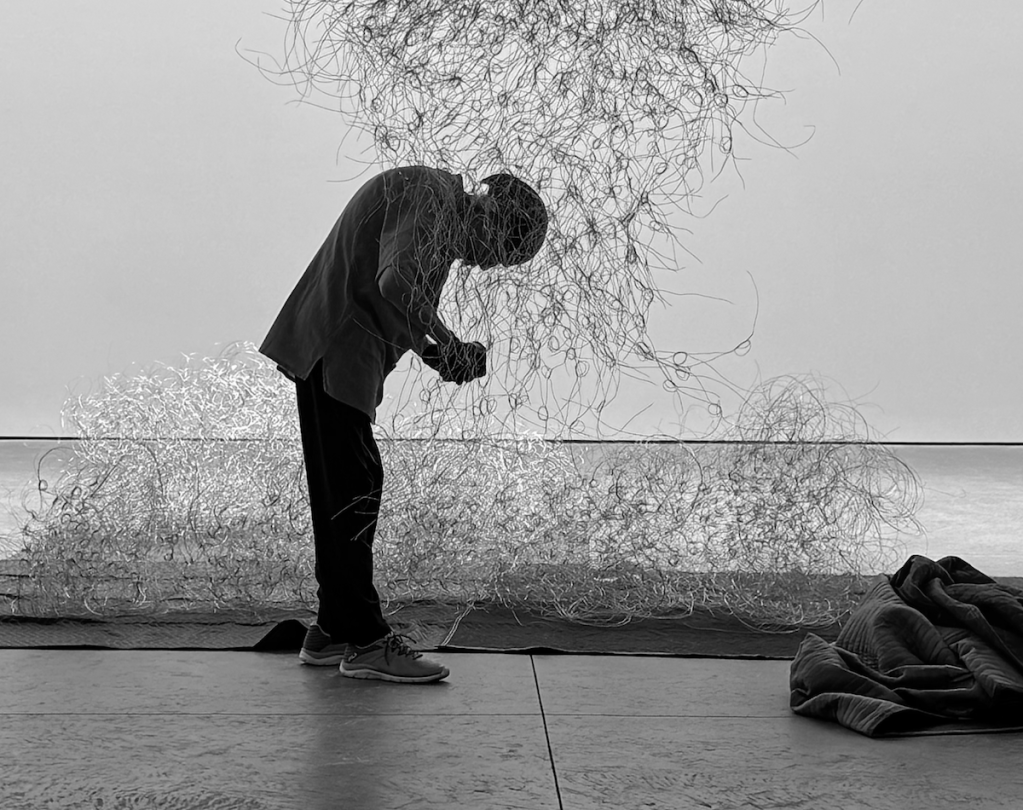
Alan Saret, an unclassifiable artist whose wire sculptures and colored-pencil drawings helped define the “anti-form” tendency of the late 1960s and early ’70s, died on Tuesday at 81. His death was announced by Karma, the New York gallery that helped bring Saret increased attention with three shows staged since 2022.
Saret remains one of the best-kept secrets of the ’60s New York art scene—an elusive presence who has often been tied to the Post-Minimalist movement, not that he ever fit neatly into its confines. Much of his work was precariously constructed and deliberately mysterious. Frequently, he concerned himself with visualizing mathematical formulae, entropy, and invisible forces of nature.
His wire sculptures remain his most well-known pieces. Crafted from nets and tangles of bronze and steel, these sculptures involved the usage of readily sourced industrial material, a strategy that was core to the Minimalist movement. But whereas the Minimalists prioritized a sharp sense of order and an aesthetic of austerity, Saret crafted wire sculptures that were chaotic and unruly, composed as they were from objects that were crushed, bent, and in some cases hung overhead.
Of those suspended sculptures, Saret, who gave few interviews to explain his work, once noted that they “breathe,” almost “like spirits, the most rarified form of matter.” These remarks hinted at the corporeal quality of these sculptures, which have been collected by institutions such as the Museum of Modern Art and the Whitney Museum.
Some wire sculptures were featured in Saret’s breakthrough 1968 exhibition at New York’s Bykert Gallery, a space that was known for its offbeat offerings. Writing in Artforum, critic Emily Wasserman remarked that the exhibition altered her notion that “the prospects for a sculptural renaissance were pretty slim,” writing that Saret’s wire and rubber creations made him “a vital and promising talent.”
A 2022 exhibition of Alan Saret’s work at Karma in New York.
Courtesy Karma
The Bykert show led to placement in Harald Szeemann’s era-defining exhibition “When Attitudes Become Form,” held at the Kunsthalle Bern in 1969, and in group shows at MoMA, the Whitney, and the P.S.1 Contemporary Art Center, whose inaugural show in 1976 featured a Saret installation composed only of an aperture carved into the space’s brick wall. That installation still exists at P.S.1, which has since been acquired by MoMA and is now known as MoMA PS1.
Saret also produced drawings made by dragging multiple colored pencils across sheets of paper at once, creating abstractions that recalled the patterns of migrating animals. In his typically idiosyncratic fashion, Saret described these so-called “Gang Drawings” as “ensouling the moment of their creation into breathing worlds” on his website. These works were surveyed by New York’s Drawing Center in 2007.
While Saret may not rank among the most famous artists of his generation, he did develop a cult following that was helped along by a 1990 survey at P.S.1. Addressing that exhibition in the New York Times, critic Michael Kimmelman wrote that Saret “remains, in the best sense of the word, eccentric.”

Alan Saret, The Hole at P.S.1, Fifth Solar Chthonic Wall Temple, 1976.
Courtesy Karma
Few biographical details about Saret have ever been made public. He was born on December 25, 1944, and attended Cornell University’s architecture program, graduating in 1966. He then attended Hunter College’s art program, studying under Robert Morris, a pioneer of the Process Art and Conceptualist movements.
In 1968, in an Artforum essay called “Anti Form,” Morris theorized a kind of art that was centered less around the final object than the process used to make it. The essay was in part a response to the Minimalist art movement, and it was one that would inspire Saret, who credited Morris with having “enabled my work to become known.” Saret fell in with a group that included Jeffrey Lew and Gordon Matta-Clark, with whom he would help form the SoHo space 112 Greene Street, which ran from 1970 to 1974.
In 1971, MoMA supported Saret’s participation in a show in New Delhi; he stayed in India for nearly three more years thereafter, “exploring the ultimate questions of Self and world that the art had occasioned,” as he put it. He returned to the US in 1974, then went on to sculpt an outdoor installation called Ghosthouse (1975), a massive, shelter-like structure formed from wire that he exhibited at Artpark in Western New York.
Alan Saret creating Ghosthouse (1975).
Courtesy Karma
Saret claimed on his website that, for much of his career, he was an “independent artist” who worked without much commercial or institutional support. Indeed, there is an 11-year gap on his CV between his 1990 P.S.1 survey and a 2001 show with James Cohan Gallery that paired his work with Carl Andre’s sculptures.
But he seemed to find his independence nourishing, if his self-written biography is any proof. “Art can benefit by reconnecting with architecture and agriculture, with the rituals of life and the transcendence of this life,” Saret wrote. “On this path is freedom from the yearly or biennial delivery of the advancing work, affording even a lifetime for the solution of difficult problems.”
