


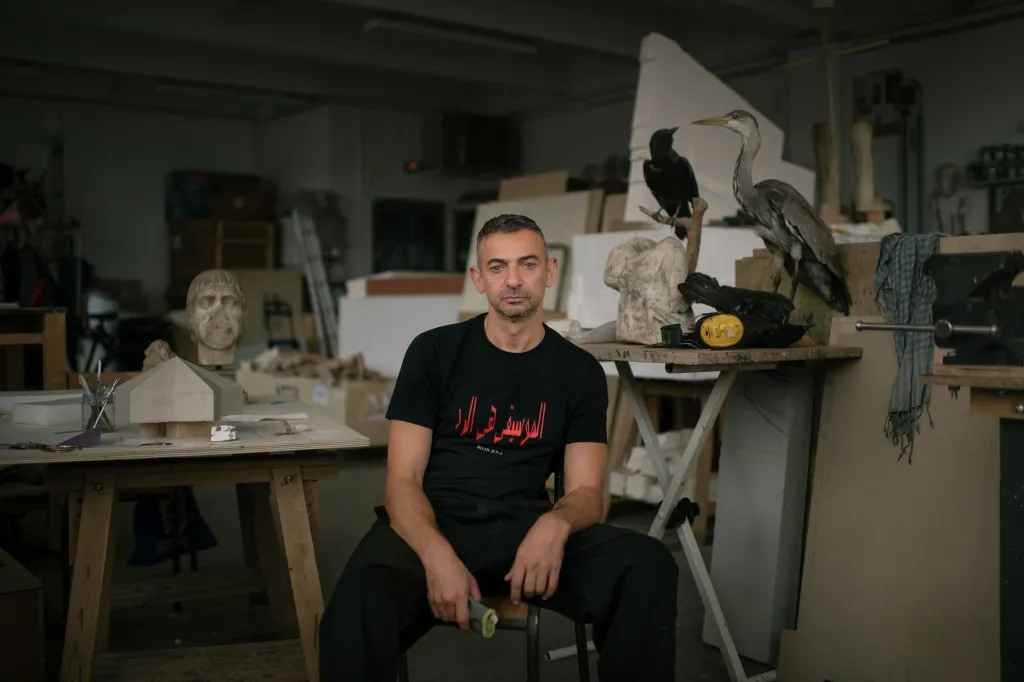
In Ali Cherri’s recent films, war maps itself onto the spine of those afflicted. The watchman, the titular figure of a 2024 short, stands rigid for unbroken hours, lost in a lineage of men stationed along the border of the internationally unrecognized Turkish Republic of Northern Cyprus. Cherri’s follow-up film The Sentinel (2025)—the second in an ongoing trilogy—debuts today. It centers on a French soldier, gently bent at the waist, a rifle lodged in his mouth. The rifle fires. Whether he dies or dreams is left unresolved, the decision deferred to the viewer.
For more than two decades of art-making, Cherri has resisted moral closure in favor of endurance. His work has been circulated through influential institutions such as the Vienna Secession and the Swiss Institute, and has been celebrated on contemporary art’s most visible stage: the Silver Lion Award at the 59th Venice Biennale, for the sculpture triad Titans (2022) and the video installation Of Men and Gods and Mud (2022).
The Sentinel, Cherri’s latest engagement with sculpture and moving images, anchors his exhibition “Last Watch Before Dawn,” on view at Almine Rech in New York through February 28. Born in Beirut as the Lebanese Civil War began and shaped by the city’s postwar creative revival, Cherri treats cultural memory as tactile—molded in the palm, examined for how it is transmitted across art, artifacts, and political narratives. “Last Watch Before Dawn” invites visitors to watch The Sentinel, then encounter its bones in the gallery: sculptures and stills from the film set, alongside the first series of watercolors Cherri has exhibited. The effect is visceral and intimate—the soldier’s heart turned inside out, ourselves invited to sift through the remains.
Below, Cherri on working with known actors, how history lives in our bodies, and the theater of sanity.
Seeing the art and objects from the film in the gallery feels like the film has come apart.
This is the first time in my practice that sculpture and filmmaking really came together. Usually there’s the film, and then there’s sculptures that are related to the film that come after. Now I’m thinking about the set design, and the objects that will be in the film before we shoot.
[Visitors] will see the film downstairs, so when they’ve come up after, they’ll have already seen the objects. So you encounter them twice: first for what they are, then as part of a film.
Did the process of translating the film set into an exhibition alter its meaning for you, or provide a meaning you didn’t expect?
Definitely, because the [sculptures] function as a standalone work, regardless of their delegation to the film. I think you can already construct a certain narrative just by looking at objects, but then they gain a new layer after seeing the film. It will be interesting to see how people read their encounter with the exhibition before seeing the film—if they first see, for example, the series of sleeping soldiers, or the theatrical diorama set with the two soldiers and a dog.
Where in the past or present—yours personally, or more broadly—did this exhibition begin?
I started this trilogy of films that’s looking at landscapes of violence—of real, violent histories and how they relate to geography. Every time it was a different location, different political situation, different histories. I also tried to look at how violence altered the landscape and people’s bodies, at what violence does to everything.
It disrupts us on a molecular level.
Exactly. In this new body of work, I’m really focusing on the figure of the soldier. We started with the watchman. I shot it in Cyprus, in the buffer zone on the division line. The person who was playing the soldier—he’s not a professional actor. Actually, he had just finished two years of military service a week before we started shooting. I wanted someone with the physical experience, in his body, of being a watchman.
Northern Cyprus is in such a complex political situation. I’m curious if you had any conversations about what his military service meant to him, how he sees what they’re fighting for.
He’s actually an artist and musician; military service is mandatory there, and he hated it. For him, making this film was like getting some sort of positive out of this experience.
All these bodies get caught up in ideological constructs, these conflicts. He’s from Northern Cyprus; he was born there, and he has his own political view on this conflict, but he can’t express it. The first thing about being a soldier is that you have to obey, not question. I was interested in this tension between being an individual and being part of an institution that governs what you should think and what you should do. He would do this watch for sometimes six, seven, eight hours.
He’d just watch the border?
Yeah. You cannot have a phone, you can’t do anything but observe. And I was asking: What do you do in all this time? Do you think about anything? He said: You cannot think. The easiest way to let time pass is to go blank.
You’re watching a border where nothing happened for 40 years. In a way, there’s no meaning to the action you’re doing, but at the same time, it’s part of something that you have to perform.
How does The Sentinel follow up on these themes?
This time, we’re not in a real location; it’s fiction. I decided to work with actors. In France, at least, [my stars] are known actors—I wanted actors who are identifiable as actors. We can clearly see in the film that it’s a set. They are playing the role of soldiers; the film is playing the role of a military base. This idea of role play also happens in the cabaret with the drag performance: someone playing gender roles.
For me, the cabaret scene evoked the theater of sanity performed after trauma. Throughout the film, the soldier is performing as if he’s not psychically trapped elsewhere. And yet, the soldier is only visibly engaged with the world around him during the drag performance at the cabaret. Stumbling upon it, he stumbled upon himself, sort of. It read to me like an ode to art itself.
Your description totally works for me. The moment they [the soldier and drag queen] talk after the performance, they’re like two lonely souls stuck in whatever world they’re in. The difference is that the drag performer has chosen the gender role to play. For him, he feels like there’s something beyond him. The soldier is faced with somebody that has authority over how they look and how they want to dress. They’re not just conforming to male or female. There is a confrontation, but there’s also understanding. There’s tenderness against this backdrop of sadness.
[The drag queen] says [in the club], “Maybe I’m living here. This is my home.” Like any other home, you can feel there is pain, but this person is trying to give joy to others, to bring them here. Even with the military doctor. Yes, he’s an authority figure, but they’re all lost souls trying to console each other.
What about the song performed in the club? The refrain was “Each man kills the thing he loves.”
The song is adapted from a ballad Oscar Wilde wrote in prison. His cellmate was someone who killed his wife out of love. It‘s a love that gone to the extreme: wanting to annihilate the thing that you love in order to own it. It’s a mixed feeling about something that you want to die for, kill or be killed for, a passion to dedicate your life to.
Ali Cherri: Still from The Sentinel, 2026.
© Ali Cherri Photo: Dmitry Kostyukov Courtesy of the Artist and Almine Rech
Can you talk more about the film set? When he’s in the doctor’s office the camera is far and above, it looks like he’s in a dollhouse.
Also, when he goes out on the street, the city feels like cardboard. It‘s this feeling of an out-of-body experience, when he’s looking at himself and talking to the doctor, but also revealing the apparatus of the film’s staged quality. We don’t know if all this happened after he shot himself, since the film opens with a dream where he sees himself putting the gun in his mouth, and then he wakes up.
I don’t want to close the story, but after that, we see another soldier walk through a gate, into the light. Maybe it’s the light at the end of the tunnel, maybe it’s a way out. You can easily project your feelings about the world into this film.
Dream or not, why did you have him kill himself?
For me, it’s clearly fiction. If he kills himself, he kills himself in fiction, on a stage, in a theater—in Macbeth, death is a metaphor. When you’re a soldier, you give the choice of life and death to the military. You accept that you won’t decide your fate. Shooting himself is like saying: I own the decision, I didn’t give over my soul. Maybe what he puts an end to is this reality in order to make other realities possible.

Ali Cherri: Still from The Sentinel, 2026.
© Ali Cherri Courtesy of the Artist and Almine Rech
Sleep is a big theme of the trilogy so far. In The Sentinel, the soldier falls asleep resting on the bas-relief in the show.
Yes, I feel sleep is a way of resisting. It’s how bodies manage to escape to the dream world, a chance to take a break from the violence of the world in order to see something better. There are three generations of women [in the bas-relief] watching over him. You’re vulnerable when asleep, so this is a notion of care.
In The Watchman, the protagonist passes through a doorway with a Turkish phrase carved into it that translates to: Wake up, soldier.
That’s from the Turkish army. They asked the soldiers to be awake and ready; for them, failure meant they weren’t awake enough, strong enough. For me, weakness is a way of resistance. It’s how we can take back our humanity.
And that idea culminates with the drag performance.
It’s a body that accepts its femininity and its weakness. In politics today, we see that everyone wants these men who seem strong. All my figures come from a space of weakness as defiance.
How does that relate to the scale of the sculptures? They are larger-than-life.
We feel like a kid when we are in front of someone a little bit bigger than us. As for the sculptures, they are big but also exhausted, maybe having a break. They’re not bronze; these are mud figures. They’re fragile. They’re not like the statues you see on the street of heroes and great figures of history.
Watercolor, too, needs a precise and delicate touch.
I started making [the series of watercolor sleeping soldiers] during Covid. Some people started baking bread; I picked up watercolor. I always say I’m a filmmaker and a sculptor, and drawings are something I do for myself. Watercolor requires a lot of patience. For me, it’s a ritual. I put down a white paper, I prepare everything, and I leave sometimes for three or four days before approaching. It’s meditation. You cannot stress or rush because you cannot undo even a little mistake. You cannot cover it up with anything.
So there’s something about the spontaneity and the attention that you need to give to watercolor that’s really healing for me versus when we work in sculpture. Sculptures are dusty and big and noisy. I have a separate space where I draw.
The neon sign from the cabaret is in the show. It says THE SURVIVORS—is that a real club somewhere?
No, I was thinking about what to name the bar, and I liked the idea of ‟survivor,” especially in French: survivant, which translates literally to over (sur) liver (vivant). There’s something about the state of being a survivor that I’m very interested in. I was born at the beginning of the Civil War in Lebanon, so I’m also a survivor. What does that do to how you perceive the world? It really requires this superpower of being over. It’s not only living, you become someone who overlives. I like that this small place becomes where people are saved and become survivors.
[In Lebanon,] there’s a survival instinct that still amazes me. The worse things are, the more we hold on to life and have fun—even if it’s excessive, even if it’s seen as a sick way of dealing with reality. But survival isn’t an intellectual thing, not really. It’s instinctual.
You said once in an interview that your work is darker than who you are, inside. Does that still feel true?
With everything that’s happened, it’s harder and harder to feel that way, but that is the resistance we need—to still long for the pleasures that art and nature give us. We’re becoming harsher on each other when we need to remain tender and empathetic—that is the struggle today. Even if there is dark, I don’t perceive it as darkness. Sometimes my work is about exorcising something in order to preserve it.
