


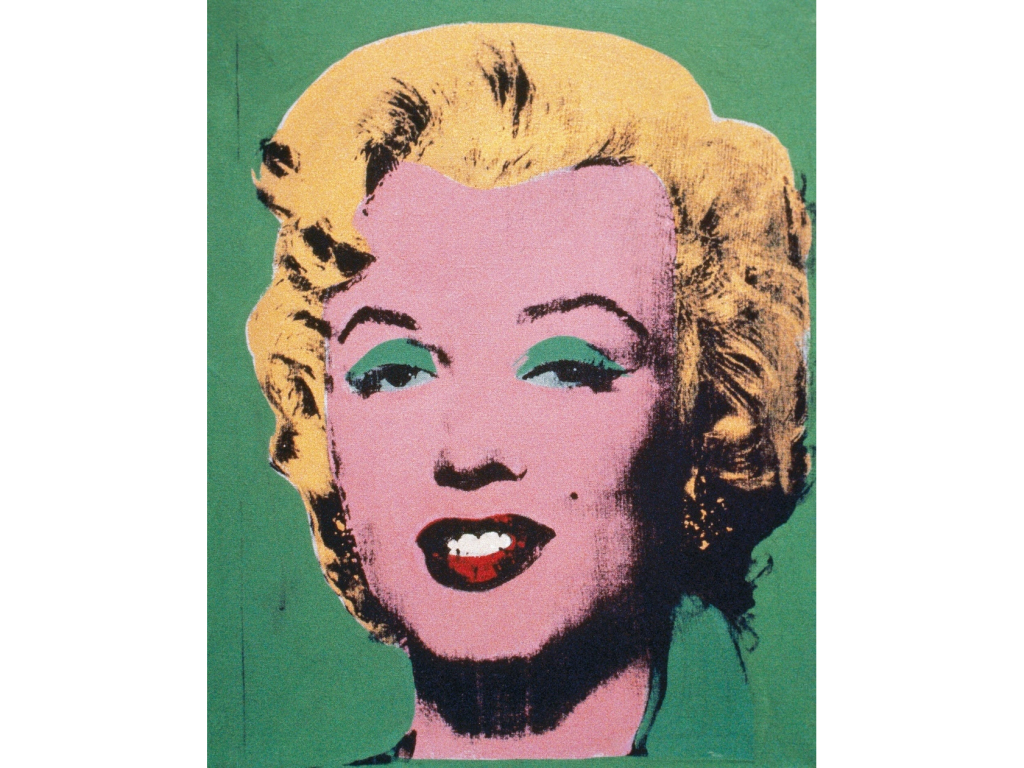
MARILYN MONROE DEAD; PILLS NEAR read the front-page headline of the August 6, 1962, New York Times. Star’s Body Is Found in Bedroom of Her Home on Coast, the subheading continued. As an artist then sponging up ideas everywhere, from newspapers to the supermarket aisle, Pop artist Andy Warhol would have seen this coverage of the Hollywood star’s untimely death at age 36. The result was one of the emerging artist’s most iconic series.
Beginning in August 1962, when Monroe’s death dominated the media, and for the next two years, Warhol created more than 50 paintings of her using a headshot taken by Gene Kornman for 20th Century Fox as publicity for her 1953 film, Niagara. One ofWarhol’s earliest Monroe paintings, which cast her as his version of a modern-day Madonna, was Gold Marilyn (1962), which shimmers like a Byzantine icon. Another version features her lipsticked mouth, Marilyn Monroe’s Lips (1962).Still another major work from that year, Marilyn Diptych (1962), joins two panels of repetitive Monroes—25 in color and 25 in black and white—the slow fade-out of her image in the latter almost a visual metaphor for her ultimate celebrity burnout.
Monroe’s death came at a pivotal moment for Warhol, who was still a relatively unknown painter at the time. In fact, the day of Monroe’s death happened to be the closing day of Warhol’s first-ever solo exhibition, of his repetitive Campbell’s Soup can series at Los Angeles’s Ferus Gallery. The Pop artist had been playing with image repetition in the months leading up to the actress’s passing, painting canvases of soup cans, Coca-Cola bottles, and coffee cans. “Many artists painted the same subject over and over from different angles, but to paint the same subject repeatedly looking the same undermined the individual preciousness of a work of art,” wrote Victor Bockris in his 1989 biography of the artist.
In addition to playing with the possibilities of repetition, Warhol had just started experimenting with the silk-screening process. “The rubber-stamp method I’d been using to repeat images suddenly seemed too homemade; I wanted something stronger that gave more of an assembly-line effect,” Warhol wrote in his book (done in collaboration with Pat Hackett) POPism: The Warhol ’60s (1980). “You get the same image, slightly different each time. It was all so simple—quick and chancy. I was thrilled with it.”
Warhol’s studio assistant at the time, Nathan Gluck, suggested that the artist use silk-screening as a quicker way to produce the rows and rows of dollar bills he was then trying to paint. The technique soon spread to encompass paintings of Hollywood stars such as Natalie Wood, Troy Donahue, and Warren Beatty, but these didn’t elicit the same responses as those of celebrities who were tinged with some form of tragedy or drama: Marilyn Monroe, Jacqueline Kennedy, and Elizabeth Taylor. (When Warhol created portraits of Taylor in the fall of 1962, she was filming Cleopatra and had halted production several times due to life-threatening health issues.) With the Marilyn series, Warhol hit his portrait stride.
For the Marilyn paintings, Warhol applied paint to the canvas before silk-screening—a background color and outlines of her head and shoulders, eye shadow, lips, and face. The slight misalignment of the color and the silkscreen image, as well as occasional blots of paint on the screen, created differentiations among the images. In 1967, when Warhol established his print-publishing business, Factory Additions, “Marilyn Monroe”was his first series of screenprint portfolios; these images each required five screens—one for the replica of the photographic image, and the other four for areas of color.
“At the heart of Warhol’s serial Marilyns there is an acknowledgment of a culture in which adoration results in a kind of consumption. We devour and discard the icons that we love,” wrote curator Douglas Fogle in the catalog for the 2017 Museum Jumex exhibition “Andy Warhol: Dark Star.” “In the mistakes, cancellations, misregistrations, and compulsive repetitions of Warhol’s silk-screened surfaces, however, one can also see a kind of resistance to these rapacious forces of darkness. There is paradoxically a kind of humanizing of Monroe in these works, as if the shifted register of the silk-screen alignment allowed a gap in the tightly maintained public persona of this textbook case of a star devoured by fame.”
In the fall of 1962, a few months after the close of his Ferus show, Eleanor Ward gave Warhol his first solo show in New York at the Stable Gallery. In addition to his large Campbell’s Soup cans, a painting of 100 Coke bottles, some paint-by-numbers canvases, and a red Elvis, it included a series of 20-by-16-inch Marilyns named after Lifesaver candy flavors and priced at $250 each (they all sold). Gold Marilyn, also part of the show, was purchased for $800 by architect Philip Johnson, who later donated it to the Museum of Modern Art.
Four 40-by-40-inch Marilyn paintings are distinctly different from the rest of the series, but not because of a choice made by Warhol. In 1964, performance artist Dorothy Podber visited Warhol’s Factory and saw five of them leaning against a wall. She asked Warhol if she could “shoot” them and he agreed, believing she meant to photograph them. Podber then took a pistol out of her purse and shot four of these Marilyns right between the eyes (only the Turquoise Marilyn was spared this fate). Now known as the “Shot Marilyns,” they were restored, but they can still be identified by rough patches where the canvas was pierced. The colorful story has only added to the legend and value of these works. The Shot Red Marilyn sold for $4 million in 1989, the highest price paid for a Warhol at the time. When the Shot Sage Blue Marilyn (1964) sold for more than $195 million in May 2022, it set a record that still stands for the most expensive 20th-century artwork sold at auction.
