





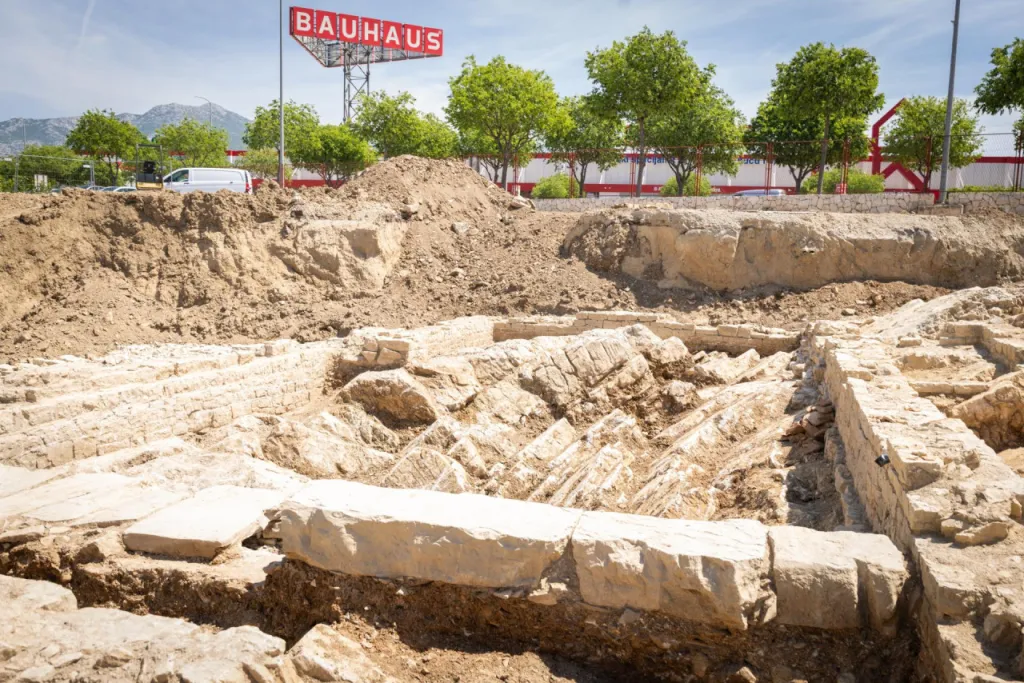
An ancient Roman residential and agricultural complex has been unearthed across from a shopping mall near Split, Coatia, according to Croatia Week. The news was first reported by Slobodna Dalmacija.
Led by archaeologist Eduard Visković, a team from the consulting company Kantharos discovered the complex during excavations at the Mostine archeological site near Split. The team had been checking for ruins around the Bauhaus retail center before further commercial development proceeded in the area, continuing work started in 2011 with the discovery of an early Christian church there.
Covering approximately 6,500 square feet, the complex appears to have been a country estate that processed olives for oil. The archaeologists date the compound’s origins to the 1st century CE, though they also found artifacts indicating that it was in use in subsequent centuries.
The find included six large rooms, including one almost 1,000 square feet in area, and the remains of olive oil production equipment, channels for funneling the oil into collection basins, a cistern for storing the oil, and pieces of ceramic vessels. About 150 feet of roadway extends north from the entrance to the complex, suggesting that the facility supplied oil to the region, which included Salona, the capital of the Roman province of Dalmatia.
The complex also included residential quarters, likely a villa for a wealthy landowner. Here, the archeologists found tesserae from mosaics, glass fragments, and kitchen pottery. Also uncovered were coins dating from the 2nd to the 6th centuries CE.
“We can say that there is no such spacious economic-residential complex in the area that testifies [as conclusively] to the lively agricultural activity in the Salona area,” Visković said in a press release.
Though rich in Greek, Roman, and early Christian artifacts, the location presents challenges to archaeologists, being prone to flooding. Excavations are expected to continue for several weeks, after which the site will be covered with geotextiles and gravel to preserve it until further research or conservation is possible.


