


Whatever anyone makes of the American pavilion in this year’s Venice Biennale, the most telling representation of the nation’s character today is likely to appear in an Italian palazzo on the Grand Canal—namely, the Prada Foundation’s Ca’ Corner della Regina.
Helter Skelter: Richard Prince and Arthur Jafa is a show made in America by Americans of new, existing and previously unexhibited works about America, handpicked by Nancy Spector, the former artistic director and chief curator of the Guggenheim New York. For this, her first institutional survey since departing the museum in 2020, she is bringing the two artists together in a call-and-response presentation as, literally, never before.
The profoundly influential Prince, whose 2007 retrospective at the Guggenheim was organised by Spector, has been poking the ribs of authorial power in art since the late 1970s, when he rephotographed unlicensed commercial images and reconstituted them as his own work. A decade younger, at 65, Jafa caught art world fire in 2016, with the New York debut of his shattering, seven-minute video compilation, Love Is The Message, The Message is Death, which Spector has linked in Helter Skelter to the apocalyptic solar glow emanating from Prince’s Sunset photographs of the early 1980s.
Richard Prince’s advertising-based 1981-82 work Untitled (Sunsets)
© the artist
Known to his familiars as AJ, Jafa is a serial appropriationist and collagist who also mines the meaning of property but as Black Americans have experienced it since the advent of slavery. Whatever their shared strategies, the two artists hardly seem like peas in a pod. Even Spector thought so, until three years ago, when she met Jafa for the first time at his studio in Los Angeles. To her surprise, “Much of what he wanted to talk about was Richard Prince. At first, I didn’t understand the connections, but then AJ spoke at length about appropriation, and theft, and how that means something entirely different to a person of colour than to a white individual, where it’s a privilege or titillation, versus a survival mode.”
Living legend
“[Prince] is a fucking living legend. I can talk, but truth be told, when I’m around Richard, mostly I listen,” Jafa tells The Art Newspaper. “In many ways a large part of what I do wouldn’t be possible without the precedent Richard set around appropriation, but there’s an overlap in terms of the things he’s interested in appropriating.”
Their mirroring interests in vernacular American culture ricochet throughout Helter Skelter—Jafa came up with the title—where Spector has installed more than 50 works as an inspired dialogue between each of them but also with the baroque rooms of the 17th-century palazzo that houses them. “We decided to own the building and not pretend it’s just a venue,” she says.
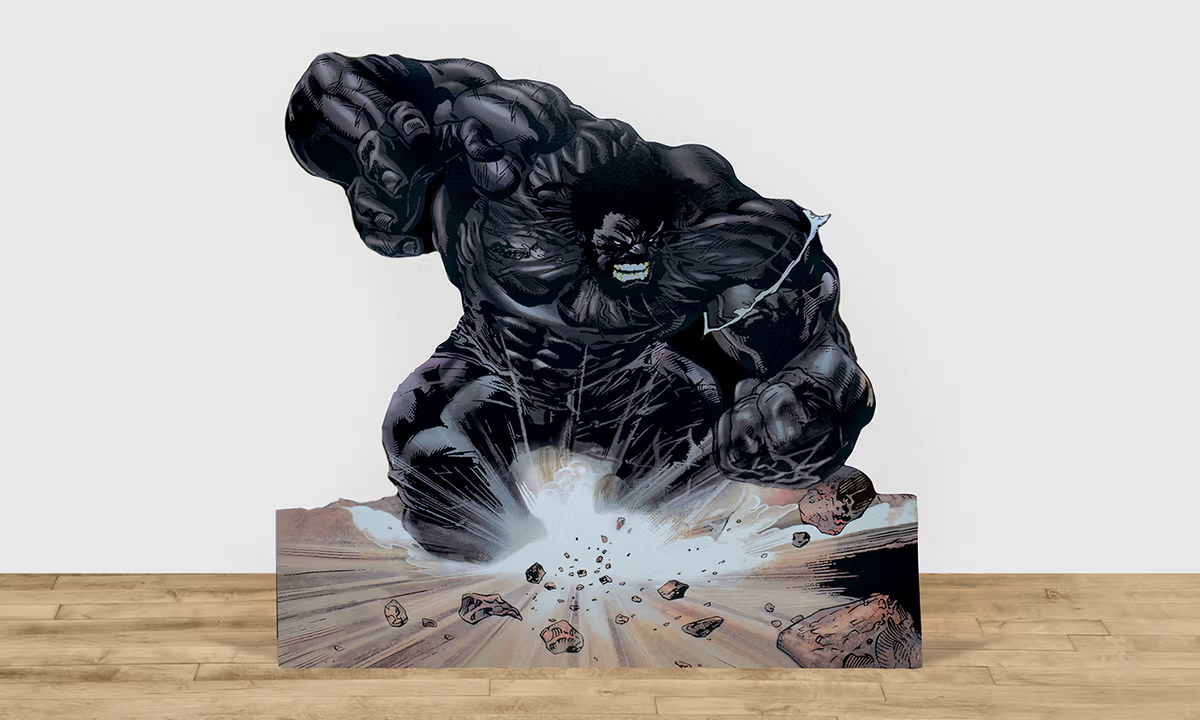
The contrasting context is certain to affect what viewers will encounter from the moment they enter, where Jafa’s massive, rather threatening, truck tyre in chains (Big Wheel II, 2018) stands adjacent to a large, previously unexhibited, nest of slashed-rubber ribbons, from a series that Prince informally calls Blasting Mats. Hanging like a limp effigy from a beam, it resembles an animal carcass but also could stand in for a sexual submissive, creating a formal and thematic link to the prison labour evoked by Jafa’s wheel.
Charged couplings
The show proceeds through similar juxtapositions of intersecting themes: Blackness and whiteness; marginalised communities (Prince’s gridded Gangs pasteups of biker girlfriends, the first of his works Jafa ever saw) paired with the latter’s Vinconium, an “array” of aluminium cutouts of Black political figures and performers made for the show; touchstones in popular music (Bob Dylan vs Miles Davis), self-portraiture, and spirituality. Neither artist shrinks from emotionally charged subject matter. (Think lynching and intersexuality.)
“Violence exists in my work, and, I would propose, enriches it,” says Jafa, comparing it to Blood Meridian, the novel by Cormac McCarthy. “But it’s more about a refusal to look away from how central violence is to the whole American project. It’s always been a demonic state, and we love it. We live in it. We wouldn’t exist without it.”
What viewers of Helter Skelter will not see is Spiritual America, Prince’s troubling 1983 appropriation of a nude, ten-year-old Brooke Shields in Pretty Baby mode. (In Italy, evidently, the photograph is still uncomfortably close to child pornography.) Spector’s proposal had paired it with Jafa’s BG, his 2024 corrective to the penultimate scene in Taxi Driver, only the white cops and pimps are played by Black actors called for by the original script. “For me,” Spector says, “that would have been the defining juxtaposition of this show. I wanted to explore the vigilante insanity around this misplaced desire for a young prostitute and the idea of releasing what is repressed in certain narratives.”
Instead, the Spector and Prince chose the next best thing: a rarely seen photograph from 1923 of a harnessed and gelded horse by Alfred Stieglitz, from which Prince had lifted the title Spiritual America. (The print on view once belonged to Stieglitz’s wife, Georgia O’Keeffe, and was later acquired at auction by Prince.) “It’s even in the original frame, with the crack in the glass,” Spector says, excited.
Aside from the number of zap-pow works in the show—visitors will be given earphones, so the sound from the films will not bleed from their galleries—the two artists also collaborated on Don’t Look Now, a zine of found images they exchanged by text during the show’s production. The zine resonates with a fly-on-the-wall studio conversation between the two artists in the show’s catalogue, designed by Peter Saville, a Briton and the only non-American involved.
For all its darkness, Helter Skelter is ultimately as redemptive as it is political. It may read differently in a Venetian palace than it would on American soil, but it promises to disturb, electrify, divide and raise the spirits of all comers, no matter where they’re from.
• Helter Skelter: Arthur Jafa and Richard Prince, Prada Foundation, Ca’ Corner della Regina, Venice, 9 May-23 November
