


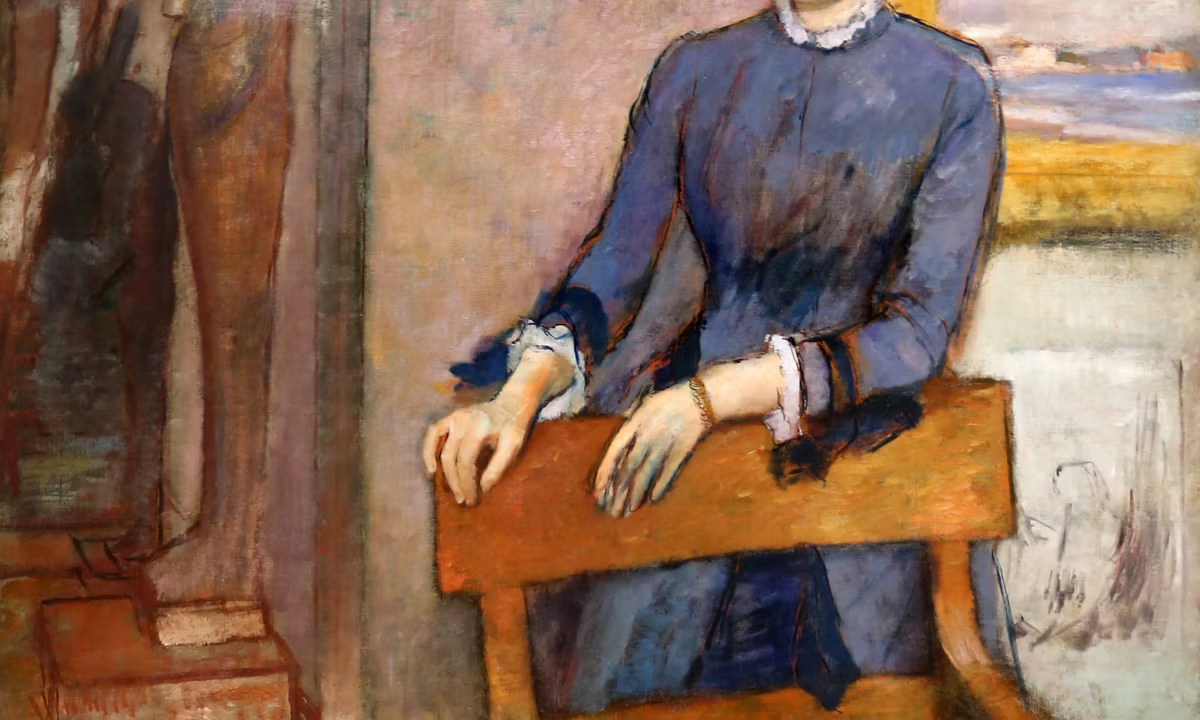
Of all artists’ dilemmas, among the toughest is deciding when a work is finished. A piece that might appear fresh and immediate runs the risk of being undercooked. And as the critic David Sylvester once remarked: “Going on for a long time is… a necessary gamble. Even with great artists, it often wrecks pictures, irredeemably.”
Sylvester said this in a 1982 interview with Howard Hodgkin, whose exhibition at Pitzhanger Manor and Gallery in London continues until 8 March. Sylvester asked the British painter how he knew a picture was complete. For Hodgkin, the process of reaching his conclusion was often anxious and lengthy—Snapshot, one of his biggest paintings, has the dates 1984-93. Yet he found it easier to know when he was finally done. “My pictures are finished when the subject comes back,” he told Sylvester. That is, once he had combined the visual memory of an event—meeting a person, an experience in a city or landscape—together with his emotions and “somehow transmuted, transformed or made [it] into a physical object”. Then, he said, “the picture’s finished and there is no question of doing anything more to it”.
Hodgkin and Sylvester then discussed Edgar Degas’s marvellous Hélène Rouart in her Father’s Study (around 1886) in London’s National Gallery. Here, Rouart stands behind her father’s empty chair, surrounded by his things: papers on his desk, Egyptian figures in a vitrine, an antique carpet on the wall, a Jean-Baptiste-Camille Corot painting behind her. Sylvester observed that “to conventional art-historical wisdom, the painting is not quite finished”, to which Hodgkin replied: “I think the whole picture is deliberately made to look like an unfinished painting.”
He pointed to the element I (and I know many painters) most love about Degas’s painting: “those curious red and blue pastel lines round the arm, along the edge of the body”. Hodgkin suggested that Degas drew back into the painting because “it had got a bit tight in places… and clearly Degas was trying to soften it again”. In other words, he worked more on it in order to avoid the wrecking-through-overworking that Sylvester warned against. Such is the tightrope artists walk.
Matisse and Cezanne
Notions of finish and unfinish abound in several current exhibitions. The Matisse exhibition opening at the Grand Palais in Paris on 24 March focuses on his later period, when at times Matisse seemed as concerned with process than arriving at a conclusion. He wrote to his son, the art dealer Pierre Matisse, in 1935: “I wish material circumstances,” meaning exhibitions and sales, “would allow me to leave [paintings] more or less in progress.” Matisse showed photographs of earlier states alongside some of his pictures, and some of his final cut-outs were only fixed with glue posthumously, after originally having been pinned, tumbling across his walls in Nice.
Meanwhile, the Cezanne exhibition at the Fondation Beyeler in Basel (until 25 May) addresses the openness of the French master’s technique—the arrangement of taches or coloured marks that, together with areas of bare canvas, add up to what Cezanne termed the réalisation of his paintings. As the catalogue for the show confirms, when we look at his work 120 years after his death, we are encountering pictures Cezanne deemed complete alongside those that were unfinished, abandoned and even, as Gottfried Boehm puts it, “fragmentarily complete”—like Montagne Sainte-Victoire vue des Lauves (1902-06), from the Kunsthaus Zürich. The poet Rainer Maria Rilke observed that we best understand Cezanne’s working process by looking at “an unfinished picture”, something borne out in the scores of artists, from Matisse onwards, who have gained so much for their own work through observing these open painted structures.
Deciding when a work is finished might provoke much gnashing of teeth in the studio
Finally, Turner and Constable: Rivals and Originals at Tate Britain (until 12 April) reflects how the modern reception of an artist’s work flies in the face of what they themselves would have countenanced. As the curator, Amy Concannon, spells out, it was displays of the two artists’ “unfinished, preparatory work, of the kind neither would have shown in public” that saw them hailed as proto-Modernists and abstractionists. Turner was presented at the Museum of Modern Art (MoMA) in New York in 1966 because, as Monroe Wheeler, then the museum’s director of exhibitions, said, “we know a modern painter when we see one”.
So deciding when a work is finished might provoke much gnashing of teeth in the studio. But posterity, frankly, won’t give a damn.
