

Close Menu
  • News
  • Stocks
  • Bonds
  • Commodities
  • Collectables
    • Art
    • Classic Cars
    • Whiskey
    • Wine
  • Trading
  • Alternative Investment
  • Markets
  • More
    • Economy
    • Money
    • Business
    • Personal Finance
    • Investing
    • Financial Planning
    • ETFs
    • Equities
    • Funds

Subscribe to Updates

Get the latest markets and assets news and updates directly to your inbox.

Trending Now

Comment | Why AI’s attempts at art historical analysis are a load of phooey – The Art Newspaper

August 5, 2026

Louvre to lend Islamic art treasures to the Smithsonian – The Art Newspaper

August 5, 2026

LSE eyes easier access and lower costs to join AIM with fresh rules

August 5, 2026
Facebook X (Twitter) Instagram
The Asset ObserverThe Asset Observer
Newsletter
LIVE MARKET DATA
  • News
  • Stocks
  • Bonds
  • Commodities
  • Collectables
    • Art
    • Classic Cars
    • Whiskey
    • Wine
  • Trading
  • Alternative Investment
  • Markets
  • More
    • Economy
    • Money
    • Business
    • Personal Finance
    • Investing
    • Financial Planning
    • ETFs
    • Equities
    • Funds
The Asset ObserverThe Asset Observer
Home»Art Market
Art Market

Comment | Why AI’s attempts at art historical analysis are a load of phooey – The Art Newspaper

News RoomBy News RoomAugust 5, 2026
Share
Facebook Twitter LinkedIn Pinterest Email

As a catastrophiser, I tend to assume that artificial intelligence (AI) is going to do art historians out of a job, along with the rest of us. But recently I’ve begun to feel more optimistic. AI may be great at coding and generating images of President Trump as Jesus, but so far it seems to be struggling with actually understanding art. Art is the nut AI can’t crack.

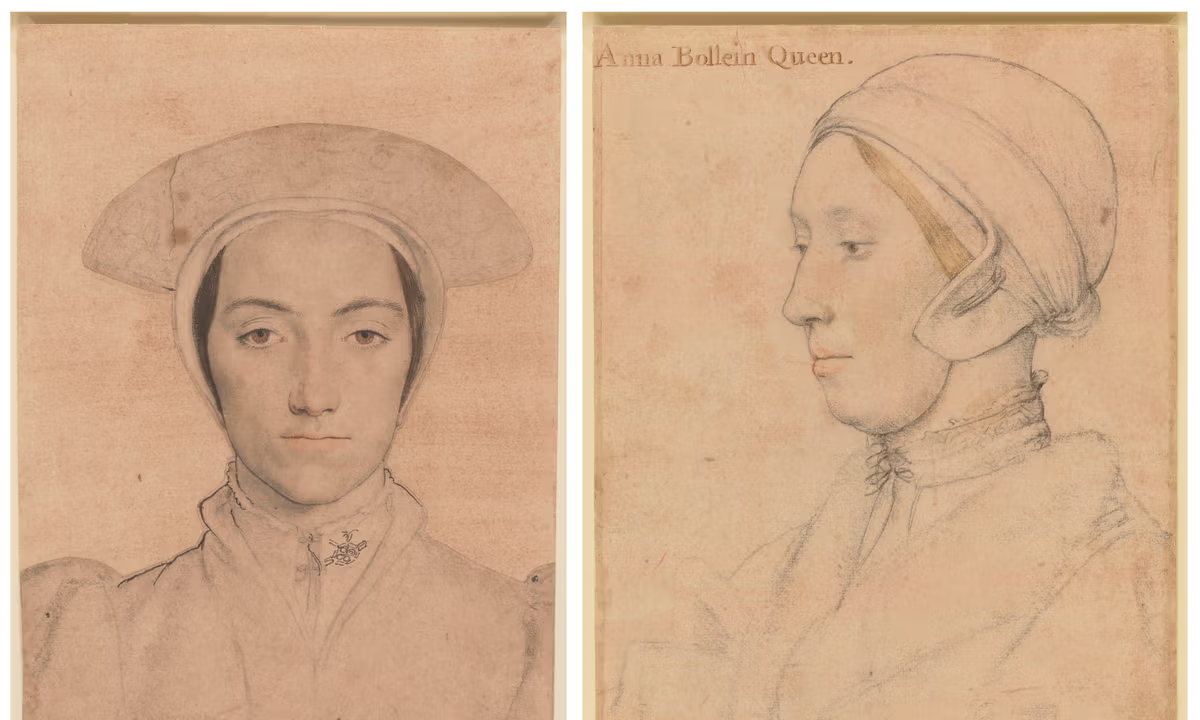
Take the latest story to do the rounds; “AI Identifies Holbein Drawing as Possible Portrait of Anne Boleyn”, ran one headline. Computer scientists at Bradford University used facial recognition to analyse Holbein’s drawings of the Tudor court. They were looking for family likenesses to help identify sitters, and concluded that one drawing in the Royal Collection, inscribed “Anna Bollein Queen”, was not sufficiently similar to Anne’s relatives to be her. Another drawing—of a previously unidentified sitter—apparently was.

The findings undid decades of art historical consensus, and at first glance seem authoritative. The analysis was accompanied with complex equations and data spreadsheets, and published in the esteemed, peer-reviewed journal Heritage Science. The facial-recognition technology was analogous to that used by the police and courts, implying the results were not opinion but measurable truth.

The BBC asked what I thought. I had to say first that I might be biased, because I’ve argued that the drawing inscribed “Anna Bollein Queen” does indeed show Anne. The identification was first attached by Edward VI’s tutor, John Cheke, who almost certainly knew Anne well enough to identify her.

Shaky statistics

I studied the data and the article. My first concern was that two Holbein drawings of the same sitter, Henry Howard, were deemed by AI to be only an 84.1% match with each other, when we’d be expecting something nearer 100% as evidence the facial recognition approach worked. The Anne Boleyn identification relied on an even shakier foundation. Holbein’s drawings were compared to an oil portrait of the young Elizabeth I by another artist, William Scrots. The inscribed “Anna Bollein” drawing was scored as a 75.4% likeness, and the other, previously unidentified, drawing was a 76.9% match. That’s a 1.5% difference, not much more than statistical noise. I had my answer for the BBC; the story was “a load of phooey”.

Some of my art historian colleagues are not only reluctant to comment on stories like this (the Royal Collection, for example, simply “welcomed further discussion”) but would never dream of saying anything as gobby as “phooey”. My view is that if we want the public to value the work art historians do, we need to play the game the modern world demands. If you see it, say it.

For in a world of fast and fake news, what counts is whether people think the story is right, and how it lands. I was contacted by other news outlets about the story, but could get none of them to actually focus on the detail. They seemed less interested in whether Bradford University’s findings were right or wrong than in securing a rebuttal. In these circumstances, all you get is a chance to say something punchy like “it’s phooey”, or you might as well say nothing.

I don’t doubt that AI will one day be a useful tool for art historical research. But so far, many of those applying it to art history appear not to understand the basics of our discipline. If AI is ever to properly understand art, it must first learn from the art historians it is supposed to replace.

Share. Facebook Twitter Pinterest LinkedIn Tumblr Email

Keep Reading

Louvre to lend Islamic art treasures to the Smithsonian – The Art Newspaper

V&A deputy director Tim Reeve departs to lead English Heritage – The Art Newspaper

Valerie Hillings appointed inaugural director of Guggenheim Abu Dhabi – The Art Newspaper

‘Criminalisation of dissent’: Indian artist remains behind bars after workers’ protest – The Art Newspaper

The Australian Museum returns remains of Rapa Nui ancestors to Easter Island – The Art Newspaper

London Mayor Defends Free Entry to Museums, UK’s National Gallery Criticized, and More: Morning Links for August 4, 2026

Spanish Police Recover a 16th-Century Virgin Relief Stolen 16 Years Ago From Monastery

Sale of Insolvent Glasgow Art Center’s Archive Would Be an ‘Irreversible Loss,’ Critics Warn

Guggenheim Veteran Valerie Hillings Tapped as Inaugural Director of Abu Dhabi Branch

Recent Posts
  • Comment | Why AI’s attempts at art historical analysis are a load of phooey – The Art Newspaper
  • Louvre to lend Islamic art treasures to the Smithsonian – The Art Newspaper
  • LSE eyes easier access and lower costs to join AIM with fresh rules
  • V&A deputy director Tim Reeve departs to lead English Heritage – The Art Newspaper
  • Valerie Hillings appointed inaugural director of Guggenheim Abu Dhabi – The Art Newspaper

Subscribe to Newsletter

Get the latest markets and assets news and updates directly to your inbox.

Editors Picks

Louvre to lend Islamic art treasures to the Smithsonian – The Art Newspaper

August 5, 2026

LSE eyes easier access and lower costs to join AIM with fresh rules

August 5, 2026

V&A deputy director Tim Reeve departs to lead English Heritage – The Art Newspaper

August 5, 2026

Valerie Hillings appointed inaugural director of Guggenheim Abu Dhabi – The Art Newspaper

August 5, 2026

‘Criminalisation of dissent’: Indian artist remains behind bars after workers’ protest – The Art Newspaper

August 5, 2026
Facebook X (Twitter) Instagram
© 2026 The Asset Observer. All Rights Reserved.
  • Privacy Policy
  • Terms
  • Press Release
  • Advertise
  • Contact

Type above and press Enter to search. Press Esc to cancel.