

Close Menu
  • News
  • Stocks
  • Bonds
  • Commodities
  • Collectables
    • Art
    • Classic Cars
    • Whiskey
    • Wine
  • Trading
  • Alternative Investment
  • Markets
  • More
    • Economy
    • Money
    • Business
    • Personal Finance
    • Investing
    • Financial Planning
    • ETFs
    • Equities
    • Funds

Subscribe to Updates

Get the latest markets and assets news and updates directly to your inbox.

Trending Now

Chianti Day 2026: Here are 10 top-scoring wines to try

September 4, 2026

Institutional Entitlement Offer and Placement Successfully Completed

September 4, 2026

A$1.1Million Placement to Fund Critical Minerals Strategyand Unlock Value from Potash

September 4, 2026
Facebook X (Twitter) Instagram
The Asset ObserverThe Asset Observer
Newsletter
LIVE MARKET DATA
  • News
  • Stocks
  • Bonds
  • Commodities
  • Collectables
    • Art
    • Classic Cars
    • Whiskey
    • Wine
  • Trading
  • Alternative Investment
  • Markets
  • More
    • Economy
    • Money
    • Business
    • Personal Finance
    • Investing
    • Financial Planning
    • ETFs
    • Equities
    • Funds
The Asset ObserverThe Asset Observer
Home»Art Market
Art Market

Arts engagement linked to slower biological ageing, study says – The Art Newspaper

News RoomBy News RoomMay 12, 2026
Share
Facebook Twitter LinkedIn Pinterest Email

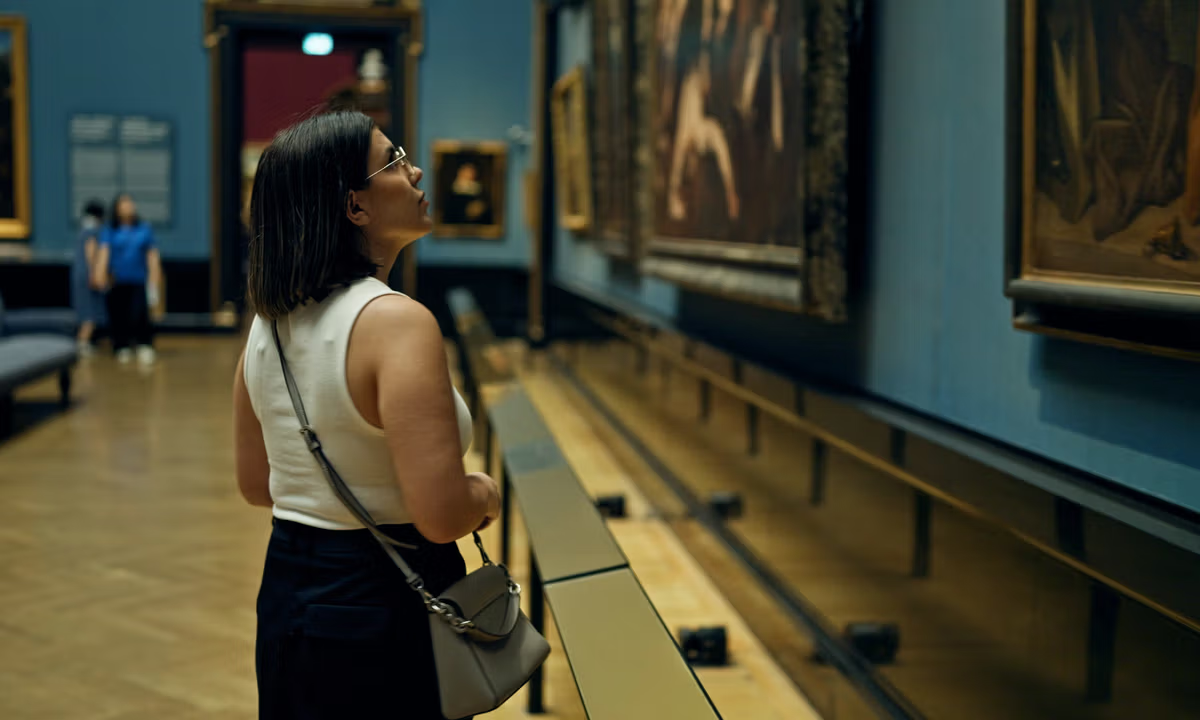
Engaging in arts and cultural activities has been linked with slowing biological aging, a new study has found. The results of the research from University College London (UCL), published in the journal Innovation in Aging on 11 May, shows that participating in arts—such as singing, dancing, painting and crafting, as well as attending art exhibitions and visiting heritage sites, museums and libraries—helps people stay biologically younger. It is the first study of its kind to demonstrate such a connection.

The study of 3,556 adults in the UK used blood samples to analyse epigenetic clocks—which measure changes in DNA as a person gets older—and ascertain people’s biological ages (rather than chronological ages). Survey responses, meanwhile, provided insight into the regularity of participation in cultural activities.

In one test, the biological ages of those who engaged in cultural activities monthly were 0.8 years lower than those who only participated once or twice a year, while those who engaged weekly had a biological age 1.02 years lower.

“Our study found that it’s not just about doing arts regularly, but also about doing a range of different arts activities,” says Daisy Fancourt, the lead author of the research and the head of the Social Biobehavioural Research Group at UCL. “Each type of arts activity—reading, making music, going to cultural performances, visiting heritage sites etc—has different effects on us cognitively, emotionally and physiologically. So engaging in a diverse range of activities—just like having lots of different plants in our diets—is most beneficial for our health.”

The research also found that the relationship between arts engagement and biological aging becomes larger and more important as we get older, Fancourt says.

The study—which suggests that participating in arts and culture is as, if not more, beneficial to biological aging as engaging in physical activities such as running, skiing and yoga—concludes that creative activities should be included in public health strategies. “This research highlights that arts engagement is a health-promoting behaviour. As such, it’s important that we don’t just treat it as a luxury in our lives but an essential,” Fancourt says. “Regular—ideally daily—creative engagement is important to promote, just like we promote 10,000 steps a day or five-a-day of fruits and vegetables.”

These results are the latest in a string of recent studies that aim to prove a connection between art and improved health, such as those undertaken by the Jameel Arts & Health Lab. The UCL’s recent research project is part of a new £3.5m seven-year programme of work funded by Wellcome, led by UCL, to understand the global and molecular impact of arts engagement as a health-promoting behaviour.

Share. Facebook Twitter Pinterest LinkedIn Tumblr Email

Keep Reading

Christie’s and Bonhams Quietly Hike Buyers’ Fees

The Lucas Museum Doesn’t Have a Narrative

Chinese Artists Officially Withdraw from Gwangju Biennale in Protest of ‘Taiwan Pavilion’

Denmark’s Largest Known Viking Age Silver Treasure Discovered in Local Garden

Amid volatile Korean economy, galleries at Frieze Seoul and Kiaf opt for cautious pricing and fresh faces – The Art Newspaper

The 10 Best Booths at Frieze Seoul 2026

Lucas Museum CEO Responds to Staff Departures: George Lucas ‘Has Always Been Chief Curator’

Leading Mexican curator Cuauhtémoc Medina tapped to organise next edition of Guatemala’s Bienal de Arte Paiz – The Art Newspaper

White House Accuses Smithsonian of Discrimination, Threatens To Cut Federal Grants

Recent Posts
  • Chianti Day 2026: Here are 10 top-scoring wines to try
  • Institutional Entitlement Offer and Placement Successfully Completed
  • A$1.1Million Placement to Fund Critical Minerals Strategyand Unlock Value from Potash
  • Aurum Adds More High-Grade Gold at Boundiali’s BST1 Deposit
  • Alice Queen Divests Non-Core NSW Asset

Subscribe to Newsletter

Get the latest markets and assets news and updates directly to your inbox.

Editors Picks

Institutional Entitlement Offer and Placement Successfully Completed

September 4, 2026

A$1.1Million Placement to Fund Critical Minerals Strategyand Unlock Value from Potash

September 4, 2026

Aurum Adds More High-Grade Gold at Boundiali’s BST1 Deposit

September 4, 2026

Alice Queen Divests Non-Core NSW Asset

September 4, 2026

Inside VCR, the Italian nursery that supplies a quarter of the world's vines

September 4, 2026
Facebook X (Twitter) Instagram
© 2026 The Asset Observer. All Rights Reserved.
  • Privacy Policy
  • Terms
  • Press Release
  • Advertise
  • Contact

Type above and press Enter to search. Press Esc to cancel.