


Betty Parsons’s importance in postwar American art history as a fearless, groundbreaking art dealer is indisputable. Within a year after she opened her eponymous gallery in 1946, Barnett Newman, Jackson Pollock, Ad Reinhardt, Mark Rothko, and Clyfford Still had all signed with her. Remarkable as this beginning was, her importance as a champion of unknown artists does not end there. Parsons gave first shows to Forrest Bess in 1949, followed by Robert Rauschenberg in 1951, Kenzo Okada in 1953, Ellsworth Kelly in 1956, Agnes Martin in 1958, and Richard Tuttle in 1965. She gave an exhibition to Sonja Sekula in 1948, and to Lee Krasner in 1951. Throughout her career as a gallerist, she advocated for women when no other dealer would, and championed queer artists and artists of color. Her ability to discern an artist’s promise long before other dealers, to stand by what she believed in, and to sustain her openness to what was fresh and innovative remains striking because she never aligned her choices with the art market.
Despite Parsons having her place cemented in art history, the full story of this remarkable and resilient woman remains underappreciated. In addition to being a dealer, she was an artist who has never gotten the credit she is due, an all-too-familiar story for women. There is a sad, predictable irony to this, because while Parsons promoted unknown artists, she never exhibited in her own gallery nor promoted herself during a career that stretched across six decades.
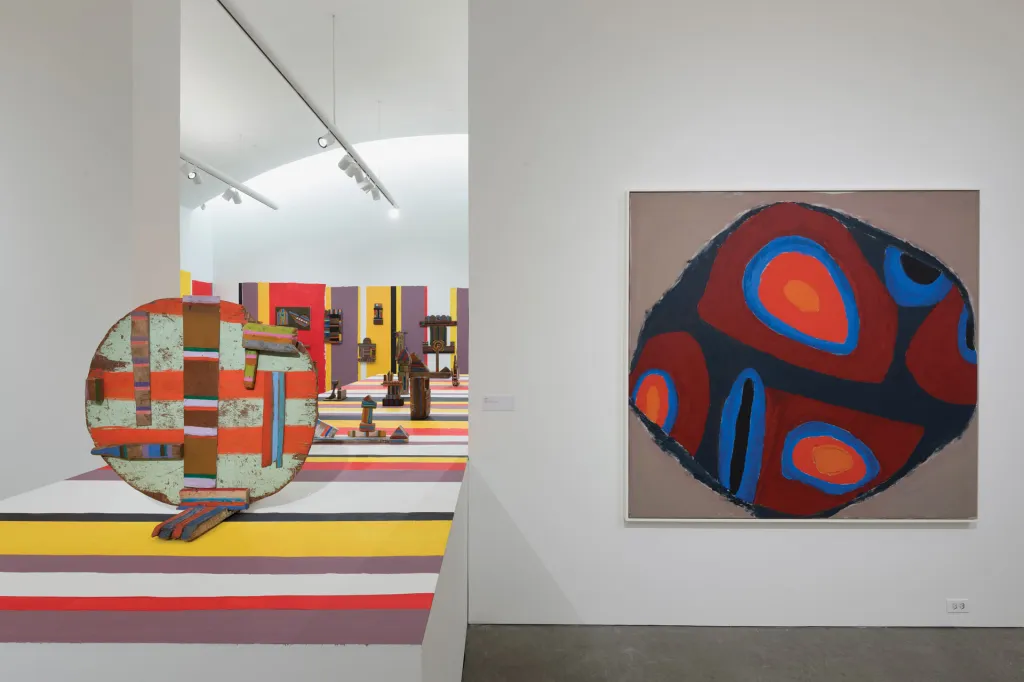
Recognizing this historical oversight, “Betty Parsons: An Expanded World”—the first major retrospective to examine Parsons’s legacy as both an artist and a gallerist, now on view at the Hessel Museum of Art at Bard College—is a step in the right direction. Curated by Kelly Taxter with artist Amy Sillman, it spans Parsons’s entire career, from nascent watercolors done in France in the early ’20s to sculptures she assembled and painted out of driftwood and signage found on walks along the beach near her Long Island home from the ’70s through the early ’80s. Featuring more than 80 paintings and sculptures, the exhibition is complemented by a newly commissioned multichannel documentary film by G. Anthony Svatek and Kaija Siirala.
View of “Betty Parsons: An Expanded World,” 2026, at the Hessel Museum of Art at Bard College.
Photo Carter Seddon
The two film excerpts on display, totaling 20 minutes, provide useful context. Parsons was born into a wealthy New York family in 1900, and spent parts of each year in Manhattan, Newport, Palm Beach, and Paris. At 13, she saw the inaugural Armory Show, which she later described as crucial in her development: “It was exciting, full of color and life. I felt like those paintings. I couldn’t explain it, but I decided then that this was the world I wanted…art.” Soon after, she began studying sculpture with Gutzon Borglum, who was responsible for Mount Rushmore.
After a short-lived marriage to a wealthy New Yorker at age 20, she moved to Paris and enrolled in the Académie de la Grande Chaumière, where she studied under the sculptors Émile-Antoine Bourdelle, formerly an assistant to Auguste Rodin, and the Cubist-influenced Ossip Zadkine. There, she became part of an expatriate lesbian community that included such notable figures as Natalie Clifford Barney, Romaine Brooks, Sylvia Beach, Gertrude Stein, and Alice B. Toklas. In 1933, when her alimony ran out, Parsons came back to the United States, settling in New York in 1935, where she had her first solo exhibition at Midtown Gallery. It was well received, and Parsons would continue exhibiting at Midtown for the next 20 years, even as she became more involved with working at galleries, exhibiting artists, and finally opening her own space.
This is where the story becomes complicated. Essentially, as Parsons’s gallery gained a reputation (though made few sales), she stopped exhibiting her own work in commercial galleries—suggesting, on a public level, that being a gallerist took precedence over everything else. This exhibition makes clear that was not the case.
Witnessing every major phase of her career, we see that the path Parsons took was always her own. Painted in the ’20s and ’30s, when she was living in France, the watercolors are accomplished, but they don’t quite prepare us for the break she made with her first abstraction in 1946. They depict landscapes and seascapes done in Brittany as well as on her travels to the Canary Islands and other places. In Canary Islands (1932), we are standing on a promontory overlooking a hilly brown and green landscape that takes up most of the composition. A tan, windowless building with a peaked brown roof sits slightly off-center on the bottom edge, inducing a light feeling of vertigo. Above it a cluster of houses is seen in the distance. The large, interlocking areas of brown and green hills foreshadow Parsons’s interest in abstraction but do not reveal how she will get there. The trace of social isolation we feel from this view is echoed in her portrait of a fisherman who takes up most of the composition but seems to have no rapport with the artist, as his eyes are directed upward, to God.
Based on seeing a rodeo, Untitled (1948) is one of Parsons’s earliest abstract paintings. Full of U-shaped symbols (horseshoes), architectonic structures, and other signs, the painting does not resemble any work being done at the time. Parsons used acrylic, a relatively new, quick-drying medium that few artists of her generation had yet taken up. The move into pure abstraction came later, after Pollock made his first poured paintings in 1947. Parsons’s undeniable strength is her use of unlikely saturated color combinations, which are applied with a light touch. She made stripes without using tape and set different-colored shapes against monochromatic grounds.

View of “Betty Parsons: An Expanded World,” 2026, at the Hessel Museum of Art at Bard College.
Photo Carter Seddon
An inveterate traveler, Parsons was inspired by trips she took and by morning light. In African Dawn (1972), the pinks, deep blues, browns, and oranges swirl in shapes stretching from near the bottom of this vertical painting up toward the top, evoking sunrise and clouds, while the vertical format suggests we are looking at a figure. In UFO (1974), she paints a large red, irregular geometric shape pinched in on both sides by blue triangles. In the middle of the red field, she has left a diagonally oriented white space that she deliberately did not fill in with brushy pale blue, suggesting that we inevitably complete the image in our mind’s eye. That shape, whose contour resembles both an indecipherable ideogram and a flat asymmetrical spaceship, shows Parsons’s inventive side. The title invites us to read the shape as a UFO, but it does not resemble any of the figures that have been popularized in mass media.
Right from the beginning, we see a sharp visual intelligence animating everything she does. And in the last decade of her life, Parsons returned to her first love, sculpture. She joined together pieces of weathered wood she picked up off the beach. Sometimes they resemble totemic talismans, lighthouses, or boats. Other works are abstract. Each piece is painted with muted-colored stripes of varying widths that honor the weathered wood. In these works, Parsons moved away from saturated color and unlikely optical combinations to timeworn things, quietly acknowledging aging and the desire to make something that endures.
