


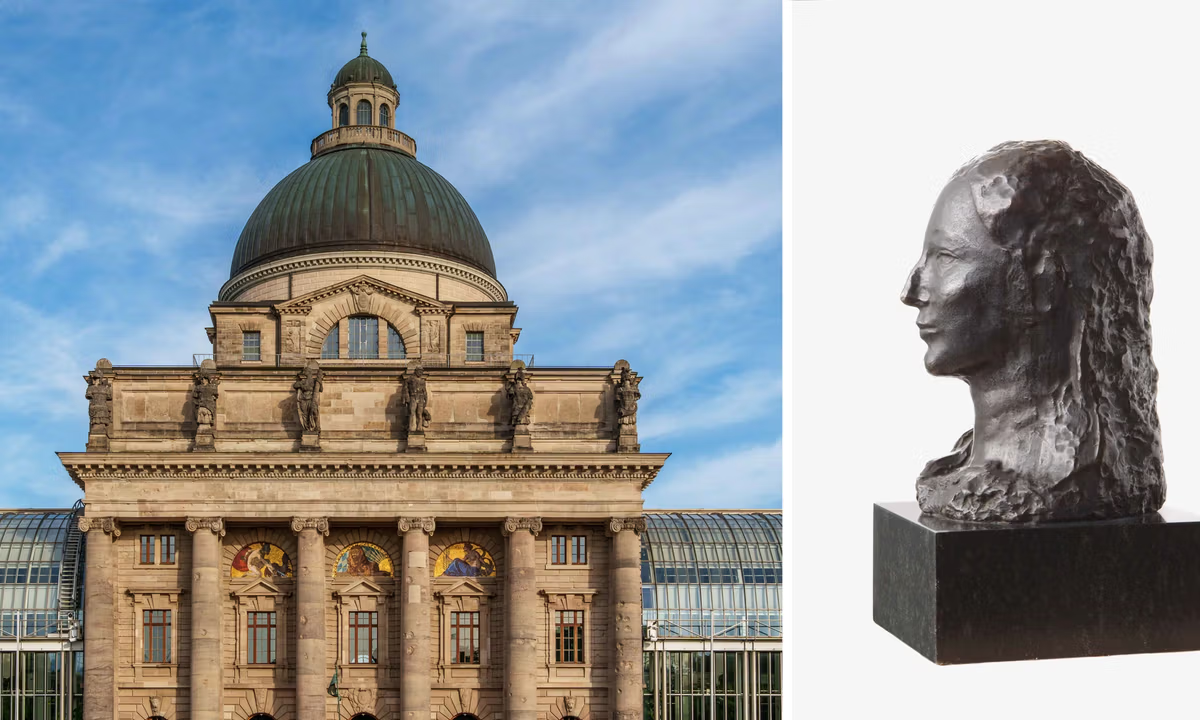
The German state of Bavaria has announced plans to transform the way it handles claims for Nazi-looted art by taking provenance research out of museums and into a separate entity and creating a new, independent panel to evaluate claims.
The changes, approved by the Bavarian cabinet yesterday, come a year after Bernhard Maaz, the director of the Bavarian State Painting Collections, resigned following media accusations that the institution was hiding stolen works and foot-dragging on restitutions.
While the museums authority vehemently rejected the report in the Süddeutsche Zeitung newspaper, the Bavarian culture minister, Markus Blume, conceded at the time that more needed to be done to overcome a “crisis of confidence” and increase “transparency, accountability and consistency”.
Blume’s announcement that Bavaria will create an independent entity to conduct provenance research on art in state collections is a radical step. Until now, as is the case in other German states, Bavarian museums have undertaken this work in house, which has prompted concern on the part of claimants’ representatives about potential conflicts of interest.
The reform, proposed by a roundtable including representatives of Jewish associations, puts Bavaria on a footing with countries such as Austria and the Netherlands, where provenance research on disputed works is carried out by independent researchers who report to government commissions rather than to the museums that possess the claimed art.
“With this change, we are treading new ground in Germany,” Blume said. “We are setting an example and this could be a blueprint for others.”
Blume said eight provenance researchers will be employed in the new entity, an increase on the current figure. It will be attached to the Institut für Zeitgeschichte in Munich, an independent academic institute.
“We need a structure that has distance from the state,” Blume said. “And we realised that at the current pace, we will never get to the end of this in a reasonable timeframe.”
A new panel—to be led by the president of the German Historical Museum, Raphael Gross—will then give recommendations on how the state should respond to claims on the basis of the provenance research, Blume said.
A ‘quantum leap”
The Institut für Zeitgeschichte said in a statement the reforms should ensure “that provenance research and restitution procedures for museums run by Bavaria are conducted independently, transparently and according to rigorous academic standards in the future.”
Andreas Wirsching, the professor who led the roundtable that proposed the reforms, described the establishment of independent provenance research and a new commission as a “quantum leap”. Rüdiger Mahlo, the representative of the Jewish Claims Conference in Europe, said the new structures “have potential to resonate far beyond Bavaria and set a nationwide benchmark in handling Nazi loot claims”.
A long-awaited return
In another sign that he is serious about improving the state’s record on Holocaust-era loot, Blume also announced yesterday the restitution of a 1905 Picasso bronze bust, Fernande/Beatrice, to the heirs of Alfred Flechtheim, a Jewish dealer persecuted by the Nazis. In 2024 the state government rejected a claim by Flechtheim’s heir for the bust, but Blume said in a statement that new national guidelines had prompted a reevaluation.
The national guidelines were devised for a new arbitration tribunal, which began work in December last year. “With the start of the arbitration tribunal, a new era has begun in the restitution of Nazi-looted art,” Blume said in a statement. “For Bavarian museums, this creates an opportunity to shed new light on complex cases and make decisions on a broad, sound basis.”
Markus Stötzel, the lawyer representing Flechtheim’s estate, welcomed the decision to return the Picasso bronze. “It is long overdue justice,” he said in a statement. “Yet this can only be the beginning. We are still waiting for the restitution of two paintings by Paul Klee and other artwork from Bavaria. Some of these claims date back to 2008.”
