


In 1980, Ana Mendieta returned to her homeland of Cuba for the first time, having fled as a child refugee in 1961. She would make another six trips between 1980 and 1983, and the works she made during these visits open Tate Modern’s new major retrospective of her work. “Esculturas Repuestras”(1981)is a series of sculptures carved into limestone caves, cliffs, and valleys in La Escaleras de Jaruco, a nature reserve in Cuba. They combine so much of what animated Mendieta’s work throughout her career: the yonic, organic shape of her abstracted body; the manipulation of earth; the influence of intersecting Caribbean mythologies and cosmologies.
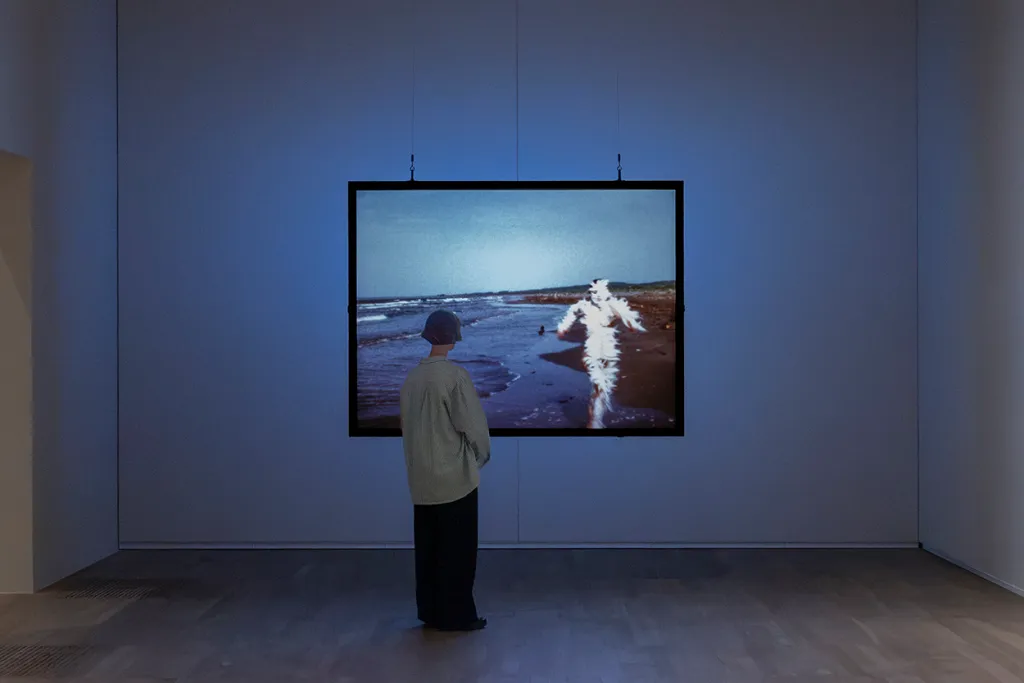
Mendieta is best known for work that interweaves sadness with violence, drawing on her experiences of exile and her feminist politics to negotiate the transient fragility of life. But these opening works feel grounded and hopeful, at home in a way that imbibes them with a sense of light. Indeed, in a corner of that first gallery is Mendieta’s final film: Ochún (1981)plays looping footage of the glittering, electric turquoise sea off the coast of Florida as it laps over and through an outline of her body Mendieta has sculpted from earth in the shallows.
Starting the exhibition both at the end of her life, and on a joyful note is a remarkable curatorial choice: This show asks viewers to meet her first as an exile who enjoyed a meaningful homecoming that pushed her work to new depths. For many British viewers, this will be their first encounter with Mendieta, an artist who has had a higher profile in the United States, and who has always been a feminist icon—one who has never been well known across the Atlantic.
But Mendieta’s story did not have a happy ending, and this is never mentioned. Her horrifying death has become the default entry point to her life and work, defining her in a way she could never have intended. Countering this trend, very little detail about her life is described anywhere in this exhibition: Viewers are told that she was expelled from Cuba as a young person, for instance, but not why. While one could read this as evasive, it is also an opportunity to take Mendieta’s work on its own terms.Women artists have long had their work swallowed up by their lives: Activism, affairs, family drama, whether she was too beautiful or not beautiful enough, and of course, all the patriarchal violence she did or did not survive. Biography can eat a woman whole. This exhibition is a proposition: What does Mendieta’s work become if we allow it to stand alone?
View of the 2026 Ana Mendieta retrospective at Tate Modern, London.
©Tate, Photo Yili Liu
Time itself is Mendieta’s great subject. Her “Silhuetas” (ca. 1973–80) are her most famous works: ghostly, tender, and woundlike, they comprise fundamentally ephemeral imprints of her body on the earth. Photographs capture her outline in the mud of a creek bank; in the snow blown against a tree trunk; in an arrangement of branches and flowers leaned against a tree; and in the sand on a beach, already being erased by the waves. Mendieta made installations of these silhouette works, too, one of which is reconstructed in the exhibition under the careful guidance of her niece, Raquel Cecilia Mendieta.
Eventually, she incorporated fire, filming her silhouette in flames. For Silhueta de Cohetes (Firework Piece) from 1976, she built a kind of Mendieta-shaped crucifixion studded with fireworks, then filmed its burning, evoking the violence of the Passion of Christ as well as the horrors of lynchings in the American South. In another film, she covers herself with blood before rolling in a pile of feathers, rising up, phoenix-like, as a bird-woman.
Hidden, almost, in the center of the exhibition are a few of Mendieta’s early paintings from the late 1960s and early 1970s, which have a jarring feeling of wrongness about them. The artist felt it to: “I wanted my images to have power, to be magic,” Mendieta said once, and she quickly realized that she couldn’t achieve her goal in paint. She moved on to explore other media, in which her pursuit of magic or spirits became palpable.
Ecstasy and fury characterize many of her films, and some of her quieter works feel especially tender in contrast. In my favorite, Untitled (Soul), made around 1973, she records young students in Iowa talking about what they think the soul is. Their tinny, disembodied voices shout out ideas like “I think it’s all over you” and “I think it’s pink with purple polka dots!” What big questions they are thinking about, and Mendieta is thinking with them. This expansive exhibition creates space for Mendieta to be multi-faceted: a teacher as well as a student, a painter and a believer.
This sort of both-ness was important to Mendieta: In 1984, she said in an interview, “I don’t think that you can separate death and life,” and often, her works are about the impossibility of one without the other—about the fleeting nature of the time we have to make sense of what it even means to be alive, to make art. Her works are full of ghosts. Perhaps her death has haunted her legacy so tenaciously not just because of its sordid details, but because her art is so imbued with a swirl of both impermanence and vitality. But for Mendieta, death is not an ending. Time never stops, and life and death dance on in the breaking waves and rustling leaves that were her tools to make it all mean something.
