


The past two months have brought an embarrassment of riches to New York’s contemporary art scene, from the major art fairs, auctions and gallery shows of May to two of the industry’s premier surveys of rising artists in the weeks before: the Greater New York quinquennial and the Whitney Biennial. But amid the flurry of activity, don’t lose track of Cooper Jacoby, one of the biennial’s standouts. His sculptures tease out the ever-multiplying ways in which AI behemoths and other corporations turn our data into financial assets. The works have proven to be unforgettable two months after they went on show.
Estate of play
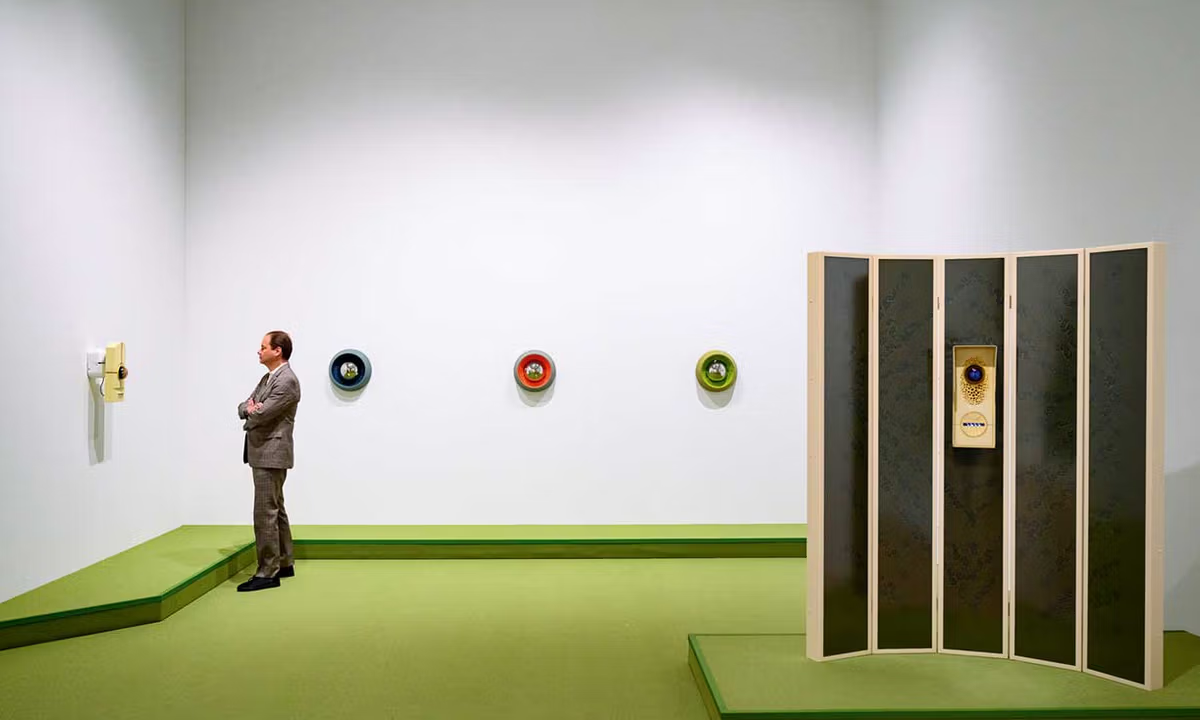
At the biennial, Jacoby presents five works in a green-carpeted environment—a layout he thinks of as “almost like a rat trap, where you’re pulled in with sound and then it grabs you,” he tells The Art Newspaper.
Practically greeting visitors in this space is the 2026 work Estate (July 10, 2022), a folding screen sporting an eerily styled intercom that addresses viewers with a wide range of comments and thoughts. Jacoby has enabled this by training and adapting AI models that together allow every machine to generate vocal outputs from a tranche of written inputs.
For each Estate work (another, sans folding screen, is wall-mounted nearby), the textual foundation is years’ worth of social media content by an anonymous creative who died on the titular date. Jacoby’s algorithms speak editorialised versions of the deceased’s posts in a voice replicating one of his own friends or family members—many of whom are creatives, he says. The intercom’s camera constantly scans the exhibition space for people and certain objects, for example food and drinks, then cues the model to surface related content from its subject’s digital archive. Meanwhile, a small screen counts up the years, days, minutes and hours from the date of death.
The first question people tend to ask about the Estate series is who exactly each of these creatives were. Rather than biographical or demographic reasons, Jacoby selects them solely based on “whoever has a large dataset” (meaning a big corpus of social posts). Why? Largely because this is how our digital lives are treated by OpenAI and its competitors: purely as what the artist calls “fertiliser” to grow their models, which can only improve by gobbling up more and more data. It’s a way in to an increasingly opaque technology. The more powerfully these information pipelines shape reality, the less comprehensible their inner workings and implications become to the population. AI, we are often told, is a black box even to its developers—but Jacoby’s series offers an antidote.
Another of the series’ themes extends beyond AI to the internet at large. “I’m trying to highlight how there’s so little regulation and norms about living online and dying online,” Jacoby says. “The rituals and rights around it are not very developed.”
The folding screen, for example, centres on a woman who earned a Masters degree in creative writing but then became a full-time parent and chronicled it all online. “What does it mean that this person had a child [who] might be able to discover their dead mother’s MFA posts?” Jacoby asks. The thorniness is amplified, he adds, by who he asked to vocalise the work. “In a weird Freudian twist, that’s my mom’s voice. So I can’t be around that one for too long.”
Mutual horror
The back wall of Jacoby’s space bears three sculptures resembling basketball-sized eyes with stainless steel pupils and bloodshot retinas of monochrome wax. Cycling around each steel dome are two teeth functioning as clock hands.
Like the Estate works, every entry in this series, Mutual Life, corresponds to a single anonymous person in the artist’s personal network. The clock’s spin rate, however, moves faster or slower than standard time based on their so-called biological age, a measure of how a person’s cells are deteriorating relative to the average lifespan of demographically similar people.
Jacoby learned about this when his health insurer offered to lower his payments if he took a biological age test. Every extra dataset refines their estimated costs for covering different types of people. Jacoby accepted, then turned the process into art.
“There’s something monstrous about approximating when someone will die and there’s something mildly eugenic about knowing where you stand relative to the norm,” he says.
AI companies, social-media giants, for-profit insurers—these and more have built colossal businesses from the quantified, digitised scraps of our lives. Jacoby’s “rat trap” at the Whitney stands in for the larger laboratory we are all scurrying around now.
- Whitney Biennial, Whitney Museum of American Art, New York, until 23 August
