


“I’m writing a novella about Eva Hesse, I say when people ask,” writes Kate Zambreno in their new book Foam, out from Semiotext(e) on September 15. But Hesse, the late sculptor who believed “art and life are inseparable,” keeps slipping away, getting subsumed or pushed out of Zambreno’s reach. Just one quick page break later, they “forgot where they were” in the writing: “I went into a period of constant work”—likely teaching, one-off commissions, the labor of family—“and thinking for others…. I completely exited myself.” The next time they articulate what their writing is about, they say it “came out of apartment life.” But Foam—a “speculative new fiction” according to its publisher, or “like spooky fictions and art essays together,” according to an interview with its author—finds its forms and subjects as it unfolds.
This morphing is not new for Zambreno. Since their 2009 debut, they have been searching for form, or exploring the extent to which a book (and a body of work) can remain unformed, across multiple projects, including the novel Drifts (2020) and the memoir The Light Room (2023). Both are narrated by an autobiographical voice that, while not exactly the same, is similar to the voice of Foam. But this voice keeps evolving.
In Foam, Zambreno has further figured out how to express love for art amidst the often-stifling pressures of daily life as a perpetual adjunct, parent, and renter with no financial safety net. They neither flatten the complicated, messy experience of living in precarity nor diminish the promise and possibility that keeps them writing. Such balance—between struggle and hope—is hard to strike effectively (and honestly), in large part because the intersecting worlds of art, literature, and academia contain an extreme kind of class striation that coexists with so many shades of privilege and power. Though Zambreno’s narrator is too inside these conditions, too implicated, to offer outside analysis, they make the textures of these striations and imbalances felt.
Reviews of Zambreno’s writing since 2012—when their third book, Heroines (2012), provoked love-hate reactions—are a wild ride, wilder than you’d expect for a writer who is so searching and process-oriented (and primarily platformed by small presses). Foam is Zambreno’s 13th book (if you count the 2013 chapbook), a quantity often commented upon in and out of their writing. “Pinprick feelings of resentment” come between Foam’s narrator and a student-turned-friend because “I have published so many books.” The “scenes of creative blockage” in Zambreno’s books “can feel disingenuous,” observed a New Yorker profile, “for Zambreno is conspicuously prolific.” Zambreno’s refusal to claim a genre is a point of contention, too; the author fails “to discern between a memoir and a novel narrated by a fictional character,” according to a 2012 Bookforum review. They express “self-doubt, inaction, excuses” in a way that makes “the stakes” seem “far higher for the writer” than “for the reader,” complained a different Bookforum critic in 2020.
Even celebratory critics find faults that seem derived from expectations of formal conventions. In The New York Times, Catherine Lacey, an experimenter herself, faulted Drifts, in which the narrator tries to write a book called Drifts and then has a baby, for one thing: “The structure of the narrative suggests that childbirth is the answer to every question she’s been asking, a necessary redemption from her existential woes.” I reread the novel’s final section twice, trying to see what Lacey saw. Perhaps Lacey simply saw a culminating event at the end of a book that should have no culmination, and equated maternal affection with resolution. I saw a writer who, while besotted enough with the baby, was just trying to get through the pain and back to her desk.
Foam opens in the hospital, where the narrator has just given birth to a second child, along with a placenta that looks like a “collapsed apartment building.” Writing about this second postpartum experience keeps bringing the narrator back to the first, and to the apartment the family will have to leave (after lead poisoning, a rent strike, legal action). The narrator does not take any maternity leave after either child, and after the first, they instead—in a desperate financial calculation that barely adds up—hire a “mother’s helper,” their former student who can ideally assist with childcare, domestic labor, and writing work.

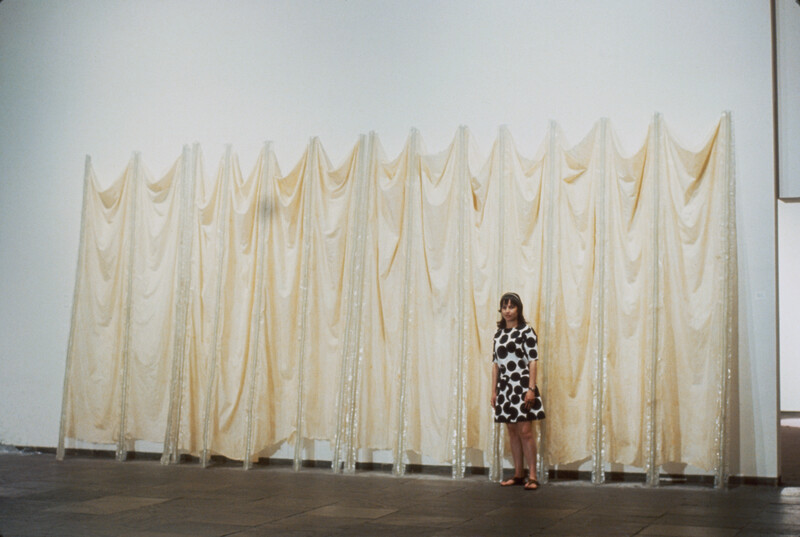
Eva Hesse, Expanded Expansion, 1969.
Photo: Midge Wattles & Ariel Ione Williams/©Solomon R. Guggenheim Foundation, New York. All Rights Reserved; Art: ©The Estate of Eva Hesse/Courtesy Hauser & Wirth
It’s the latter task that attracts this young person, an aspiring writer named Eva. Eva and the narrator strain against their dynamic. Eva is given endless flexibility because she is paid so little, yet still more than the narrator and their husband can afford. The narrator has power, as the employer, as the teacher, and as the published writer, but Eva has (the narrator guesses) parents who support her, pay for her apartment, give her the freedom to insist she needs time off to write. When the first Eva cuts back her hours, the narrator hires a second Eva. The Evas begin proliferating across the book well before Eva Hesse (introduced to the narrator by the first Eva-employee) enters. The Evas could feel like a gimmick and yet they don’t, because no forced connection is made between these women. After Hesse is introduced as a potential subject, additional Evas keep coming (a brilliant student, dead by suicide, who was ambivalent about the narrator’s writing, “the melancholy of [their] characters, their whiteness and heterosexuality”; a disruptive student whose behavior puts the narrator at odds with an unsupportive university administration; a dismissive cardiologist). Together they feel like evidence of the narrator’s stretched-thin existence, their inability to do much more than enumerate, and the way their privilege coexists with powerlessness.
Foam, likewise, begins to make appearances before it is named as a throughline. There are foam shoes and fake flowers in a foam block at the hospital; expanding, yellowing spray foam filling the holes in the wall that the landlord will not properly repair. Then foam becomes a potential alternative to form, a name for “these desires toward softness” that the narrator feels, “like Eva Hesse’s desire for form and non-form” (here the narrator extrapolates from the artist’s 1970 interview with Cindy Nemser). Foam conjures the fragile sturdiness that characterizes both Hesse’s sculpture and Zambreno’s own vacillation between precarity and privilege.Foam is, in Zambreno’s words, “nervous systems and hostilities”; it is texture, it is—as philosopher Peter Sloterdijk writes in the book’s epigraph—“almost nothing, yet not nothing.” Foam is a model, perhaps, for how to write outside a predetermined shape, and how to squeeze creative work through the gaps left between contract labor (i.e., adjuncting) and domestic duties, yet make it wondrously expansive all the same.
