


This is not a book about art. It is about useful art, which is quite another thing. John Byrne knows this, because he is the professor of useful art at John Moores University, Liverpool, and has been closely involved as useful art has developed in the 21st century. It is international, with examples ranging from the architectural collective Assemble, which won the Turner Prize in 2015, to the Congolese Plantation Workers Art League and the people’s parliament in Rojava, Kurdistan. Byrne writes with calm clarity, but Useful Art: How Activist Artists Can Change the World carries echoes of other texts committed to an extant, but not quite successful, avant-garde.
The reason why useful art will change the world is that art, as we have come to know it since the 18th century, is the subject of “neoliberal occupation”, government regulation and commercial sponsorship. It has become useless, but not because the aesthetic exists in a Kantian separate world, but because, like everything else, including ourselves, it has become part of the neoliberal circulation of commodities, instrumentalised by the creative industries. Artists have become slaves in the gig economy, museums have been captured and we have all been aestheticised and commodified into the postmodern. The answer to this is “collaborative microresistance”.
If art has become useless, existing only in its aesthetic sphere, then it must be made useful. Since 2010 a series of summer schools and other projects have progressed this idea internationally. The Cuban artist Tanya Bruguera has stimulated the idea of useful art. In 2013 the Van Abbesmuseum in Eindhoven mounted The Museum of Arte Útil, seen as a “social powerplant” from which emerged an archive and The Association of Arte Útil. Work began on the idea of The Constituent Museum, a museum 3.0. Offices of Useful Art were established in Istanbul, Eindhoven, Manchester, Liverpool and Japan. A four-year research programme worked on a reconception of museums to change their values from spectatorship to usership.
John Ruskin’s influence
In 2018 the Van Abbesmuseum and the Whitworth in Manchester followed this as “constituent museums”. The former director of the Whitworth and Manchester Art Gallery, Alistair Hudson, is an important figure, having come from Grizedale Arts in the Lake District, which had been pursuing a useful art course since 2011. In 2019 he mounted A Joy for Ever, which reached back to the arguments of the influential Victorian art theorist and critic, John Ruskin. Hudson is now the scientific-artistic chairman of ZKM Karlsruhe, and co-directs the Association de Arte Útil with Bruguera. Grizedale, under director Adam Sutherland, continues its exploration of useful art.
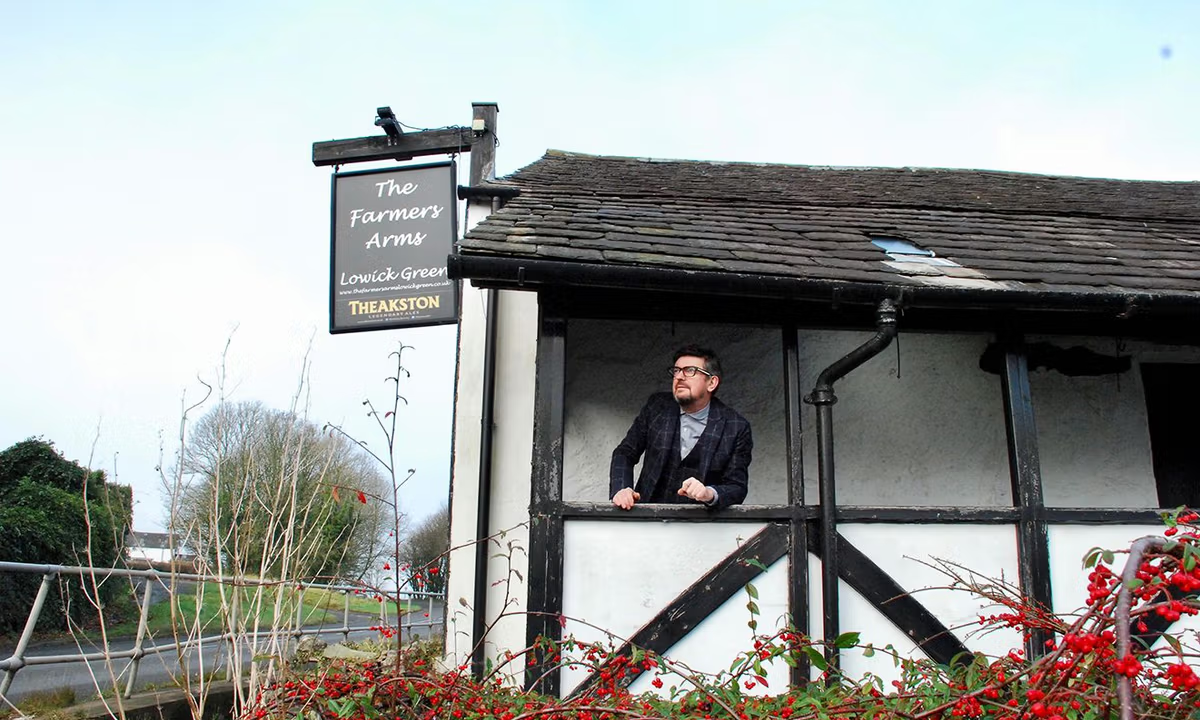
Which brings us to the simple question: what does useful art look like? Most of the illustrations in this book are of people sitting round tables talking to each other. But it must be understood that useful art operates on a scale of 1:1. That is to say, it is the same size as the issue it represents. It is an art that is no longer symbolic of some larger matter. Its manifestations are no longer paintings but projects. Grizedale Arts has bought a local pub, The Farmer’s Arms. It is the same size as what it represents, The Farmer’s Arms. But it is also a social centre, a place for discussion and experimental, socially useful projects.
“Joyous clusterfuck”
An extreme of useful art, because of the cultural position it occupied, and the controversy it caused, was Kassel’s documenta 15 in 2022, which was curated by an Indonesian collective, ruangrupa. This followed the practice of creating the equivalent of a community’s co-shared rice barn, a lumbung. Described in this book as a “joyous clusterfuck”, readers of The Art Newspaper will recall the confusion caused and accusations of antisemitism against a separate contributor. Supporters saw it as a turning-point. Others thought it all nonsense.
John Byrne writes well enough to convince us that useful art is not nonsense and produces evidence of its serious intentions. It is a critical introduction to something that exists as a counter-narrative to the ruling ideas of a neoliberal-captured system, one that separates what we think of as art and what we think of as life. But challenging as the subject is and socially critical as it is, it is still not art.
• Useful Art: How Activist Artists Can Change the World, by John Byrne. Published 20 January, Manchester University Press, 265pp, 22 b/w illustrations, £13.99/$20.95 (pb)
