


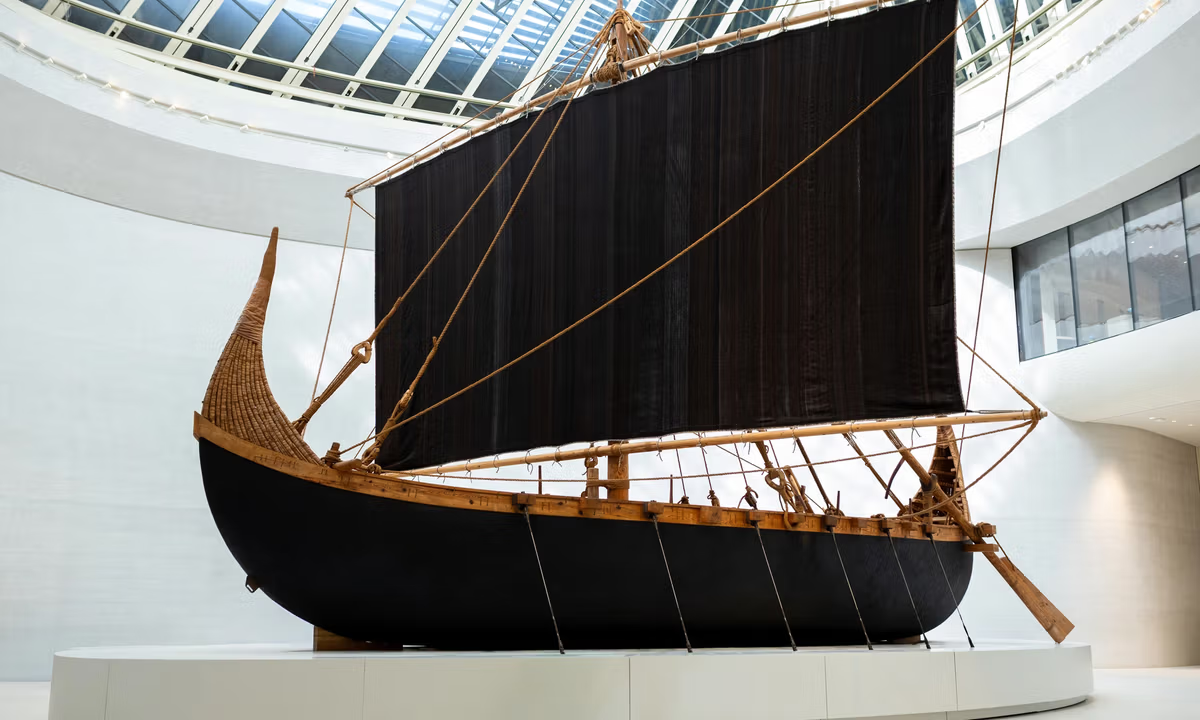
As visitors move through the atrium of the new Zayed National Museum in Abu Dhabi they are confronted by an imposing, 18-metre-long black ship. The Magan Boat, as it is known—after the ancient name for the region—is the kind of vessel that would have been used for trade between the United Arab Emirates, Mesopotamia (modern-day Iraq) and South Asia more than 4,000 years ago. But rather than being centuries old, this boat was completed in 2024—it is a recreation made possible by years of research led by Zayed National Museum, in partnership with Zayed University and New York University Abu Dhabi, into Bronze Age maritime history in the UAE.
The largest reconstruction of its kind ever attempted, the Magan Boat was designed by a team of more than 20 specialists, including archaeologists, anthropologists, shipwrights, engineers and scientists. Together they experimented with ancient technologies, traditional building techniques and local raw materials, as described on an ancient clay tablet, to keep the vessel as historically accurate as possible.
Not content with simply recreating the boat, the research team then took it out to sea—co-skippered by the champion Emirati Captain Marwan Abdullah Al-Marzouqi—and brought history to life. Over two days of sea trials, the Magan Boat covered a distance of 50 nautical miles (92.6km) in the Arabian Gulf, reaching speeds of up to 5.6 knots.
Dr Peter Magee, Director of Zayed National Museum; Moaza Matar, Curatorial & Collection Management Department Director Images: Courtesy Zayed National Museum
“What distinguishes the Magan Boat project is not only its experimental methodology, but its ability to bridge past and present,” Dr Peter Magee, the Director of Zayed National Museum, tells The Art Newspaper. “By physically reconstructing and sailing such a vessel, the project offers new insights into early seafaring technology, trade networks and the UAE’s long-standing role as a point of connection between cultures. [The project] engages contemporary audiences, both locally and internationally, by making this research tangible, visible and deeply human. In doing so, it reflects the museum’s broader commitment to research that is both rigorous and accessible.”
State-of-the-art facilities
The Magan Boat project is a seminal example of the kind of innovative, deep research that Zayed National Museum is undertaking. Further examples can be found inside the museum’s six carefully curated permanent galleries that trace the history of the UAE and its founding father, the late Sheikh Zayed bin Sultan Al Nahyan. The immersive galleries combine archaeological artefacts and historic objects with cutting-edge audiovisual and sensory displays.
For example, the “By Our Coasts” gallery, which explores the UAE’s historic ties to the sea, features an interactive scent wall that enables visitors to explore the aromas of the spices that have historically been traded via maritime trade routes. While the Magan Boat, displayed in Al Liwan, is accompanied by an interactive display that allows visitors to explore the research process, the materials used and the broader historical context.
Another recreation made possible through the museum’s research facilities is a recent discovery of a tomb of a woman dating back around 8,000 years on Marawah Island, just off the coast of Abu Dhabi. Alongside her skeleton, archaeologists found black feathers, shark-tooth pendants and finely crafted stone weapons with handles of human bone. Known as the Marawah Woman, research has shown that she lived well beyond the average lifespan of the time and may have been a warrior or chief.
“Forensic artists and archaeologists carefully analysed her skeletal remains to determine age, health and physical features, enabling a reconstruction that conveys not only her appearance but also the cultural practices and values of her community,” explains Moaza Matar, the museum’s Curatorial & Collection Management Department Director. The reconstruction of her burial can be found in the “To Our Ancestors” gallery.
Zayed National Museum also has integrated cutting-edge facilities for research and conservation. These include dedicated conservation laboratories for paper and textiles, and for three-dimensional objects, as well as a digitalisation studio for detailed recording and studying of artefacts. The museum has a multispectral imaging system, which allows staff to examine objects beyond what is visible to the naked eye.
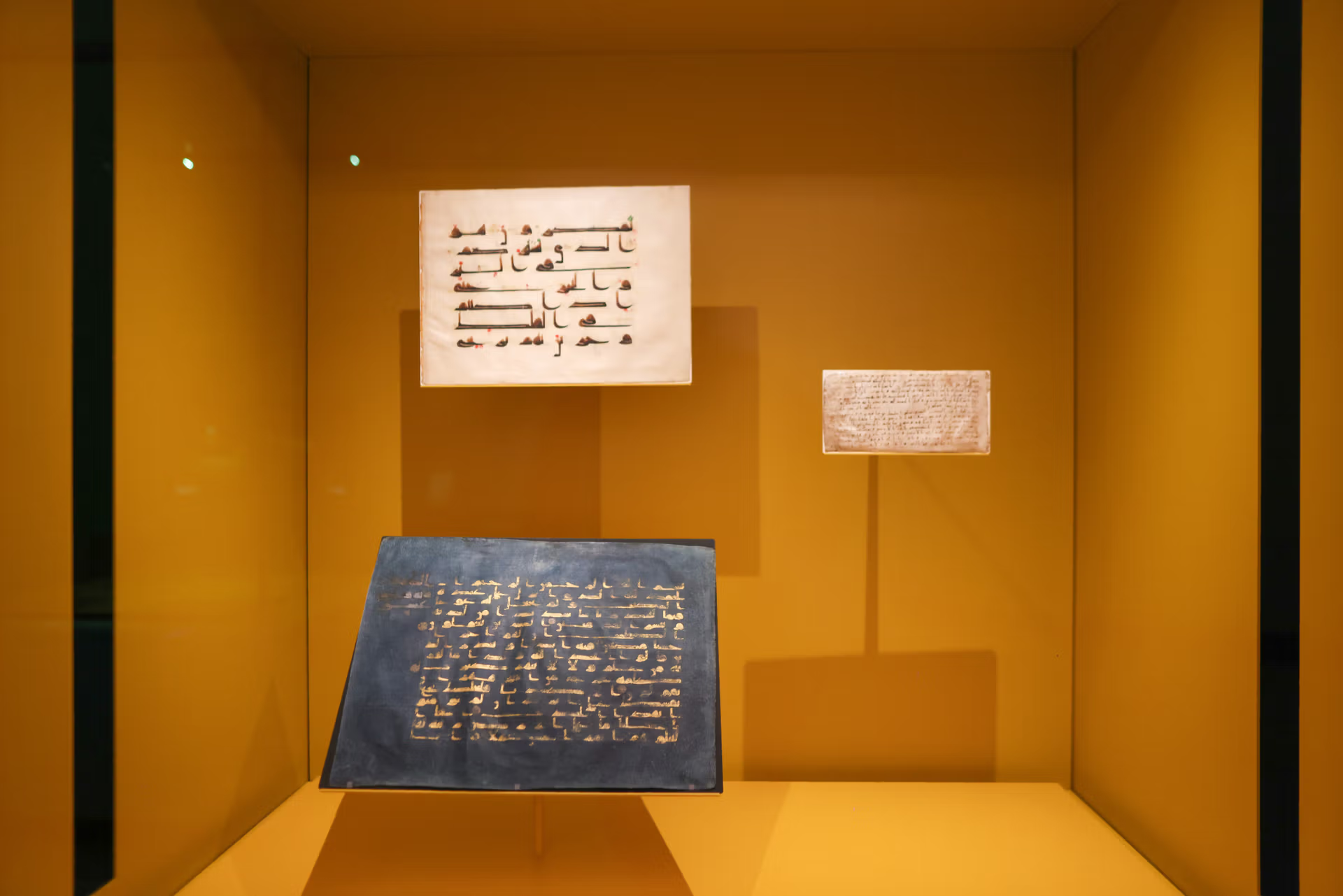
Folios from the Blue Qur’an were studied using multispectral imaging Image: Courtesy Zayed National Museum
“Research on the museum’s objects is central to our work, allowing us to uncover new insights and bring the UAE’s history to life,” explains Matar. “For example, folios from the Blue Qur’an were studied using multispectral imaging, and one page revealed previously unseen verses beneath layers of gilding. This has provided a deeper understanding of the materials, techniques and artistry involved in early Islamic manuscript production.” The Blue Qur’an, dating from 800-900AD, is one of the most important examples of Islamic calligraphy and the museum’s five folios are a highlight of its collection.
“While the presence of advanced equipment is important, what we are particularly proud of is how these facilities are integrated into a broader research framework,” Magee says. “They are not standalone resources but form part of an approach that brings together scientific analysis, curatorial expertise and, where appropriate, experimental methodologies.”
Research Fund
A central tenet of the research programme at the museum is Zayed National Museum Research Fund. Launched in 2023, it awards AED 1 million (around £200,000) each year to a wide range of projects across disciplines and countries, including China, Egypt, India, Italy, Poland, the UAE, the UK and the US. The fund “not only deepens understanding of the UAE’s archaeology, environment and cultural heritage, but also builds international networks of knowledge and expertise”, Magee says. As well as being published in peer-reviewed journals or as globally distributed books, these research projects have practical outputs for the museum: they inform the narrative and exhibition spaces as well as helping to craft future temporary exhibitions.
In its first round, ten recipients were selected, with standout projects including Mohamed Almarri’s reconstruction of the UAE’s population history through ancient DNA analysis; Lesley Gregoricka’s study of Early Bronze Age mobility and cultural shifts in the Al Ain Oasis; and Sumaya Al-Weheibi’s research into the untold stories of women in the Arabian Peninsula during the Silk Road trade. “Each project combined rigorous scholarship with an innovative approach, offering new insights into the UAE’s history and heritage,” Magee says.
The second round of the fund awarded eight grants that included Ms. Fatema Al Shehhi and Ms. Hessa Al Shehhi’s study of pottery shards from Ras Al Khaimah archaeological sites; Akshyeta Suryanarayan’s organic residue analysis of ancient vessels in southeast Arabia; and Marwan AlFalasi’s illustrated encyclopedia of native trees in the UAE. The recipients of last year’s research fund are due to be announced and a new call for submissions will follow, Dr Peter Magee says.
Looking ahead, Magee says that the museum aims to deepen international research collaborations, extend and enrich its oral history collection, and continue developing projects that bridge traditional scholarship with innovative methodologies. “These initiatives ensure that the museum remains a dynamic and living institution, capable of responding to new technologies and perspectives,” he adds. “Through these efforts, Zayed National Museum plays a pivotal role in preserving the UAE’s rich history and culture for future generations, while inspiring and mentoring the next cohort of historians, archaeologists, heritage specialists and thinkers.”
• zayednationalmuseum.ae
