

Close Menu
  • News
  • Stocks
  • Bonds
  • Commodities
  • Collectables
    • Art
    • Classic Cars
    • Whiskey
    • Wine
  • Trading
  • Alternative Investment
  • Markets
  • More
    • Economy
    • Money
    • Business
    • Personal Finance
    • Investing
    • Financial Planning
    • ETFs
    • Equities
    • Funds

Subscribe to Updates

Get the latest markets and assets news and updates directly to your inbox.

Trending Now

A 222-year-old U.K. firm to fall into American hands as Nuveen to buy Schroders for $14 billion

February 12, 2026

Tartisan Nickel: Working Towards a Feasibility Study and Production Decision at the Kenbridge Nickel Deposit

February 12, 2026

Partner Insight: Unlocking emerging markets – the advantage of flexibility

February 12, 2026
Facebook X (Twitter) Instagram
The Asset ObserverThe Asset Observer
Newsletter
LIVE MARKET DATA
  • News
  • Stocks
  • Bonds
  • Commodities
  • Collectables
    • Art
    • Classic Cars
    • Whiskey
    • Wine
  • Trading
  • Alternative Investment
  • Markets
  • More
    • Economy
    • Money
    • Business
    • Personal Finance
    • Investing
    • Financial Planning
    • ETFs
    • Equities
    • Funds
The Asset ObserverThe Asset Observer
Home»Art Market
Art Market

Can a new cipher help to explain the mysterious Voynich Manuscript? – The Art Newspaper

News RoomBy News RoomJanuary 8, 2026
Share
Facebook Twitter LinkedIn Pinterest Email

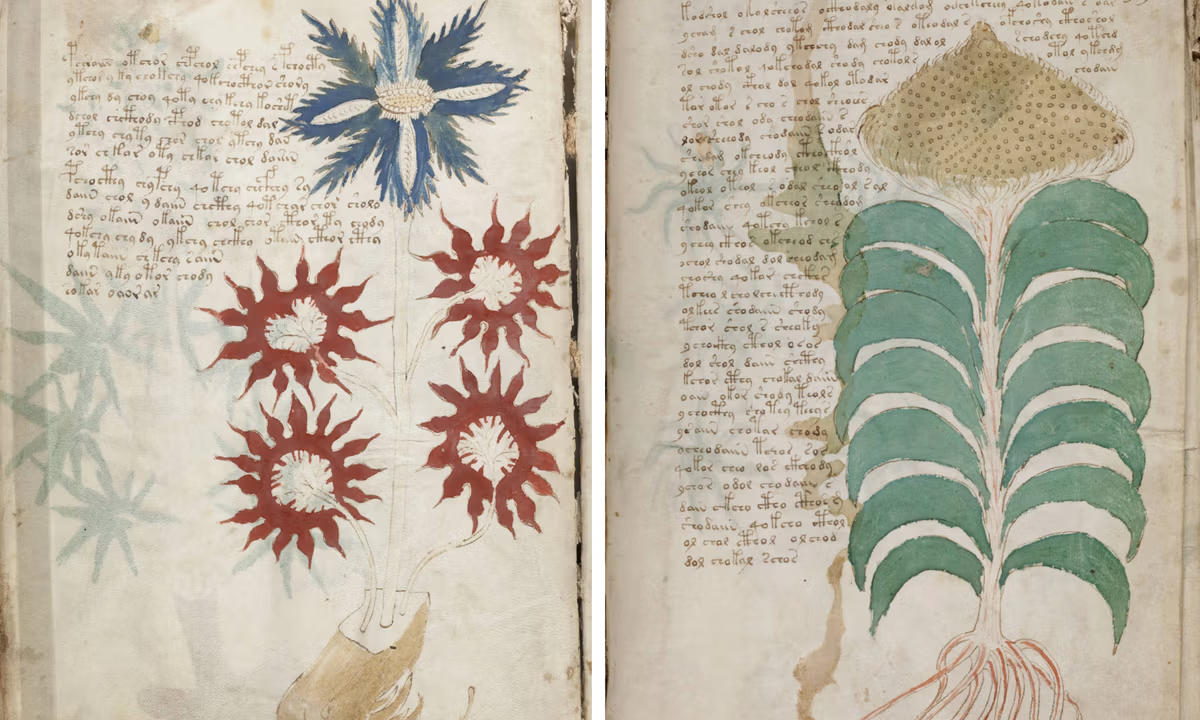
A researcher has developed a cipher that might provide insights into how medieval scribes produced the Voynich Manuscript’s unreadable writing.

Created in the early 15th century, and often called the world’s most mysterious manuscript, the Voynich Manuscript bears unusual illustrations and illegible writing in a unique script. When statistically analysed, “Voynichese”—as the script is known—reflects some characteristics of a typical language, but in other ways, behaves strangely. This has led experts to argue that its text could be an unknown or artificial language, gibberish, or a cipher.

Now, the science journalist Michael A. Greshko has developed an encoding method that replicates some of the unusual features of “Voynichese”. He has called this the Naibbe cipher, after a card game known in Italy in 1377.

“This encoding method leads to a decipherable secret message consisting of ‘words’ whose internal structures, lengths, and frequencies replicate what is observed within portions of the Voynich Manuscript,” says Greshko, the author of a research paper published in the journal Cryptologia.

“The Naibbe cipher is my attempt to find a way to encode something like Latin by hand as text that partially mimics the Voynich Manuscript’s strange properties. The cipher works by randomly breaking a text into chunks that are one or two letters long.

“The cipher then disguises these chunks as Voynichese words, by encoding individual letters as groups of Voynichese glyphs through the use of six different substitution tables. To reliably ensure that these tables are chosen in certain average proportions, the Naibbe cipher uses a draw from a deck of playing cards to determine which table encodes a given letter.”

When Greshko experimented with his new encipherment method—for example, encoding the start of Julius Caesar’s De bello Gallico—he found that the resulting ciphertexts reproduced some of the Voynich Manuscript’s unusual features.

Nonetheless, he emphasises that the Naibbe cipher cannot be exactly how the Voynich Manuscript was made. It doesn’t replicate all of the manuscript’s important properties, and doesn’t conclusively prove that the Voynich text must contain meaning.

The Naibbe cipher does, however, provide a way to encode Latin and Italian in a Voynich-like way, and it may help experts to narrow down how medieval scribes might have created the Voynich Manuscript’s text.

“Linguistically speaking, the Voynich Manuscript is as far from most natural languages as London is from Sydney,” Greshko says. “Extending this analogy, the Naibbe cipher is like mapping one of the Silk Road’s many possible land routes: a demonstration that at least some of that vast linguistic distance could be navigable.”

Share. Facebook Twitter Pinterest LinkedIn Tumblr Email

Keep Reading

Iconic Baseball Painting by Norman Rockwell Acquired by the Art Institute of Chicago

Centre Pompidou’s New Jersey Museum Is Officially ‘Dead,’ Says Jersey City Mayor

Queens Museum Promotes Debra Wimpfheimer to Executive Director

World Monuments Fund Commits $7 M. to Protect Global Heritage Sites in 2026

David Zwirner announces representation of American painter Louis Fratino.

Artforum’s Tina Rivers Ryan Steps Down—Rachel Wetzler and Daniel Wenger  to Lead Magazine as Co-Editors

Ornate 1,400-year-old Zapotec tomb discovered in Mexico – The Art Newspaper

No, The Gardner Museum’s Stolen Rembrandt Is Not in the Epstein Files, Despite Claims in a Viral Video

David Bowie Will Be the Subject of the Next Immersive Exhibition Experience, Opening in London in April

Recent Posts
  • A 222-year-old U.K. firm to fall into American hands as Nuveen to buy Schroders for $14 billion
  • Tartisan Nickel: Working Towards a Feasibility Study and Production Decision at the Kenbridge Nickel Deposit
  • Partner Insight: Unlocking emerging markets – the advantage of flexibility
  • TomaGold: Advancing a District-scale Gold and Base Metal Portfolio in Québec’s Chibougamau Mining Camp
  • 55 North Mining: The Economic Upside of US$5,000 Gold and High-grade Project Next to Alamos Gold

Subscribe to Newsletter

Get the latest markets and assets news and updates directly to your inbox.

Editors Picks

Tartisan Nickel: Working Towards a Feasibility Study and Production Decision at the Kenbridge Nickel Deposit

February 12, 2026

Partner Insight: Unlocking emerging markets – the advantage of flexibility

February 12, 2026

TomaGold: Advancing a District-scale Gold and Base Metal Portfolio in Québec’s Chibougamau Mining Camp

February 12, 2026

55 North Mining: The Economic Upside of US$5,000 Gold and High-grade Project Next to Alamos Gold

February 12, 2026

Iconic Baseball Painting by Norman Rockwell Acquired by the Art Institute of Chicago

February 12, 2026
Facebook X (Twitter) Instagram
© 2026 The Asset Observer. All Rights Reserved.
  • Privacy Policy
  • Terms
  • Press Release
  • Advertise
  • Contact

Type above and press Enter to search. Press Esc to cancel.