



London’s gallery sector is in the middle of a reset. A slower market, rising operating costs and changing patterns in collecting behaviour have created challenges for dealers of all sizes, while a handful of high-profile closures have underscored the pressures facing the trade.
Yet, as London Gallery Weekend (LGW) returns this month (5–7 June), a different picture is emerging. Galleries continue to open and expand across the capital—around two dozen in the past few years—while dealers are experimenting with new business models. Rather than retreating, many are doubling down on what London still offers: a deep pool of artists, a global audience and a gallery scene whose breadth and diversity remains difficult to replicate elsewhere.
If there is a common thread among London’s newest gallery openings, it is a growing emphasis on what happens inside the gallery walls. For much of the past two decades, art fairs became an increasingly important route to market. Today, however, many dealers are questioning whether the costs and risks still stack up.
Speaking at a panel on 4 June to mark the launch of LGW, Emma Hodgson, who co-founded Pale Horse Gallery in Marylebone last year with Thomas Graham, says the gallery is prioritising its exhibition programme. The gallery specialises in outside or self-taught artists and during LGW is showing works by the Dutch artist Marijn van Kreij (until 18 July). “We both come from backgrounds where doing ten art fairs a year was the norm,” Hodgson says. “We’re keenly aware of the positives that they can bring, but as a young gallery everything you do, especially art fairs, is a gamble.”
The calculation reflects wider financial pressures. London remains one of the most expensive cities in which to operate a gallery, with rising overheads, business rates and post-Brexit shipping costs all eating into profit margins.
A renewed focus on exhibitions is echoed by Jeremy Epstein, the co-founder of Edel Assanti, which opened a second London space in St James’s earlier this year. As he puts it: “Over the past five years we have confirmed that the gallery’s lifeblood, both culturally and from a business perspective, is exhibition making.” Together with Sarah Rustin, Epstein is also a co-founder of LGW.
Edel Assanti’s new Bury Street space is deliberately different from its Fitzrovia headquarters. More intimate and flexible, it allows artists to stage focused presentations without the lengthy planning cycles that larger exhibitions often require. It is currently showing three paintings there by Lonnie Holley (until 7 June).
When Epstein and his business partner, Charlie Fellowes, first looked at expanding they looked beyond the UK, exploring opportunities in France and the US. Ultimately, they decided to double down on London. “Fundamentally, we have a strong conviction in London’s untapped potential,” Epstein says. “After 17 years, we still feel as though we’ve barely scratched the surface here.”
Lonnie Holley, Coming Through the Doors, is on show at Edel Assanti, St James’s © Lonnie Holley. Courtesy the artist and Edel Assanti. Photo by Tom Carter
Other galleries are adapting in different ways. Elizabeth Xi Bauer, which began life as a pop-up in 2015, recently opened a second space in Exmouth Market while transforming its original Deptford premises into studios and a residency programme. The move reflects a broader trend towards offering artists infrastructure as well as exhibition opportunities. “When we first opened in Deptford, we felt it was the right art scene for us there—the artists, the studios, the galleries, the buzz around it,” says the gallery’s artistic director Edward Sheldrick. Exmouth Market, meanwhile, brings a different advantage: visibility.
“There’s a lot of footfall; we get just under 1,000 people per show.” Performances organised by the curator Brian Griffiths are taking place throughout LGW.
For some dealers, London’s appeal remains fundamentally international. Last month, the veteran dealer Sundaram Tagore opened a flagship London gallery with a group show about hybridity after more than two decades in business. The move represents a significant investment at a time when question marks hang over the city’s competitiveness.
Tagore is unfazed. “I don’t worry about trends or economic downturns or upturns,” he says. “Our world is very small. If you connect with five people, you can do really well.” More than 400 people attended the launch of his London space, including collectors who travelled from Singapore, Hong Kong and the US. “London has become truly global, more than any other city in the world,” Tagore adds.
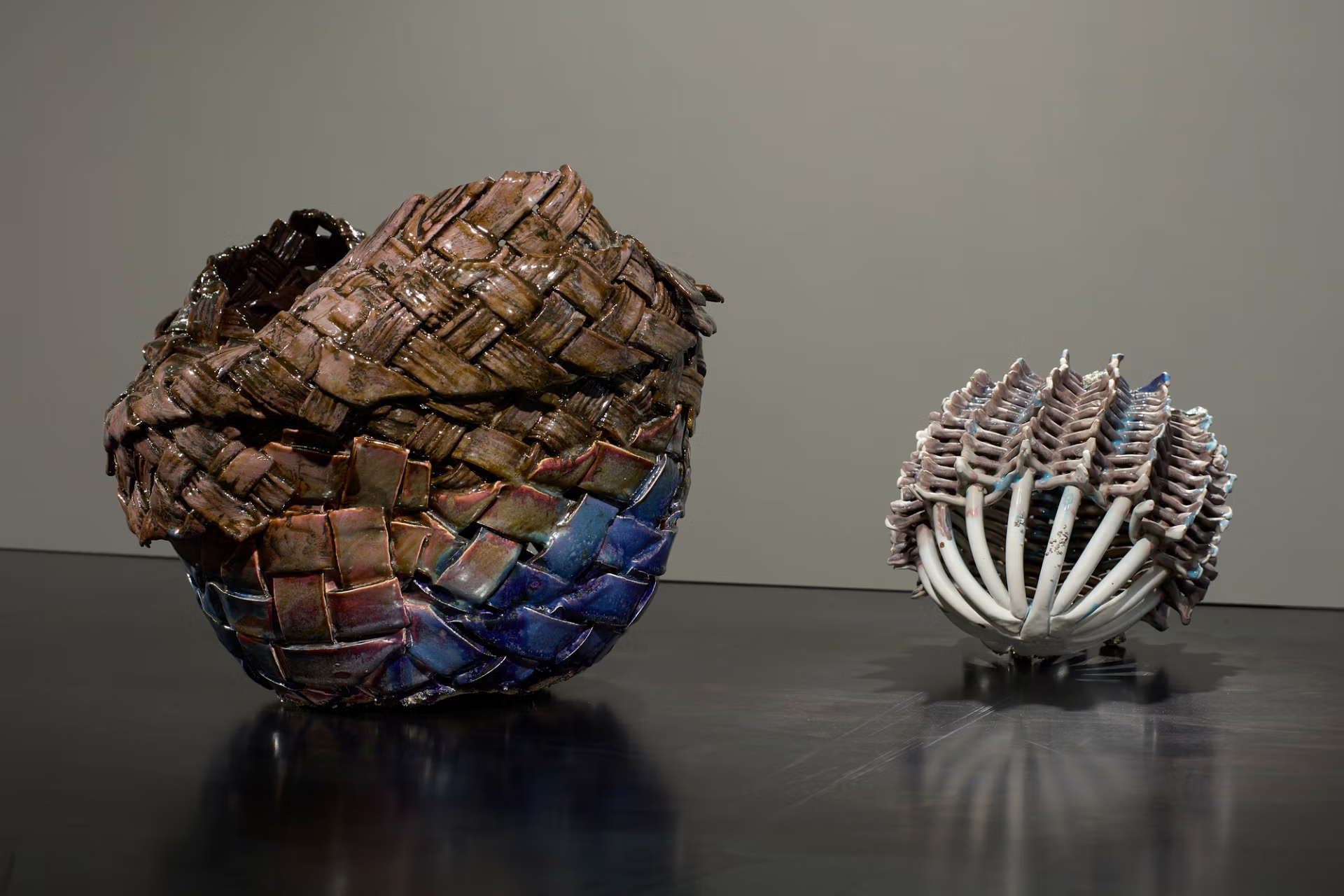
Anina Major’s show Tender Seedlings is on show at Larkin Durey during London Gallery Weekend Image: courtesy of Larkin Durey, © the artist
While commercial sales remain under pressure, galleries also speak increasingly about the importance of institutions. Oly Durey, who relaunched his business as Larkin Durey last year, says museum acquisitions have become an important source of momentum in a quieter market.
“We’ve had amazing support from museums who’ve been collecting our artists’ work,” he says, citing acquisitions by institutions including Tate, Louvre Abu Dhabi and the Detroit Institute of Arts, which purchased a piece last year by Bahamian artist Anina Major, who Durey is showing during LGW (until 3 July).
Durey believes the renewed appetite for in-person experiences is one reason London Gallery Weekend has gained such traction. “It’s a super-sustainable version of an art fair,” he says. “The collectors are coming to us, and we’re not shipping things across the Atlantic.”
That emphasis on locality sits at the heart of London Gallery Weekend. According to co-founder Sarah Rustin, one of the initiative’s central ambitions is to showcase the diversity of London’s gallery ecosystem: not only different generations of galleries, but also different neighbourhoods, business models and approaches to working with artists. “A core aim of LGW is to draw deserved closer attention to the evolving make-up of the very diverse gallery sector across the city,” she says.
The UK capital’s gallery sector is undoubtedly under pressure, but this year’s London Gallery Weekend highlights the breadth and variety that continue to define—and sustain—it.
• The Art Newspaper is a media partner of London Gallery Weekend
