


On South Aulatsivik Island in Canada’s Nain archipelago, the usually chilly temperatures have begun to warm over past decades. Permafrost—an icy layer that helps to keep archaeology frozen in time—is thawing, placing the island’s heritage at unprecedented risk. Among them is South Aulatsivik 6, a site where the remains of Inuit houses and objects from daily life have long been protected by the freezing conditions.
Now, according to research published in the journal Archaeometry, Rachel Labrie of Université Laval, Canada, and colleagues have used ground-penetrating technology not just to map the site’s archaeology, but to evaluate which spots are most at risk from permafrost thaw. This novel approach will help Arctic archaeologists to monitor the changing condition of endangered sites and prioritise their excavations accordingly. With the same problem facing the entire Arctic and sub-Arctic zones, such innovative and speedy methods of data collection are now, sadly, a necessity.
Across the planet, climate change is forcing archaeologists to make hard decisions; with limited time and resources, they must choose what to save. This, with the knowledge that every site lost is an irreplaceable piece of humanity’s shared story. The library of human history is burning and we’re scrambling to gather as many books as possible before it all goes up in flames; methods of preventative conservation, like that employed at South Aulatsivik 6, show us where the fire will spread first.
So, there is still hope. Armed with non-invasive geophysical and remote sensing methods, experts can peer beneath the ground or see from far above to locate archaeological sites, create a digital record of their existence and, significantly, assess and monitor their condition. In other cases, 3D scanning or photogrammetry can freeze a monument in time, creating a “digital twin” for posterity in case disaster strikes. With these detailed records, experts can quickly spot any changes in a site’s condition and hopefully manage them.
Take Nepal’s Dolpo region in the Himalayas, for example, where thousand-year-old Buddhist temples are endangered by landslides and earthquakes. Add in a lack of funds for maintenance and damage from increasing rainfall, and these little-known cultural treasures face myriad risks. Now, though, according to research published in the journal Heritage, Carmen Auer of Graz University of Technology, Austria, and colleagues are using 3D technology to produce digital models of these remote Buddhist sites, with records of their inscriptions, sculptures, paintings and plans. These can help to guide renovations, but they also digitally preserve this sacred landscape.
Out-of-this-world technology
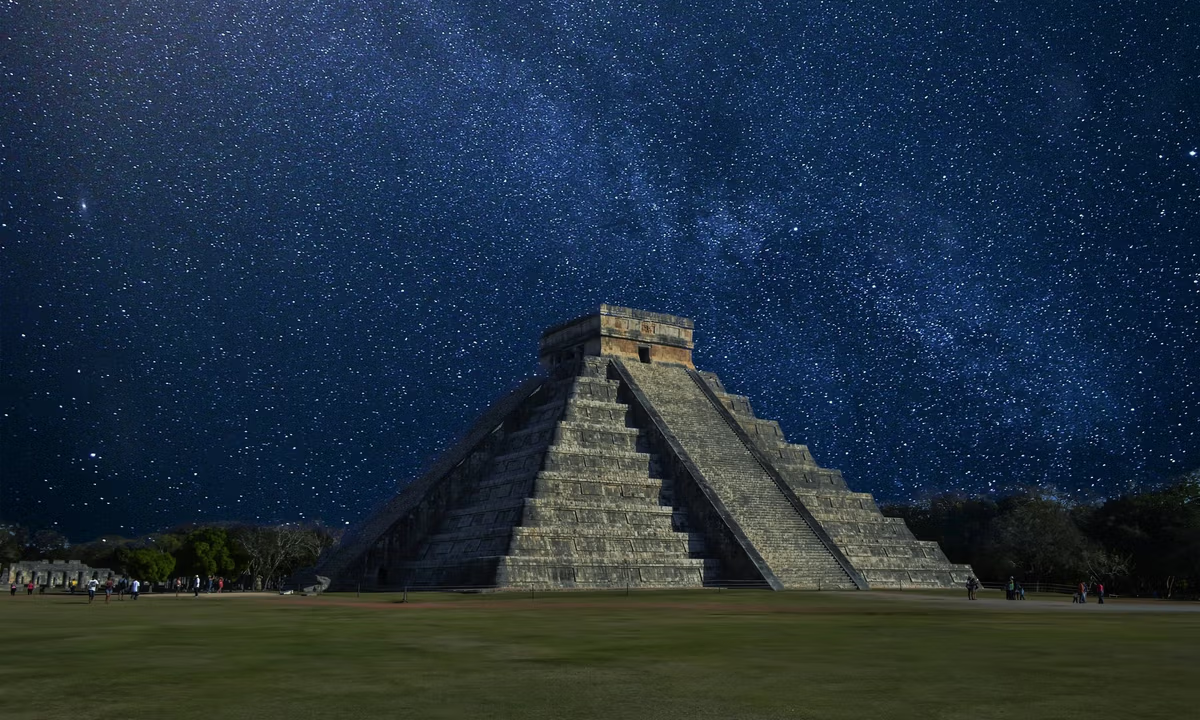
Archaeologists have also been experimenting with more out-of-this-world technology. Muon particles, created by cosmic rays, constantly fall to earth, passing through materials as they go. A receptor, placed close to a monument, can collect these particles to create an “x-ray” of the building’s interior. Researchers led by Edmundo García Solís of Chicago State University plan to install two muon receptors inside the pyramid of El Castillo at Chichén Itzá, Mexico, hoping to reveal the pre-Hispanic structure’s secrets. It’s exciting stuff—but on a practical level, these scans will also record the current state of the structure. If there are any anomalies in the pyramid’s density, or the ground below is unstable, conservators will be able to react.
Nonetheless, these technologies remain far from perfect. During the war in Syria, experts used satellite images to monitor looting and site destruction, but a new study, published in the journal Archaeological Prospection by Amal Al Kassem of the University of Cologne, Germany, and colleagues, has evaluated the accuracy of this data. The team visited 28 sites in Daraa previously monitored by satellite, and found that only 24% of the actual damage was visible on the satellite images. Only site visits, on the ground, revealed the true extent of the destruction.
Clearly, to best protect world heritage, a combination of approaches is necessary, but this all takes time and money, both of which are extremely limited. This is why it’s imperative to boost the momentum that cultural heritage has built over the past few years in global climate change policy. With the challenges facing the world in 2026, from climate change to armed conflicts, political uncertainty and natural disasters, archaeology might seem less relevant than other concerns. But remember: once it’s lost, it cannot be replaced. How much of humanity’s library can we preserve, before it irrevocably burns?
