


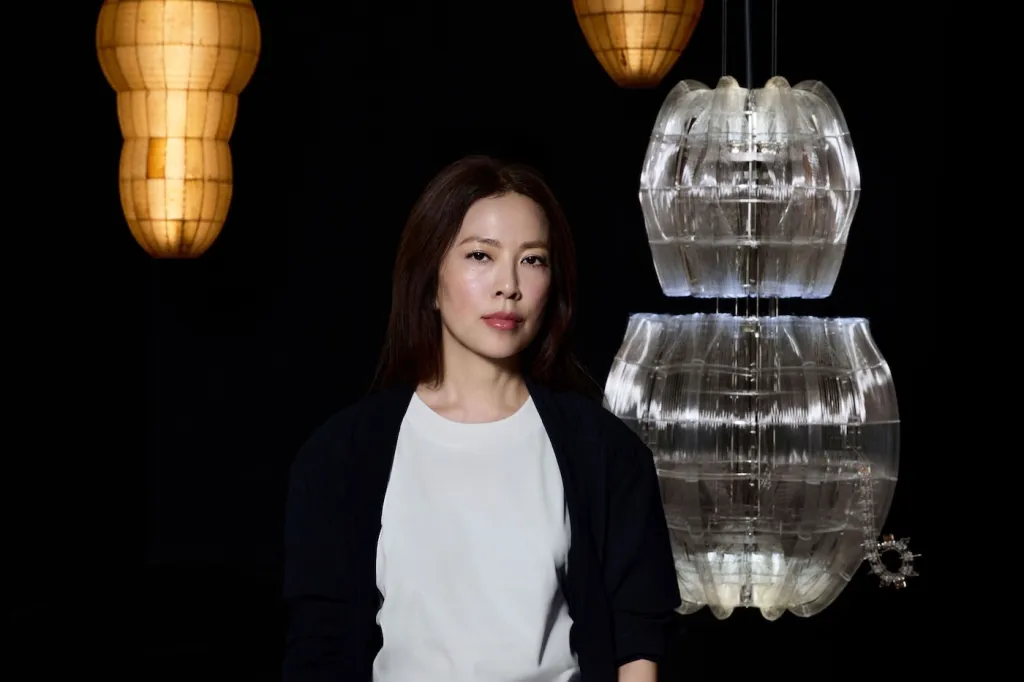
New York–based conceptual artist Anicka Yi has joined the roster of Pace, which will represent the artist in partnership with Gladstone Gallery, 47 Canal, and Esther Schipper.
Born in 1971 in Seoul, Yi entered the art world in 2008 after years working in the fashion industry. Her research-based and often conceptual practice combines organic and human-made materials and machines to create imaginative installations that engage the senses—especially the sense of smell.
Many of Yi’s best-known works have involved creating scents, like Shigenobu Twilight, in which she created a perfume “portrait” of Fusako Shigenobu, the cofounder of the militant group the Japanese Red Army, which operated between 1971 and 2001. In another work, the 2015 project Grabbing at Newer Vegetables, Yi asked 100 of her female friends to swab a body part of their choosing. She then worked with a bioengineer to create what she called “a giant petri dish” of superbacteria paint with the phrase “YOU CAN CALL ME” spelled out. The work’s powerful, unpleasant smell was framed as a feminist recasting of the often male-dominated white cube space.
In 2021, Yi was selected for the prestigious Turbine Hall commission at Tate Modern in London. The sculptures, which she called “aerobes,” resembled aliens and emitted scents. Yi’s aerobes will return to the public eye later this month when they appear in the New Museum’s upcoming exhibition to inaugurate its expanded building, “New Humans: Memories of the Future.” While that show is a group exhibition, it fits well with Yi’s overall practice, which is deeply engaged with scientific techniques, emerging technologies, and the often blurry line between humans and the rest of reality.
ARTnews sat down with Yi to discuss her move to Pace, the explosion of AI, and why she thinks the biggest AI developers are approaching “intelligence” from the wrong perspective.
The interview has been edited lightly for clarity and concision.
ARTnews: What made this the right moment to join Pace? Was it a specific need in your practice, or a shift in how you wanted to work?
Anicka Yi: There’s a lot of symmetry in our genealogy. Pace is known to be the science gallery. There’s that history and legacy from Bob Irwin to James Turrell. That was definitely a contributing factor. But I also think a lot of it is that Marc [Glimcher] is one of the few—if not the only—gallerists who really understands technology: emergent, advanced, complex technology like AI. His collaborations with Superblue and with teamLab, and having this intrepid, risk-taking mentality with this kind of work. I knew that was why I needed to join the gallery.
I felt that, with what I do, I’m not a traditional artist. I work with materials like bacteria and algae and I work with algorithmic-based art. A lot of people don’t know what to do with it, and I felt that Marc just gets it. It’s so refreshing, because a lot of times I’m having to explain what I do and contextualize it, having to overcompensate verbally because a lot of people are not familiar with evolutionary biology or microbiology. Marc studied biology at Harvard. His brother is a famous neuroscientist, and he comes from a family with a deep STEM background. We just got on really well.
Do you find that that scientific fluency is unique in the art world?
There’s a lot of rhetoric around concepts and new ideas, especially in the curatorial sense. But when it comes to the gallery world, they don’t know how to sell it, let’s be honest. They don’t know how to optimize. I’ve been looking for people who resonate with the work and who I don’t have to over-explain things to. And then it’s like, can they translate that to others? I feel like I’ve always had to do a lot of the heavy lifting.
Installation image of Anicka Yi’s In Love With The World, Hyundai Commission 2021, Turbine Hall, Tate Modern.
Anicka Yi / Photography by Will Burrard-Lucas / Courtesy Tate Modern
Your practice has always encompassed so many different mediums, but your first work with Pace will be a new painting at Art Basel Hong Kong later this month. What influenced that decision?
The paintings were actually developed during the pandemic, and the first group was exhibited at Gladstone in 2022. These are all AI-generated, algorithmic-based paintings that are a collaboration between the human and AI. That was a technique I’ve been developing since 2020, and it just seemed like a really good fit for our first showing together. Pace has a love for painting and also a love for technology, and this strikes a really good balance between the two. Hong Kong is also a good place for it.
AI is obviously all anyone is talking about now, but has it always been an important part of your practice?
AI is becoming increasingly pervasive in my practice—not just in subject matter, not just in technique, but in every aspect. And I don’t say that lightly, because it’s not that I chase technology or that I’m interested in automation for automation’s sake. But I am interested in developing a hybrid studio between AI agents and human agents.
I’m working with these very new emergent tools, and they’re also the focal point for a lot of artworks I’m developing. Currently we’re working on a very ambitious project with a new paradigm for AI that involves causal reasoning brains, which is completely counter to the corollary model of machine learning that we have today [i.e. large language models like OpenAI’s ChatGPT or Anthropic’s Claude]. It’s extremely exciting, super ambitious, and important because it’s so deeply embedded in our existence today.
I think there’s a new paradigm on the horizon, and this is something we’re absolutely working with. Art is a really important space to unpack these questions around technology and AI, rather than having a passive relationship to it or feeling that you have no agency unless you’re an engineer or a developer. It’s important for artists not only to insist on being part of the conversation but even to develop new tools.

Installation view of “Anicka Yi: There Exists Another Evolution, But In This One,” Leeum Museum of Art 2024.
Photograph by Andrea Rossetti, courtesy Leeum Museum of Art. Artwork © 2026 Anicka Yi/Artists Rights Society (ARS), New York
I’ve spoken to a fair number of artists whose practices concern AI. They tend to fall somewhere along a spectrum. On one end are artists interrogating these technologies to reveal their underlying structures and socio-political implications. On the other are those collaborating with AI to push the frontier of what it can do. Where do you see yourself in relation to those poles?
Honestly, what I’m learning now about what’s possible—I reject the entire model of reinforcement-learning AI that is popular right now. We don’t need it. We need to be thinking spatially. We need to think about the physics of AI and the fact that we’re existing right now on a one- or two-dimensional plane with AI. It’s been functional for what it is, but it’s not sustainable, primarily because of the energy demands of the current model.
But on an intellectual level it also doesn’t reflect biological life at all. It can’t think causally the way we do, or reason the way we do. It has a very limited scope in how it can think. So can we really call it intelligence?
There was a recent New Yorker feature about Anthropic suggesting that both neuroscientists and frontier AI researchers are struggling to define intelligence, and how it works. How do you understand it?
I’m much more inclined to think that intelligence is a product of social interaction. It’s not an autonomous phenomenon. It only happens through interacting with your environment and with other forms of intelligence. That’s how you develop intelligence.
So this notion of the large language model drawing from all this data in isolation—to me that doesn’t signify real intelligence. It’s more like a knowledge calculator or a probability machine than actual intelligence. I think that word tends to get abused in these spaces.
I remember when we just called it machine learning, which wasn’t that long ago. If I’m understanding you correctly, you see intelligence as relational—something that exists between two people or two things.
Absolutely. It’s interdependence. Nothing can exist outside of itself. You can’t be the cause of your own creation. Intelligence functions that way. The universe itself functions through interdependence.
I can see the thread between that and some of your earlier, more sensory works. But how does this understanding manifest in your practice now? Where is it pushing you?
It’s about using different tools and training new models—whether we call them models, digital brains, or digital neurons. I’m working with this company, Inait, in Switzerland, started by the neuroscientist Henry Markram. He developed the Blue Brain Project over 20 years, trying to digitally map the mammalian brain.
What’s interesting is that these systems require far less data and are not necessarily reflections of us. Current machine-learning models draw on human data, or a distortion of our data. These digital brains require far less data because of their causal reasoning abilities. They might begin accessing perceptual worlds that we cannot—maybe the perceptual world of a pink dolphin or a rubber tree plant in the Brazilian Amazon.
That’s what’s exciting to me. I’m interested in AI that is not just a distortion of the human, but rather something that can be more transcendent.
An AI that thinks the way a machine thinks, rather than trying to mimic the way we think?
Or an alien intelligence. We never define an alien as machine or non-machine, right? That’s interesting to me. Otherwise it becomes a regurgitation of ourselves—a solipsistic intelligence that’s really an illusion of intelligence.
Yes, these algorithms can do things we cannot. They can master quantum physics. They can master every language known to humanity. But they don’t actually understand the data. All they can do is arrange it. There’s no capacity for reasoning or philosophizing.
Anicka Yi, Biologizing The Machine (spillover zoonotica), 2022.
Commissioned and produced by Pirelli HangarBicocca, Milan. Artwork © 2026 Anicka Yi/Artists Rights Society (ARS), New York
A lot of your work seems fragile, or even ephemeral at times. How does that translate into a gallery setting where you’re making work for collectors? As opposed to a commission, like your upcoming installation at Storm King Sculpture Center in May?
I’m not a gallerist. I don’t sell art. But I think it really comes down to narrative. So much of art is about language—the narrative, the backstory, the lore. There’s certainly a history in conceptual art where there’s not much to see, and a lot of that relies on narrative.
Similarly, I think people are interested in the practice—what it means and where to contextualize it—rather than simply wanting a desire object independent of its means of production or context or what it is trying to say. In that sense, my practice is very sticky. It’s hard to isolate independent parts. It’s really about the metamorphosis of an entire practice. I would argue that many of my works have their lineage within a meta-thesis around ideas I’m exploring in evolutionary biology and systems of the universe, trying to get at a truer nature of reality.
And perhaps blurring the line between object and environment?
And also participation. Often the visitor is not passive. You’re inoculated by scent molecules, so you become a participant in the work. The work becomes activated through the visitor.
That blends nicely with your idea of intelligence as relational—that an artwork becomes an artwork when it’s received by a viewer.
Exactly. Or through multiple agents, whether it’s AI or even the insect in the room.
Pace is representing you in partnership with Gladstone, 47 Canal, and Esther Schipper. What does that arrangement look like for you?
I feel really grateful that I have strong relationships with all of these galleries and that everyone is very proactive when it comes to collaboration. This is not a time in the art world to have a fortress mentality, where everyone has their mini-fiefdoms and empires. We’re not in a position to have that attitude anymore.
We have to coexist and collaborate, and that’s what Pace is really about. Entering into this relationship with these other galleries—vis-à-vis me—is a really positive statement for the art world. You can collaborate with others, and it doesn’t matter if you’re a slightly larger gallery or a smaller one. It’s an ecosystem, and an ecosystem should function symbiotically to support each other and the artist.
