


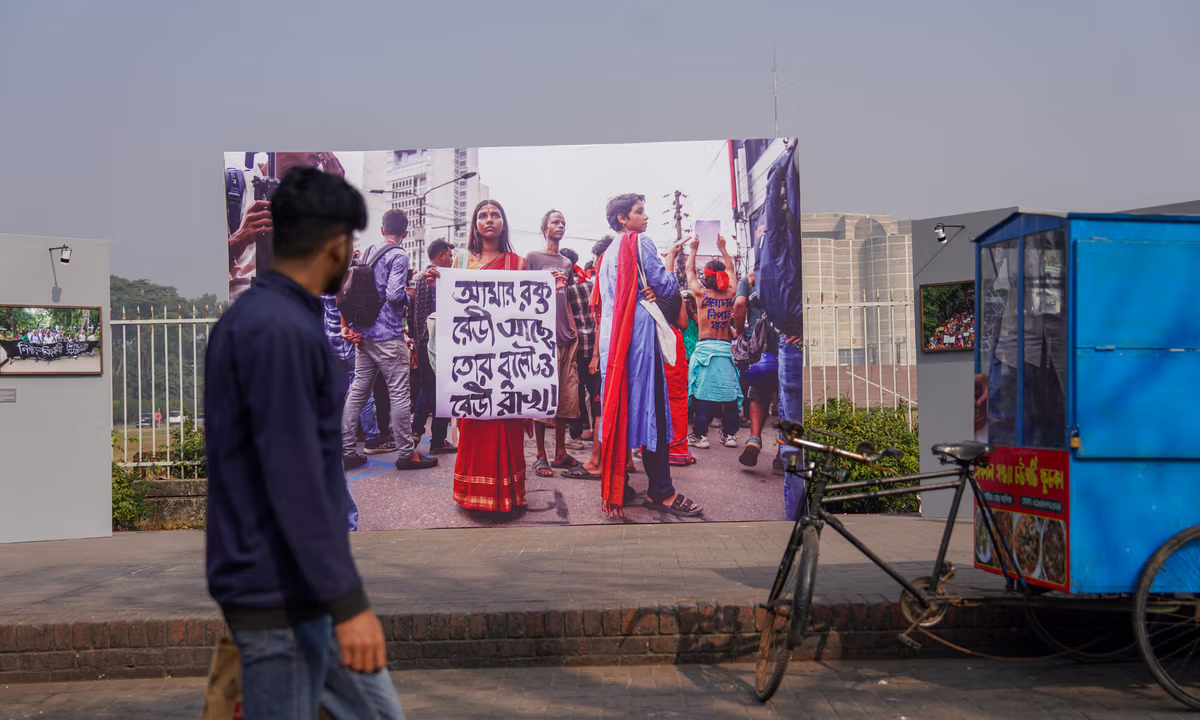
Green-liveried cycle rickshaws and horse-drawn tongas idled outside the parliament of Bangladesh on a night in February. Families and couples from nearby colleges drifted past life-sized photographs of women at the frontlines of a revolution, their bodies contorted with the pain and defiance of political violence. It was the 11th Chobi Mela photography festival, and that bustling stretch of pavement in central Dhaka was hosting the temporary installation Women in the July Uprising: Essential Then—Why Erased Now? In front of the broad area of manicured foliage that surrounds the parliament building, Dhaka’s photography community was posing a troubling question: after a popular revolution, what happens to the people?
After three weeks of bloodshed in the summer of 2024, in which more than 1,000 people were killed, the 15-year dictatorship of Sheikh Hasina was overthrown and the parliament complex overrun by a sea of protesters.
Less than two years later, around 70 million Bangladeshis voted last month in the country’s first free elections in 17 years. They handed power to the Bangladesh Nationalist Party (BNP), which has long dominated the country’s politics, alongside its bitter rival, Hasina’s Awami League. The BNP represents the old guard of Bangladeshi politics, which the uprising promised to sweep away. In recent months, mob violence has targeted minorities, media outlets and symbols of secular culture. For many, it felt like a practical demonstration of how popular revolutions fail. “The movement toppled the government,” says Manisha Chakraborty, a leftist activist, “But it did not help the people.”
The arts a crucial forum for discourse
For the country’s artists, the transitional period has offered danger and inspiration in equal measure. In a post-revolutionary climate marked by insecurity and trepidation, the arts have become a crucial forum for critical discourse. “There’s no guarantee things will get better, so we can’t just sit at home and hide,” Munem Wasif, a co-artistic director of the Chobi Mela festival tells The Art Newspaper. “We felt we had to take the pulse of the moment—out of solidarity for the community.”
Bangladeshi artists have drawn on their unique strength in documentary photography to explore troubling developments in the country’s history. For example, Women in the July Uprising uses visceral images of ordinary women’s bravery to tell a familiar story: in 2024 female students defied a “deeply entrenched culture of fear” to join the protests, writes the installation’s curator Jannatul Mawa. “Within hours, the sparks leaped across campuses and cities, until the whole nation could feel it.” But then, as the new interim government under the Nobel-Prize laureate Muhammad Yunus failed to deliver on its promise to create “Bangladesh 2.0”, the revolutionaries became divided over issues of ideology and identity.
In the process, women lost crucial ground: on 12 February, just seven women were elected to the parliament out of 300 seats, while a hardline Islamist party, the Jamaat-e-Islami, which has never been supportive of women’s rights, won its strongest showing in history. “If we want to stay in politics, we have to develop a thick skin,” says Tajnuva Jabeen, an activist who rose to prominence during the uprising. The temporary open-air exhibition is both testament of that thick skin and an indictment of its necessity.
Photography where words are censored
Chobi Mela also probed perhaps the most unsettling part of Bangladesh’s transition from autocracy: more than 1,600 people “disappeared” under Hasina’s regime. The photographer Mosfiqur Rahman Johan has spent years with the desperate relatives of those who were abducted by the security forces. Together with Mayer Dak, a campaign group for victims’ families, Johan took part in hundreds of small protests under Hasina. As their stories could not be told in detail in the country’s censored newspapers, Johan and his colleagues used photography to convey the horror of what he described as a “disappearance machine”.
“Sometimes I see him in my dreams. I see him lying down, inside the house.” Mosfiqur Rahman Johan’s photo of a woman and her daughter, whose husband is one of the 1,600 “disappeared” under Hasina’s regime Courtesy of the artist
Johan tells The Art Newspaper about one of his subjects, Shimu, whose husband disappeared after five years of marriage. “He was missing for longer than she had known him, but she never remarried,” he says. “She told me she tried to forget but couldn’t because he kept coming into her dreams.” Braving threats from the security forces, Shimu joined Johan at protests around the country, but her husband was never found.
The day after Sheikh Hasina fled the country on 5 August 2024, a handful of men were released from secret sites around the country. But the perpetrators—some of them senior army officers—remain in service, and hundreds of victims remain missing, including Shimu’s husband. After a prolonged campaign, Johan and colleagues from Mayer Dak were allowed to visit one of the empty detention sites, where he found Shimu’s name carved on the wall of a tiny cell, barely 1m by 2m. “When we told her, she came very close to the wall and ran her fingers over the letters,” he recalled. “She said she wanted to touch her husband, but this was all she could do.”
Johan is one of the curators of the new July Uprising Memorial Museum, built in the ruins of Sheikh Hasina’s former residence. Displaying his photos of the disappeared, Johan describes the museum as essential to the “truth and reconciliation” process. On the lawn, the curators have built a scale replica of an infamous detention site known as Aynaghor, or The House of Mirrors, complete with torture devices, names carved into the walls, and speakers playing survivors’ testimony.
Creating a ‘pluralistic’ narrative
Describing it as a “museum of democracy”, its director Tanzim Wahab says he wants to curate a “pluralistic” historical narrative in a “critical dialogic space”, in contrast to the “exclusionary…nationalistic” way that history was presented under Hasina.
Wahab is also the director of the country’s National Museum, which holds, among other things, a priceless collection of mid-century Modern art, alongside historical artefacts from East Bengal. He describes a politicised environment that obscured the daring innovative works of Bangladeshi Modernist painters like Zainul Abedin and Quamrul Hassan.
Right from the beginning, art has played the most instrumental role in building the nation
Tanzim Wahab, director, National Museum
Now Wahab has a masterplan to restore the museum and rearrange its collections, but he faces a “stagnant” bureaucracy and a lack of curatorial expertise. Asked whether the country needed another museum dedicated to political history (there is already a Liberation War Museum, an Independence Museum and a Military Museum) when its rich heritage of Modern art has been so neglected, Wahab says it is impossible to separate the two branches of culture: “Right from the beginning, art has played the most instrumental role in building the nation. So contextualising works for their time and place is a way of respecting them.”
“We understand that art is public practice, its lived experience—and that’s thriving in Bangladesh right now,” Wahab says, adding that Bangladeshi artists’ activism and “long-format social documentary photography” have produced “some of the finest work we’ve ever seen.”
But, after elections that handed a two-thirds majority to one of the country’s oldest political parties, he knows the struggle is not over: “If we restore the art before we restore democracy, then we will lose the art too.”
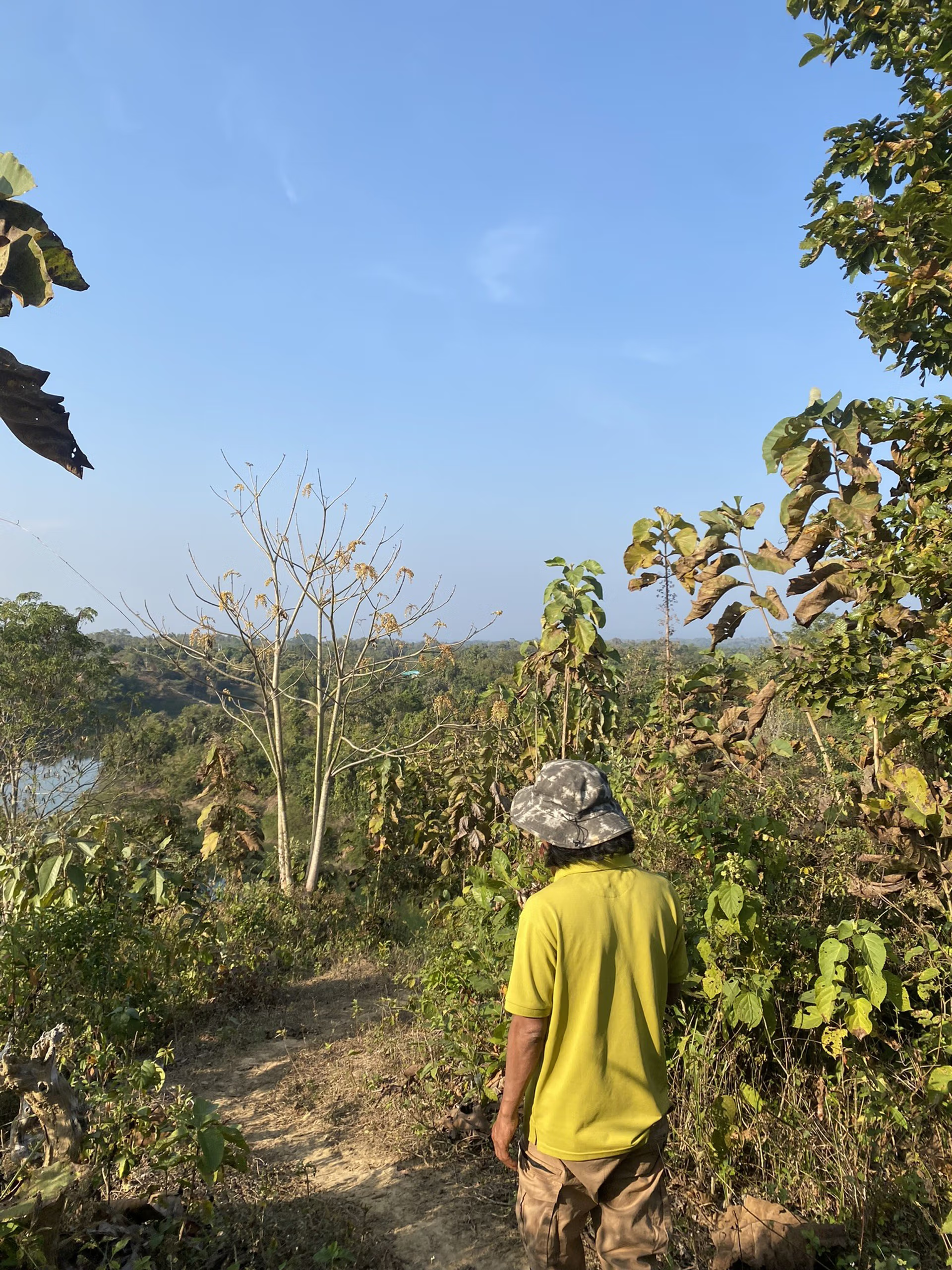
Indigenous artist Joydeb Roaja lives in the Chittagong Hill Tracts in the east of Bangladesh Photo: Cyrus Naji
Indigenous artists sidelined, censored
Bangladesh’s Indigenous people are less excited about the “restoration of democracy” than the population at large. The Indigenous artist Jayatu Chakma tells The Art Newspaper: “The election makes no difference to us,” he says. “Now another government will come and there will be no change.” Jayatu comes from a densely forested territory on the historic frontier of South and Southeast Asia, where over a million Bangladeshis live under tight military control. Villagers cannot use the roads or buy food without the army’s approval, while Indigenous journalists, writers and artists report strict censorship.
In his studio, on the side of a hill that rises from a tributary of the Karnaphuli River, the Indigenous artist Joydeb Roaja describes how the violence of his childhood still penetrates his psyche. “My friends and I would play as the army and the Shanti Bahini [an Indigenous rebel group],” he recalls. “Now it comes automatically in my mind when I work”. He has turned those memories into subtle works of performance art in which the hebaang head-dresses traditionally worn by Indigenous women have been transformed into camouflaged tanks.
As an Indigenous artist, Joydeb has to veil his commentary in an allusive visual language;“Whenever I go abroad for an art show, they take me into a separate room at immigration and interrogate me about what I do.” He usually shows them an album of anodyne landscapes, which are popular with Bangladeshi buyers, he says.
Joydeb’s latest works, shown in London in February as part of Condo, show couples, in the bold pinon hadi garb of the Chakma, surrounded by cameramen, training their lenses on the Indigenous people. That is not a reference to media interest; after all, one does not hear much about the Chittagong Hill Tracts. “I showed people trying to find us,” Joydeb says. “Because soon we might all disappear.”
