


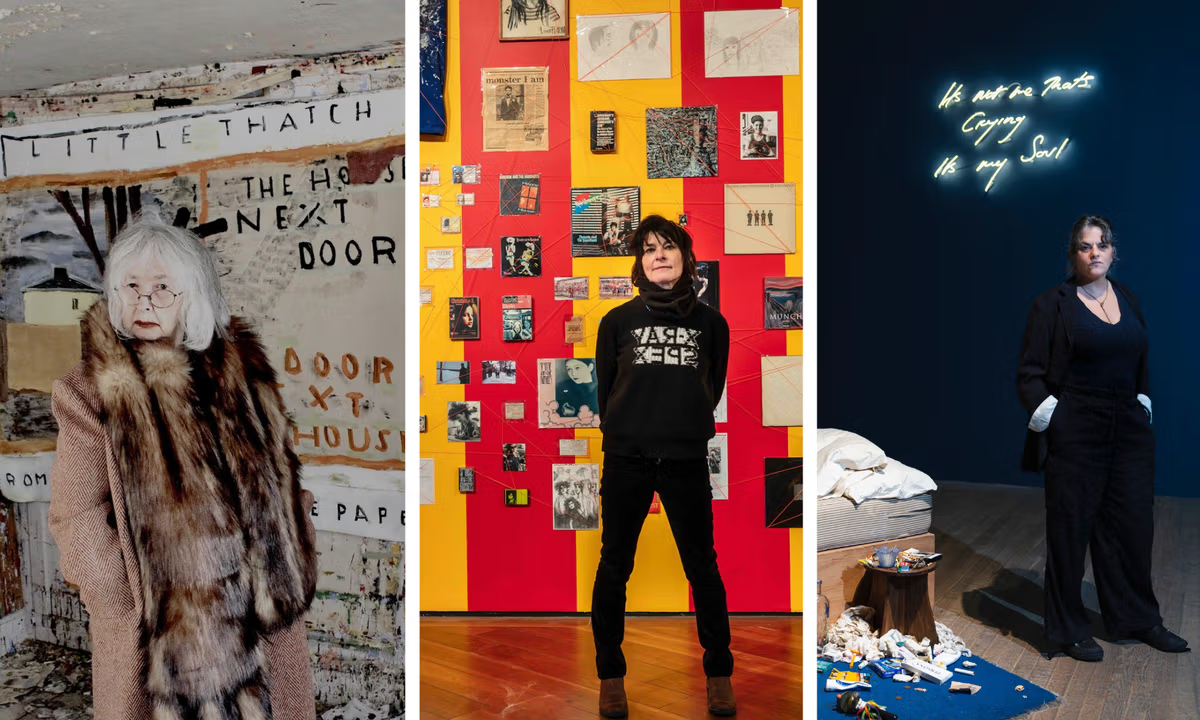
While it has felt like everything else is going to hell in a handcart, the UK’s art world has been reverberating with the positive energy of three formidable women. Advanced in age, indomitable of spirit and with seemingly boundless reserves of creativity, Rose Wylie, Tracey Emin and Sue Webster each have high-profile survey shows open now that break with convention and pay tribute to the redemptive power of paint.
Oldest in years but arguably the most youthful in demeanour is Wylie, who turns 92 this year and is currently filling the main galleries of the Royal Academy (RA) with her enormous oil paintings. Shockingly Wylie is the first female painter to be granted the entire run of these spaces in the RA’s 258-year history, and her canvases have a maverick presence while managing to seem utterly at home. Her works mash up an idiosyncratic span of subjects—from ancient Babylonian sculpture to Quentin Tarantino movies—with exuberant, eclectic non-hierarchical brio. “I don’t like restriction,” she told me. “I don’t like being too precious. It’s like being in a coffin or in a hospital.”
I like big paintings, it suggests confidence
Rose Wylie
The Picture Comes First is no ploddingly linear retrospective. The earliest piece, The Well-Cooked Omelette, is in the penultimate room and is dated 1989, a few years after Wylie graduated from the Royal College of Art—having stopped making art for 25 years to rear her children. Now this nonagenarian tornado shows no sign of stopping. Some of the most impressive works at the RA were made over the past two years, and when I visited her magnificently dishevelled studio in Kent at the start of this year (Wylie makes Francis Bacon look like Marie Kondo) she was working on floor-to-ceiling canvases for a David Zwirner show in Paris. “I see myself as metaphoric, specific and inventive,” she said. “I like big paintings, it suggests confidence.”
A consummate storyteller
Emin’s Tate Modern survey likewise eschews conventional chronology. Organised thematically around subjects generally bypassed in fine art—including abortion, explored in two dedicated rooms—A Second Life intersperses recent paintings and bronzes with earlier watercolours, texts, monoprints and memorabilia as well as neons, films and installations. The show pays tribute to Emin’s consummate skill as a storyteller, showing her as both coruscatingly raw and upliftingly affirmative as she recounts her tales of trauma in multifarious materials.
Emin describes the show as “a before and after of my mental and physical state pre- and post-cancer”, referring to how her life changed dramatically following aggressive bladder cancer and invasive surgery five years ago. Now she is more prolific than ever, with painting a main priority. There are over 20 of her large acrylics here, many depicting splayed or bleeding figures. Most date from 2018, and some from last year. Emin views her paintings as autonomous entities, stating: “I don’t work on them, they work on me.” Her relationship with the paintbrush has always been volatile: in 1990 she destroyed all her paintings, and she describes her interaction with the medium as “extreme”, comparing the act of painting “to having sex with someone new that you really love: you’re never going to be the same person afterwards”.
Webster talks with similar intensity about the impact of paint. Her show at Firstsite in Colchester is titled Birth of an Icon and this unorthodox overview of her turbulent life, which culminates in a series of self-portraits in oils, marks Webster’s first solo institutional show since her 25-year collaborative career with her former husband Tim Noble ended in the 2010s. “Tim and I worked together so closely and intuitively, and when that stopped I needed to fall in love again with something else,” she says. “Now I’m at my happiest when in the studio and completely isolated—just me and the paint, I love it!”
Webster only started painting when she became pregnant in her 50s with her now five-year-old son, and wanted to celebrate this momentous moment on a grand scale. When she couldn’t blow up a photograph large enough for a “massive statement”, she turned to oil on canvas. At Firstsite, her procession of larger-than-life self-portraits with bump jutting proudly through a leather jacket or above a pair of boxing shorts line the penultimate room. They are preceded by Crime Scene, an array of intricately orchestrated, intimate memorabilia and 18 suspended leather biker jackets, meticulously hand-painted with images of Webster’s beloved Siouxsie Sioux. The grand finale is a chapel-like room with another tender self-portrait as a mature, single-mum “Madonna”, clad in Adidas and holding her mini-tracksuited son. Birth of an icon, indeed.
• Rose Wylie: The Picture Comes First, Royal Academy of Arts, London, until 19 April
• Tracey Emin: A Second Life, Tate Modern, London, until 31 August
• Sue Webster: Birth of an Icon, Firstsite, Colchester, until 10 May
