


Fashion designer Dries Van Noten and his partner Patrick Vangheluwe will launch next month a new foundation in Venice dedicated to craftsmanship.
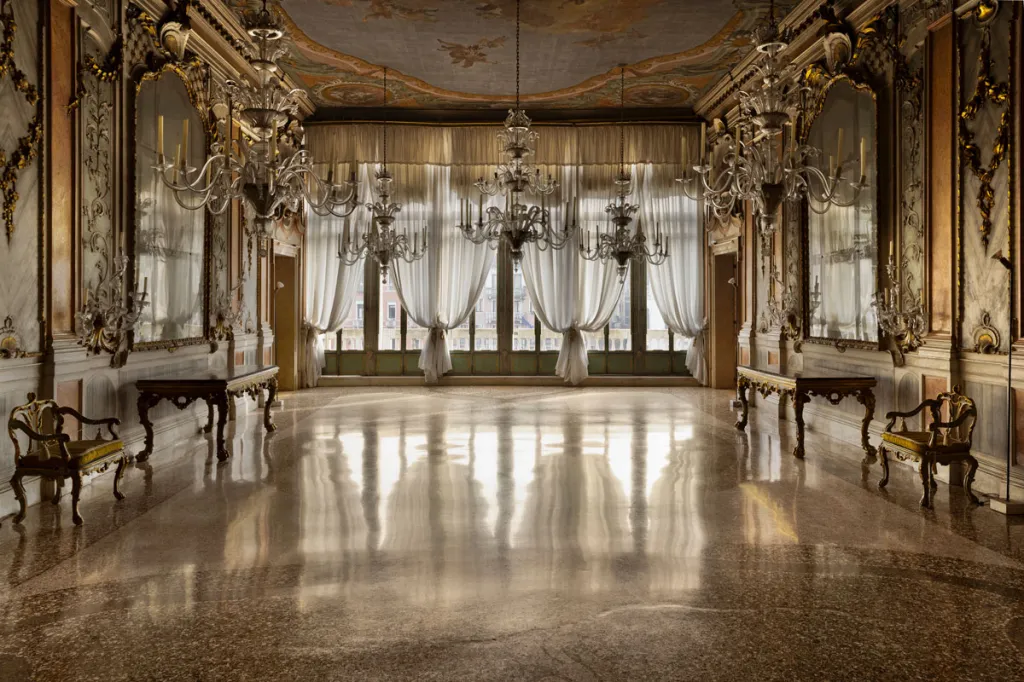
The new Fondazione Dries Van Noten will be located in the historic Palazzo Pisani Moretta on the Grand Canal in the San Polo neighborhood. Over the course of each year, the foundation will stage a number of presentations, collaborative projects, residencies, special events, and activations for artists, designers, and craftsmen at all levels of their careers.
The goal of the Fondazione is “to unite the arts by dissolving traditional boundaries, affirming that all creative expression stems from the gestures and skills that define human making,” according to a release.
A manifesto published by the Fondazione reads, “Here, centuries of craftsmanship serve as a backdrop for new dialogues: between artworks and artisans, between past and present, and between local talent and international creativity. The Fondazione envisions Venice not as a static museum, but as a living, evolving hub where ideas circulate as freely as the tides.”
The Gothic exterior of the Palazzo Pisani Moretta.
Courtesy Fondazione Dries Van Noten
Built in the second half of the 15th century by the Pisani family, the Palazzo Pisani is known for its exterior in the Gothic Floral style and for its Baroque interiors, completed by several Venetian artists in the 18th century. In the near future, the Palazzo will undergo a renovation by Venetian architect Alberto Torsello. A satellite site Studio San Polo will open later this year.
“Venice is more than a weekend destination; it’s a city full of life, from its markets to its young residents, with a one-of-a-kind cultural stimulus. We fell in love with the Palazzo Pisani Moretta not as a monument frozen in time, but as a stage for creativity,” Van Noten and Vangheluwe said in a statement about the project.
They added, “Through the Fondazione, we aim to develop a pulsing venue where artists and artisans can present their work, where students can engage in hands-on exploration, and where visitors experience making as an act of culture. It’s about nurturing an ecosystem that empowers craft, giving it visibility, relevance, and vitality in the age of machines and digital revolution, while connecting the city’s past, present, and future.”

A teaser image for “THE ONLY TRUE PROTEST IS BEAUTY” at the Fondazione Dries Van Noten, Venice.
Courtesy Fondazione Dries Van Noten
Opening on April 25, the Fondazione Dries Van Noten’s first presentation will take the title “THE ONLY TRUE PROTEST IS BEAUTY,” and will be curated by Van Noten and fellow Belgian fashion designer Geert Bruloot.
“Here, the concept of beauty,” a release describing the exhibition reads, “is not understood as mere prettiness, but as a moment of intensity: a charged encounter, an unexpected harmony, or a subtle disturbance capable of unsettling, awakening, and creating space for the new.”
The exhibition will be spread over 20 rooms of the Palazzo Pisani Moretta and gather together more than 200 objects, ranging from “fashion, jewellery, art, collectible design, photography, glass, ceramics, [to] material experimentation within a shared investigation of beauty’s ability to question norms and disrupt dogma,” according to a release.
Couture pieces by Christian Lacroix and Comme des Garçons will mix with photographs by Steven Shearer and sculptures by Joyce J. Scott and Peter Buggenhout. Emerging Palestinian fashion designer Ayham Hassan shown his pieces in proximity to ceramics by Rebecca Manson and Kaori Kurihara. Artists represented by contemporary design galleries, like Antewerp’s Supercut, Brussels’s Objects With Narratives, New York’s Friedman Benda, and Barcelona’s Side Gallery, will also feature in the exhibition.
Dries Van Noten.
Photo Camilla Glorioso
“We are interested in beauty not as an answer, but as a question,” Van Noten and Vangheluwe said in a statement about the exhibition. “It is not an escape from reality, but a way of engaging with it. When beauty allows for ambiguity, slowness, and contradiction, when it disturbs rather than resolves, then it becomes a subtle form of protest.”
