


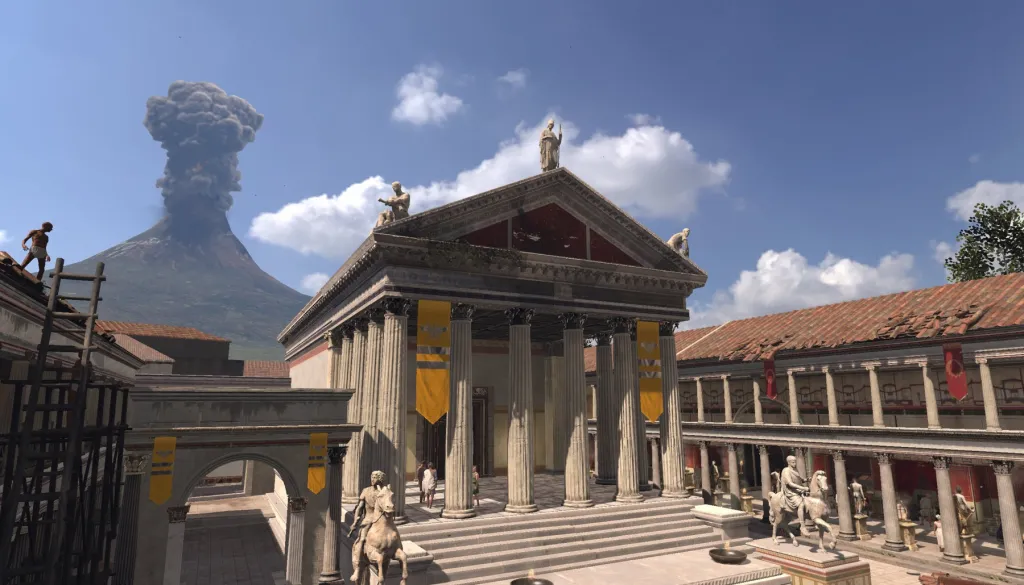
A new augmented reality app will enable devotees of the ancient city of Pompeii to explore the city as it was in 79 C.E., before the disastrous eruption of Mount Vesuvius—as well as during the historic catastrophe, in which some 2,000 are believed to have perished, possibly in ghastly fashion, including asphyxiating amid clouds of ash or even having their bodily fluids vaporized by burning gas. Besides seeing the sky go dark on that fateful day, they’ll be able to see gladiators fighting in the amphitheater or, if less violently inclined, take in a play at the theater.
It will all be visible using a new app, Portyl, that relies on detailed reconstructions achieved with the latest advances in LiDAR, photogrammetry, and generative artificial intelligence. Every site in the ancient city has been scanned, researched, and recreated by a team of artists from History, Incorporated, a historic preservation consulting firm.
Pompeii, lying 14 miles southeast of Naples and part of the Roman Empire when it was destroyed, has fascinated history buffs ever since it was excavated in the 18th century. The high state of preservation of the ruins, as well as the affecting discovery of human-shaped cavities in the ash, sparked the imagination and, as Hannah Edgar recently wrote for ARTnews, rekindled an interest in antiquity that remains unabated.
Portyl will be free to all visitors until July 15. After that, three features will remain free: the basilica (which is near the forum), the quadriportico, and the exterior of the amphitheater. All other immersive features will cost €15 ($17). Want a bigger screen? For €20 ($23), visitors can rent a tablet with all content unlocked. The app will also be available remotely.
Gladiators do combat in the amphitheater in an augmented reality rendition of the ancient city of Pompeii.
Pompeii Archaeological Park
The first site to be offered with this digital project is the House of the Citarista, one of the largest houses in the city, opening to the public today. It houses the statue of Apollo the Citharist, also known as Apollo Citharoedus, which depicts the Greek god of music playing the cithara, a large lyre. Inside, visitors will see digitally reconstructed rooms, furnishings, and scenes of daily life. Many of the house’s frescoes and artifacts were carted off to the Naples Museum.
“The introduction of artificial intelligence and digital technologies marks a crucial step,” says park director Gabriel Zuchtriegel in press materials. “AI represents an extraordinary opportunity if oriented toward the democratization of knowledge, making complex and often difficult-to-understand content accessible to all. It can broaden the audience, engage new generations, and break down cultural and physical barriers.”

An augmented reality rendition of the House of the Citarista at Pompeii.
Pompeii Archaeological Park
But even he acknowledges that the undertaking presents some dangers.
“At the same time, there is a risk: that technology becomes locked in a self-referential loop, producing content for its own sake, without a real connection to scientific research and authentic heritage,” he says. “This is precisely where the role of archaeology comes into play. Archaeologists must not become passive spectators of machines processing data and reconstructions, but conscious directors of the transmission of heritage.”
