


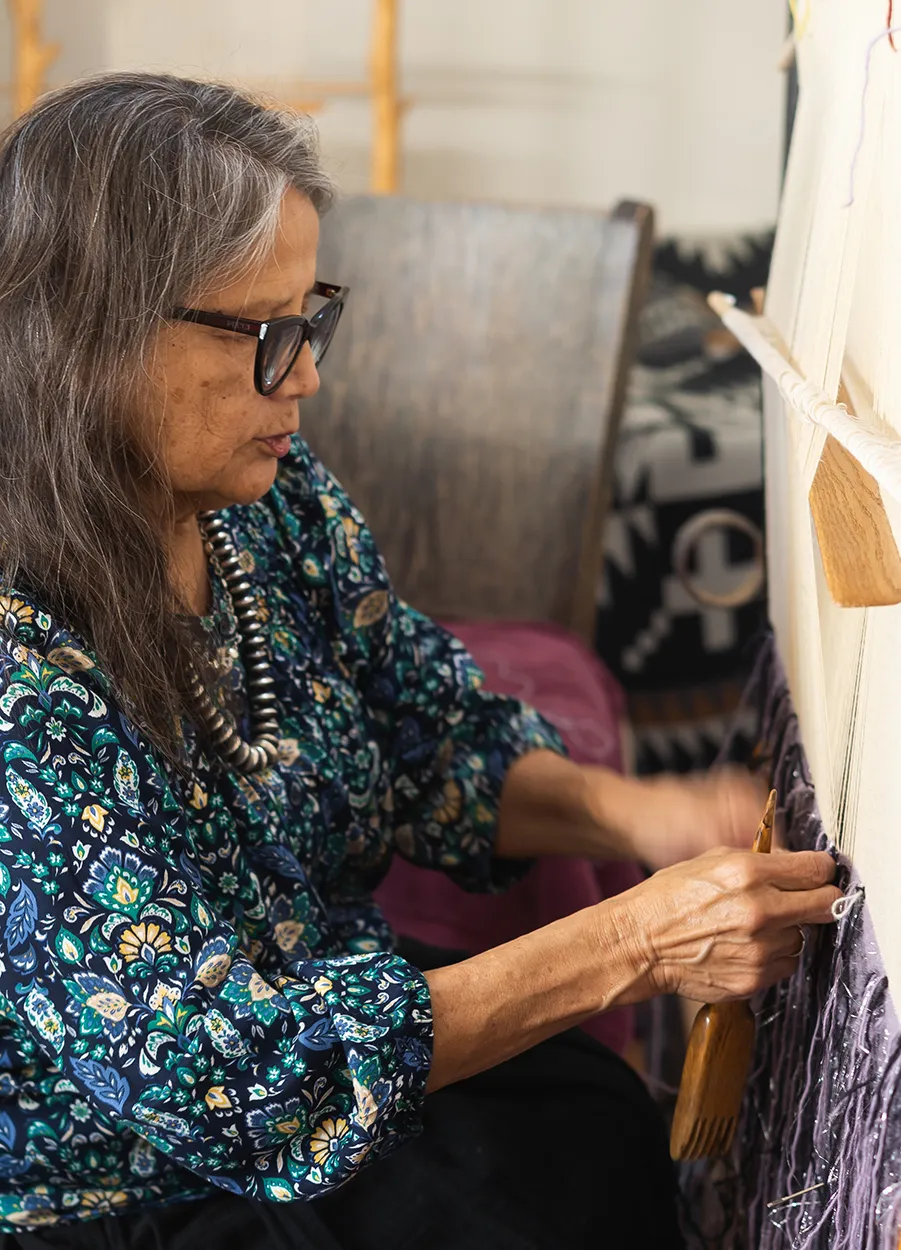
Weaving may be the world’s oldest way of reproducing information—and computing is poised to become its final one. Across millennia, surprising similarities persist: both media operate on binary logic (over/under, on/off), are intrinsically based on counting, and are characterized by patterns that emerge structurally, not on the surface. In fact, the first automated machine, the Jacquard machine, was a loom, and weaving was a favorite metaphor employed by Ada Lovelace while she was working with early computers and algorithms. Even language betrays this lineage: etymologically, before “text” became “textual,” it was “textile.”
Diné weaver Marilou Schultz has been probing the harmonies and dissonances between these technologies since the 1960s. Her first retrospective opens this week at the Hessel Museum of Art at Bard College in upstate New York, where curator Candice Hopkins has brought together some 55 works, threading them together with contextual archival materials. The show highlights Schultz’s range as a weaver, from her command of traditional styles to her penchant for formal experimentation, and hones in on one subject that has preoccupied her practice over the last thirty years: computer chips.
Growing up in Leupp on the Navajo Nation, Schultz started weaving at just five years old. Her mother and grandmothers were weavers, and looms were a staple in the home. “In Navajo, they say, you meet your elders, you connect with them through the loom,” she told me this spring. Moving to Mesa and working as a math teacher allowed Schultz to continue weaving outside of financial need: “I had my salary, and from there on, I started experimenting and playing with the yarn, the dyes, the wool, then the looms themselves eventually.” She experimented with styles and techniques, finding plant-based dyes and keeping notes on their interaction with different metal containers. And while materials and their sources have changed—during Schultz’s lifetime, a flock of Churro sheep was reintroduced to her family, producing a lustrous, traditionally undyed wool—techniques have remained the same for generations.
Honoring the way Schultz’s weaving developed through intergenerational mentorship and knowledge transfer, the retrospective contains works by four generations of weavers in her family, including her mother, Martha Gorman Schultz, who passed away last year at the age of 93. The show includes her final weaving, a Germantown-style rug made with wool gifted to her by Melissa Cody, the acclaimed contemporary weaver and Marilou’s cousin.
An early rug sets the stage for Schultz’s experiments with form: Untitled (late 1990s) breaks up a third-phase wearing blanket, a Navajo design style from the period 1860–68, into a triptych. Schultz split its geometric patterns across a center panel and wings. “My thinking was that if fashion can change, why can’t Navajo wearing blankets?” Other works challenge weaving’s confinement to the warp: for a series of rugs realized in 2016–17, Schultz invented a new form of loom that allowed her to create three-dimensional shapes out of traditional wedge-weave patterns. This square loom, transformed into a cylinder, is inspired by the spinning of the globe and the cycles of the seasons.
Marilou Schultz: Popular Chip, 2025.
BY 1995, SCHULTZ’S willingness to remix the conventions of Diné tradition led to an unexpected commission: Louis Baca, a Pueblo man working for Intel, approached her at the Heard Indian Market, where he was looking for a weaver who might take on an unusual request. On the occasion of the “Weaving and Technology” theme of Intel’s annual conference, held to celebrate the success of its 1993 Pentium chip, she was asked to weave a design based on the microchip. Always eager to marry tradition to experimentation, Schultz took on the request.
But it proved more challenging than expected. Schultz riffed on the raised-outline technique, a three-dimensional weaving method that gives geometric patterns an embossed appearance by creating a raised ridge where two colors meet, stacking alternate colors like a railroad. Her mother tried to help make the rug—but when Schultz came home to check on her progress with the unusual task, she found her despondent, lying on the floor, overwhelmed by the challenge of representing the intricate and asymmetrical miniature patterns in Navajo techniques familiar to her. Asked by her family how she was able to help Schultz with her mysterious commission, her mother told them: “That wasn’t no rug Marilou was weaving… But something that goes into the radio,” misreading the representation of the chip as working components. Schultz recalls: “She didn’t understand the concept of a chip. She never discouraged me from weaving it, she just said: that was no Navajo rug.”
Presenting the resulting Replica of a Chip (1994) at the conference, Schultz found that engineering students recognized the discrete parts woven into the rug: multiprocessor units, floating-point units, clock drivers, and data and code caches. In 1994, Intel presented Replica, currently on view at the San José Museum of Art, as a gift to the American Indian Science and Engineering Society in Albuquerque.
Still, it would take some years before the technological achievement of the rug was recognized. Schultz’s second chip commission followed only in 2008, and both works were exhibited at Documenta 14 in 2017. In the commissions Schultz took on afterward, she began taking a less literal approach to representing a given chip’s internal architecture, allowing Navajo subjects and myths to become visual markers. For Chip (2018), Schultz selected an image of a microchip for its resemblance to Navajo bow guards, traditional protective wrist cuffs decorated with silverwork elements that incorporate the four cardinal directions. From then on, her work began to draw out the striking visual similarity between Diné weaving and the material architecture of our digital worlds.
INTEL HAD A REASON to ask a Navajo weaver to commemorate its chip: Intel’s predecessor, Fairchild, had deliberately sought out weavers to hire at its plant on the Navajo Nation in Shiprock from 1965 to 1975. The resulting workforce was made up mainly of Navajo women, whose weaving expertise led to significant contributions to computing. At the plant, Navajo women helped the Space Age along: integrated circuits for the Apollo Guidance Computer were made there.
Fairchild appealed to the “nimble fingers” of Navajo weavers in advertisements aimed at both recruits and stakeholders. By appealing to handcraft, microchip manufacturing helped integrate women into wage labor. Navajo society was matrilineal and matriarchal, and women had already long been involved in work outside the home. Diné women’s weavings had driven their economy since the nineteenth century. While the way the Fairchild plant impacted Navajo society has been widely critiqued—after an eight-day occupation in 1975, the plant abruptly moved its operations to Asia, undermining the economic sovereignty for the Navajo Nation it once promised—curator Candice Hopkins noted that one piece of this history she felt was missing was this: “Was there an impact on Diné weaving, because of the women weaving in the factory?”
Certainly, the impact went the other way around. Some thirty years after weaving Replica, Schultz set to work on a rug based on the 9040 processor made at the Shiprock plant. Titled Integrated Circuit Chip & AI Diné Weaving (2024), it also nods to the processor’s Diné origins. The white pads on the chip, used for external communication, bear symbols like the Navajo figure of Spider Woman who, according to lore, gave Schultz’s family the gift of weaving. The microchip symbol, an early representation of artificial intelligence, has been adjusted to have four prongs on each side instead of three, referencing a number of great significance to Diné people because of the four sacred mountains.

Marilou Schultz: Integrated Circuit Chip & AI Diné Weaving, 2024.
MICROCHIPS WERE MADE up of thousands, and now billions, of transistors, tiny switches with three states that can be set to on, neutral, or off. It is this very architecture that makes computing “digital”: it is based on fingers—also known as digits. Schultz brings digitalism back to its dexterous roots, paying homage to the hands that assembled the virtual realm.
Along the way, Schultz’s work has caught the eye of an unusual group: online communities of microelectronics hobbyists. Exchanging images with these enthusiasts, Schultz often picks her subjects from among their references, modifying them to integrate Diné cultural elements as she goes. Lately, she has been prolific: GEO X (2025) is currently on view at the New Museum in New York, and GEO XX (2026) at the Museum Tinguely in Basel.
These online collaborations have enabled Schultz to think more deeply about how weaving is a technology. The computer-history blogger Ken Shirriff has published interactive maps diagraming her rugs, pointing out the places where bond pads, voltage dividers, and discharge pins are depicted. Recent works have started to incorporate metallic threads, forming conductive networks: Popular Chip (2025), based on a best-selling timer microchip, was the first work in which Schultz used aluminum and copper threads in her weaving.
As Schultz incorporates hardware, a productive friction arises: the pace of the technology she depicts is at odds with the intergenerational technology of Diné weaving. Microchip manufacturing is governed by a paradigm known as Moore’s law, which in practice ensures the obsolescence of any given chip in 18-month cycles. Diné weaving uses intergenerational knowledge transfer to update well-established traditions. And while chip diagrams quickly age out of their microscopic, high-technology medium, Schultz’s microchip rugs take the components on which our world operates and draw out their intricacies and beauty.
In Schultz’s work, Navajo women, underrecognized for their past efforts, are part of our collective technological futures. At 71 years old, she is set to retire from teaching at Mesa Public Schools this year and dedicate herself to weaving full-time. She is still excited by the possibility of tapestry changing convention: a slow process, using ancient tools. She is especially keen to experiment with integrating music into her next projects: “It would be as though the rug was talking to you through sounds. Before the loom, lungs were our first technology.”
It would be a suitable continuation of a practice that is as innovative as it is time-honored. “Weaving,” in Sadie Plant’s words, was always “already multimedia: singing, chanting, telling stories, dancing, and playing games as they work, spinsters, weavers, and needleworkers were literally networkers as well.” From the textures of a weave, we may decipher more about our early ways of living, technologies, and communications than from the text that succeeded the textile. Plant posits: “How do we know this? From the cloth itself.”
