


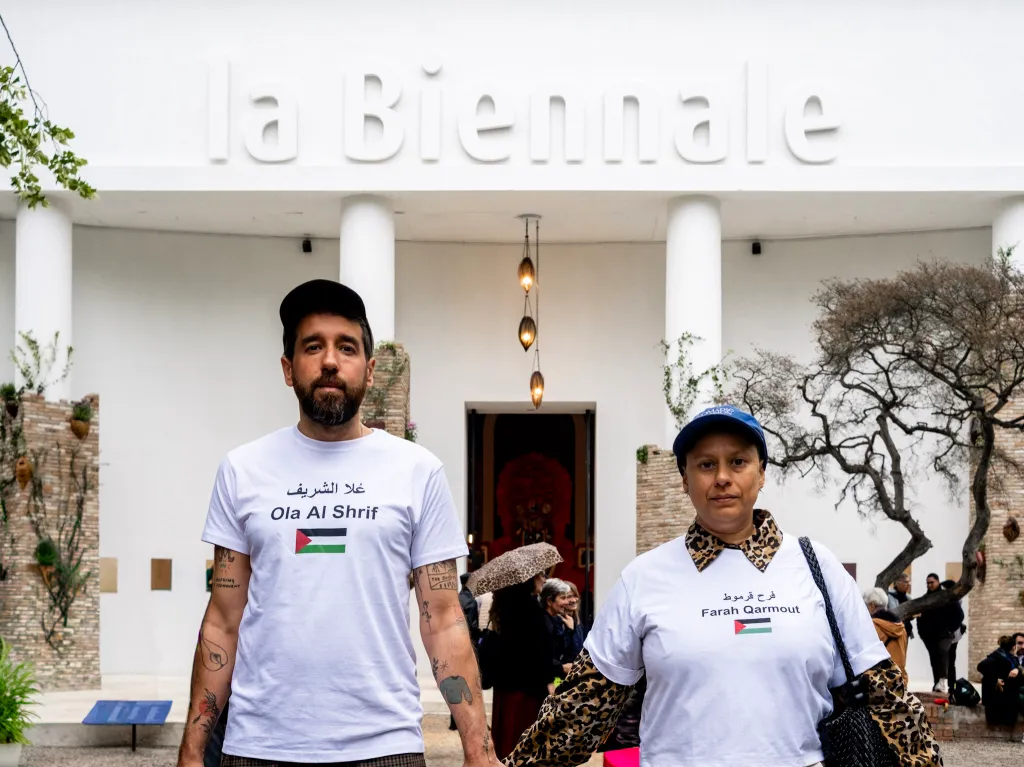
The Venice Biennale opened for its professional pre-opening on Tuesday, and artists participating in the exhibition wasted no time making their voices heard. At noon, around 60 artists and a few dozen other participants gathered for an action protesting Israel’s participation in the event and protested in support of Palestine.
For the action, titled “Solidarity Drone Chorus,” the artists gathered at the entrance to the Giardini and hummed “Drone Song,” a viral song composed by Gazan composer and music teacher Ahmed “Muin” Abu Amsha, in order to “sonically occupy space,” according to press materials. They then moved in a procession to the Central Pavilion.
“The sound of drones is so heavy and present on a daily basis in Gaza,” artist Carolina Caycedo told ARTnews after the action. The song and the humming were meant “to bring to the Biennale a little bit of the reality that people in Gaza suffer every day, and resist every day.”
The action, according to Caycedo, was organized by artists in the main exhibition over the last several months, following on from the activist group Art Not Genocide Alliance’s open letter published in March demanding that the Venice Biennale prevent Israel from participating in this year’s exhibition. That letter has been signed by nearly 200 artists, curators, and arts workers associated with this year’s edition of the Biennale.
“We are outraged that the Biennale directors decided to relocate the Israeli Pavilion within the Arsenale. It throws us into complicity without us wanting to,” said Caycedo, whose work appears in the main exhibition “In Minor Keys.”
“It’s a way for us to show our discontent and our disgust with the politics that happen underneath the Biennale, and the refusal of the Biennale to be held accountable…. We’re tired of the lack of accountability in the art world.”
But, according to Caycedo and artist Rui Dias Monteiro, who also participated, the action was less about drawing the conversation away from the Israeli Pavilion than it was about “uplifting the voices of Palestinian artists and centering them in the conversation.”
To that end, most of the artists participating were wearing T-shirts with the names of Gazan and Palestinian artists, many of whom have been killed over the last several years. On the backs of the T-shirts are artworks by those artists. Caycedo and Dias Monteiro carried handouts introducing artists such as Farah Qarmout and Ola Al Shrif, both of whom have participated in the Gaza Biennial and have since been displaced from Gaza to Cairo and Abu Dhabi.
The artist list of those featured on the T-shirts was “a collective effort” led by Palestinian artists participating in “In Minor Keys” and the Palestinian Museum in Ramallah.
Another artist-participant, who asked to remain anonymous to put the attention on “the collective action,” told ARTnews that he decided to participate because he could no longer stay silent. “The Biennale is normalizing the participation of countries that commit war crimes and illegal wars and genocide, and we cannot stand by that,” he said.
The artists plan to perform the action at noon on Wednesday, Thursday, and Friday at different sites around the Biennale.
