


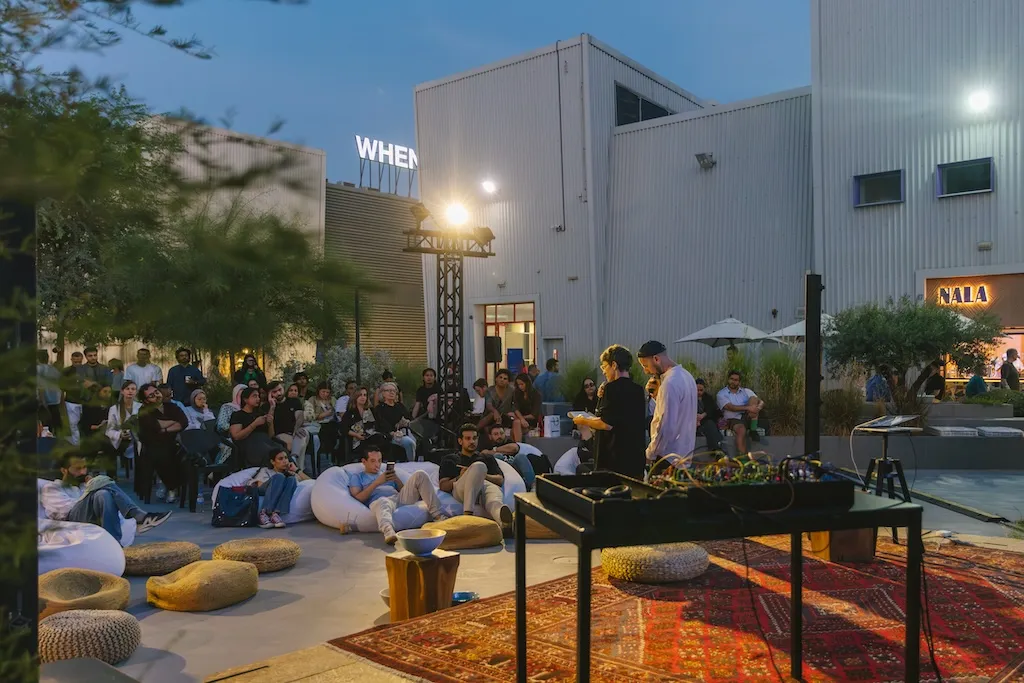
Alserkal Avenue will stretch its usual Art Week into a five-week “Art Month” from April 18 to May 18, adding grants, temporary warehouse space for collectives, and a commercially focused group show organized with 12 galleries from around the United Arab Emirates. The extension is an effort to keep exhibitions and sales moving at a moment when pressure is building across the market and the global stage.
The initiative broadens what was once a tightly packed week of openings into a more distributed model: 16 gallery exhibitions, public art commissions, and more than 100 talks, performances, and events unfolding over five weekends. Among the opening shows are Green Art Gallery’s group exhibition “All the Lands from Sunrise to Sunset” that examines the persistence of imperial power through work by artists like Michael Rakowitz, while Efie Gallery will debut a public-facing viewing room with art by El Anatsui and Aïda Muluneh, among others.
At The Third Line, Sara Naim’s solo exhibition will feature paintings that move between figuration and abstraction and will be paired with a video work that breaks language down into gesture and sound. At Leila Heller Gallery, Douglas White’s The Great Wave translates Hokusai’s iconic print into monumental sculpture made from discarded tires, capturing a moment of suspended force that mirrors a period of ecological and geopolitical strain.
The expanded Alserkal Avenue calendar leads into a rescheduled Art Dubai in mid-May, after the fair was pushed back with plans to shift it to an “adapted format” amid ongoing conflict in the region, as organizers adjust to changing conditions.
Alserkal’s role here is not incidental. Over the past decade, the Avenue has grown from a handful of galleries into one of the central nodes of Dubai’s cultural infrastructure, now housing around 90 creative businesses across repurposed industrial spaces. The month-long format is meant to serve as a sustained platform to counteract the volatility surrounding the fair.
The broader context is hard to ignore. The US and Israel’s airstrikes against Iran have also led to strikes against the UAE, and Iran has restricted use of the Strait of Hormuz, which as of Monday was under a blockade against Iranian ships by the US. The UAE has a direct economic stake in keeping the Strait of Hormuz open, a narrow but vital corridor through which about 20 percent of the world’s oil shipments pass as well as other regional trade. These disruptions have led to increases in gas and energy prices, changes to airline routes, and, by extension, interrupted the movement of artworks and people that sustain the art market’s Gulf ambitions. In that light, Alserkal’s expanded programming seems to be a way to make sure the ecosystem keeps working even as conditions around it remain uncertain
