


Sometime in the summer of 1460, a traveller, Pierre de Montfort, found himself in the Alpine Vallée des Merveilles in south-east France. He was horrified. It was, he thought, “a hellish place with figures of devils and a thousand demons carved everywhere in the rocks”. So aghast was he that he set his thoughts down, thereby leaving us the first written description of an encounter with rock art in European history.
Rock art takes many forms, but the variety that De Montfort encountered were petroglyphs: images, using various techniques, cut into non-portable stone surfaces. In fact, as Christoph Baumer reveals in Rock Art and Its Legacy in Myth and Art, some 80% of the petroglyphs at Mont Bégo, the wider site that encompasses the Vallée des Merveilles, represent bulls, with anthropomorphic forms accounting for just 1%.
The interpretation of these powerful, intense but often opaque figures and marks has always been difficult and all too often subject to intellectual bias of one kind or another. Baumer, the president of the Society for the Exploration of EurAsia and a member of, among other organisations, The Explorers Club, New York, and the Royal Geographical Society, London, has little time, for example, for modern theories that link the production of rock art to shamanistic rituals: such arguments embody “a fundamentally ahistorical perspective reducing art to determinism”, he writes.
Unknowns beleaguer our understanding of rock art. Precise dating is difficult and we typically have little idea what occasioned the making of any specific image. Petroglyphs may have been made at the same location for anything up to 2,000 years, so even where a site has tens of thousands of images, annual production may have been as low as ten or 20 a year. While the known mythological culture of Central Asia and Scandinavia is extensive, for the Sahara it is close to non-existent.
For all that, what these compelling images can still tell us is remarkable. The bulk of Rock Art records either significant or characteristic examples of outdoor petroglyph by region, examining sites across northern Africa, the Middle East, Europe and Asia, although in places it does discuss relevant cave art too. Baumer notes, for example, how a recently discovered Neolithic cluster of life-size camels carved into sandstone in northern Saudi Arabia resemble the two exquisite bison modelled in clay relief in the Tuc d’Audoubert cave in southern France 10,000 years earlier.
Remarkably well-preserved Bronze Age rock art from Saimaluu Tash in Kyrgyzstan depicts scenes of ploughing © Christoph Baumer
Among other things, rock art offers an eye-witness account of the emergence of human civilisation. The introduction of domestic livestock into Arabia some 8,000 years ago is reflected in petroglyphs at Jubbah-Ha’il and Shuwaymis, where herding scenes replace older hunting images, sometimes deliberately overlaying them. When the wheel arrived in Mongolia, it came first in heavy two-axle carts and later in lighter, single-axle chariots. Petroglyphs also reveal changing patterns of behaviour. In Central Asia, before the Bronze Age, weapons are only shown directed at prey. Then the lances and arrows were turned on fellow humans. This does not imply “that pre-Bronze Age societies were free of violence”, Baumer writes, “but that violence was now an admired virtue”.
From chariots to ships
We can see, too, how mythologies spread and evolve. At Tamgaly in Kazakhstan, petroglyphs show how the horse slowly replaces the bull during the Bronze Age as the most revered animal, becoming associated with the sun, likely in tandem with its domestication. This Indo-Iranian image of a sun-headed deity driving a chariot across the sky reached as far as Scandinavia, where the chariot was sometimes replaced by a ship, or the ships themselves were given horse-headed prows.
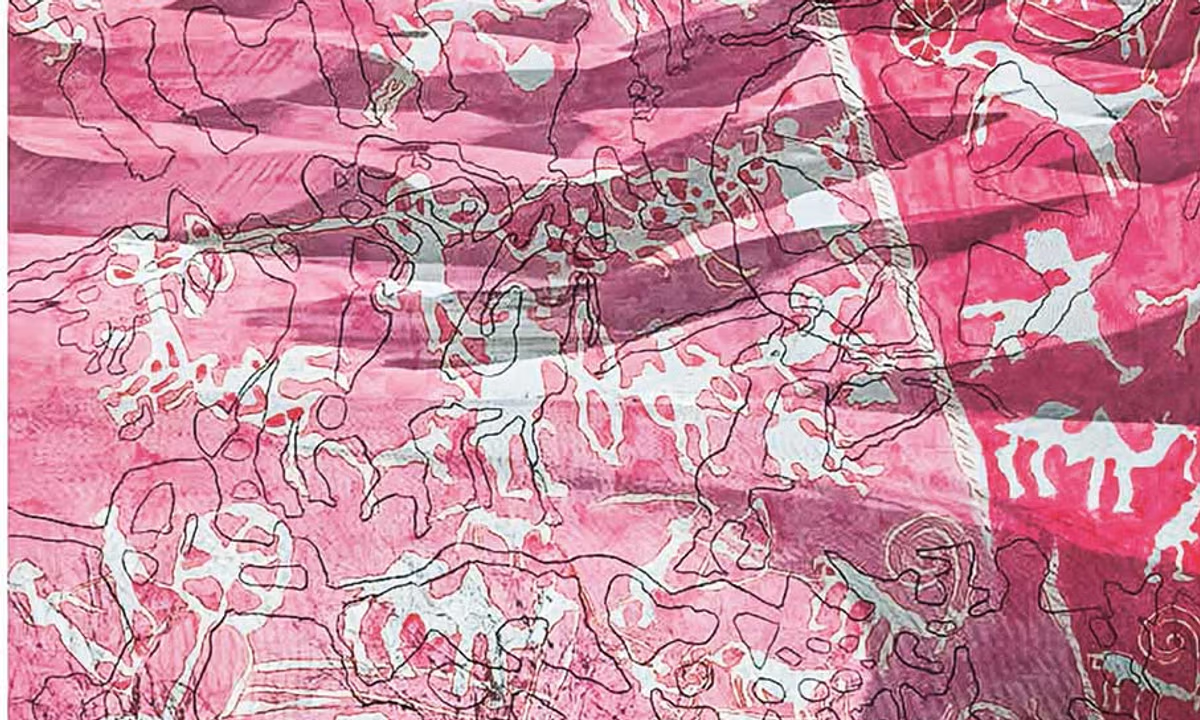
The Museum of Modern Art, New York, dedicated an exhibition to rock art as far back as 1937, and in the book’s final chapter, the Swiss paper artist Therese Weber discusses the influence of rock art on modern artistic practice, including her own. Petroglyphs, she writes, are “a means of communication that makes comprehensible a world that is no longer visible”; her practice seeks to “animate… what has been frozen in time”. This sense of continuity and dialogue with the deep human past reverberates through the other artists discussed, from the Swiss-born Paul Klee (1879-1940), who wanted to “be like a newborn, knowing nothing of Europe”, to those such as the Khakass (Siberian) painter Alexey Ulturgashev (1955-2000) and Dale Harding (born 1982 in Moranbah, Australia), who use rock art to explore indigenous identities.
Rock Art is not encyclopaedic, but nevertheless it represents a remarkably extensive survey of the major petroglyph sites across much of the world. Bringing together research from various fields, including anthropology, ethnography and archaeology, the book offers a profound exploration of the physical and metaphysical landscapes of our ancestors. It is also superbly illustrated, and consequently will surely prove a magnificent resource for anyone interested in the very origins of artistic form.
- Christoph Baumer, with an essay by Therese Weber, Rock Art and its Legacy in Myth and Art: Petroglyphs from Eurasia, Arabia and Northern Africa, Bloomsbury Academic, 488pp, 340 colour illustrations, £30, published 13 November 2025
