


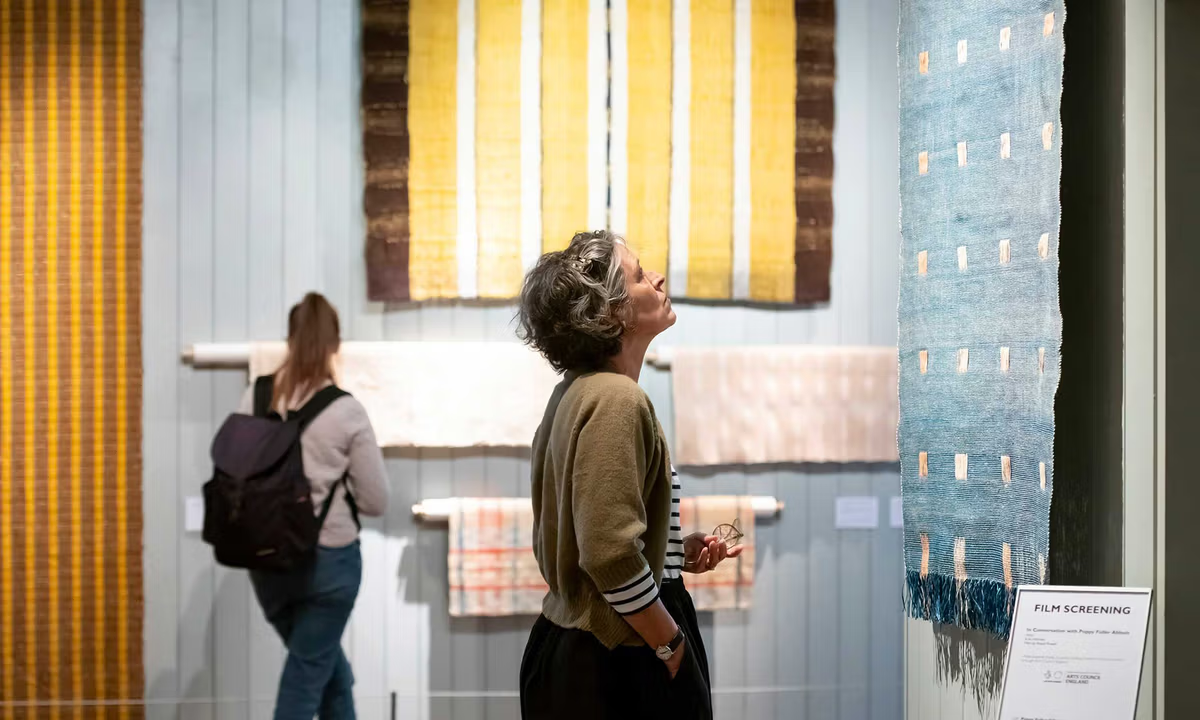
When the Ditchling Museum of Art and Craft in Sussex announced in January that it would temporarily close to the public as part of a planned pause to work out the institution’s next phase, fans far and wide uttered a collective “Oh no!”
The closure took effect the day after the last group exhibition, whose title It Takes a Village was lent greater poignancy by the love the local community professed in response. Deborah Humphrey, a local writer, posted on Instagram: “This so feels like a goodbye letter. I do hope you will reopen”. Caroline Kent, a local illustrator, offered her help. The affection felt by a local photographer, Michael C. Hughes, was plain: “Please do reopen soon. We love our museum and are so proud of it.”
In April, however, those hopes appeared dashed, at least for the time being. The board of trustees extended the closure, releasing all volunteers from their duties and making all staff redundant. The initial closure was an emergency measure to stabilise the charity, a spokesperson for the board tells The Art Newspaper.
The museum has since secured funding from the Association of Independent Museums, the National Lottery Heritage Fund and local donors to prevent permanent closure and pay for a period of “review and reimagining” to devise a sustainable operating model.
“A deteriorating financial forecast was the reason that trustees needed to close the museum, although the situation reflects much wider pressures facing independent museums across the country,” the spokesperson says.
According to research commissioned by the charity Kids in Museums in early 2025, as many as three in five small museums and galleries in the UK fear the same fate. Declining footfall and revenue are cited as reasons, in the wake of that now ubiquitous deadly trinity—Brexit, Covid and the cost-of-living crisis—not to mention the ongoing turmoil in local authority funding.
A short-term cash boost
In response to this longstanding problem in England, in April the Department for Culture, Media and Sport (DCMS) announced a first round of government grants from the Arts Everywhere Fund: £127.8m, to be distributed among 130 organisations around the nation. No museum will ever not welcome what that April announcement termed “a much needed cash boost”. The bigger question, however, is precisely what Ditchling’s stewards are confronting: is there a long-term solution to financial viability?
Earlier this year, Mapping Museums Lab, a research project jointly convened by Birkbeck, University of London and Kings College London, published an in-depth review of the 524 UK museum closures between 2000 and 2025.
The research shows that, while there are now more small museums than 25 years ago, it is that same bracket that has seen the highest closure rate. Conversely, more medium-sized museums closed than opened in that time, and over 50% of those that closed were council-run.
The museum is currently closed due to financial woes © Ditchling Museum of Art
“It was depressing how hard hit the local authority museums are,” says the director of Mapping Museums Lab Fiona Candlin, because those places were serving an audience. When asked to what degree museum attendance and local affection is taken into consideration in wider discussions over strategic funding, she says: “I think ‘not at all’ would be the answer.”
Closure is not necessarily a bad thing. Manchester’s decision in 2017 to shutter its Gallery of Costume was a solid strategic move, driven by the need to better cater to the local community around Platt Hall, its home for 70 years, and better steward the 25,000-strong collection by placing it in the more central Manchester Art Gallery. Fewer items are on display, but more people now see them.
In most cases, however, the museums were closed for financial reasons—or some political calculation around funding choices. This is despite the fact that closing an institution is, in itself, a costly business.
Candlin notes that, on the whole, collections from closed museums have been dealt with responsibly. “Honestly, I expected to find more horror stories,” she says. Where the council owns the building, local authority-funded museums’ collections tend to be left in situ because it is cheaper than paying for storage. In other cases, items are sent to bigger, national museums. For example, colour charts from the erstwhile Museum of Domestic Design and Architecture in North London and badges from York Racing Museum were dispatched to Tate Britain and the British Museum respectively.
The communities whose museums have been shut, however, have not only lost access to collections they valued, they are without a crucial part of the civic infrastructure. The degree to which the expert staff who lost their jobs have suffered, meanwhile, is clear in how few people will agree to talk about it. As Candlin puts it, “I’ve never had research that’s ghosted in the way that this research has been ghosted.”
The culture secretary Lisa Nandy announced in January, while under the previous Keir Starmer government, the investment of £1.5bn to save over 1,000 cherished arts venues, museums, libraries and heritage buildings across England from closure.
In that first raft of funding to 130 institutions, the DCMS made an effort to distribute this aid throughout England. The Museum Estate and Development Fund portion of the funding includes £2.4m for Hartlepool Borough Council to upgrade the Museum of Hartlepool; £3.5m for urgent repairs to Bristol Museum and Art Gallery; and £2m for York Museums Trust to repair and upgrade the Grade I-listed Yorkshire Museum.
Entrenched regional inequalities
However, Bethany Rex, a museologist at the University of Warwick, points out that these are short-term, one-off funding pots, which do not address years of underfunding and entrenched regional inequalities. “What remains unaddressed—and a football that no one seems to want to take up—is the ongoing revenue funding that enables museums to have confidence that they will still exist in five years, and the impact that has on employment practices, creativity, innovation etc,” she says.
Ditchling Museum of Art and Craft is a case in point. As a small independent charity, the museum receives no public revenue funding. It was shortlisted for Museum of the Year in 2014, after a £2.3m refurbishment, funded mostly from the Heritage Lottery Fund. But “the fine line that we have been balancing since reopening was reliant on visitor numbers and philanthropic donations both being strong”, the spokesperson for the board of trustees says. “Even a slight falter in either is enough to create real challenges.”
In April it was reported that DCMS had started work on the development of a new strategic framework for museums in England, as recommended in the Labour peer Margaret Hodge’s review of Arts Council England (ACE).
Rex says such a framework needs to include the question of how funding is balanced between national and local museums, and, crucially, “the question of revenue funding now that local governments have been so stripped down”. A further issue is how to balance what is free and what is paid for in terms of museum ticketing: “Are we seeing a quiet degradation of the free offer?”
When asked in May for details on what that framework will contain, and a timeline for its delivery, a spokesperson for the department said: “DCMS have already begun discussions with ACE on the scope of this strategic work. We will have more to say about our ambitions in due course.”
Following his appointment as prime minister on 20 July, Burnham dissolved the Department for Science Innovation and Technology, distributing its function between other departments. As a result, the DCMS is being expanded and restored to its previous iteration as the Department for Digital, Culture, Media and Sport, with Nandy remaining in post to head it up. A DCMS spokesperson confirms that the Arts Everywhere Fund programme and the new strategic framework for museums in England apply to the current parliament and so they will continue under Burnham’s government.
In his first speech at Downing Street, Burnham promised to unveil a ten-year plan in the coming months. The Campaign For the Arts organisation launched a petition on 25 July demanding that Burnham include the arts and culture in that plan. At the latest count, it has garnered over 22,258 signatures.
