


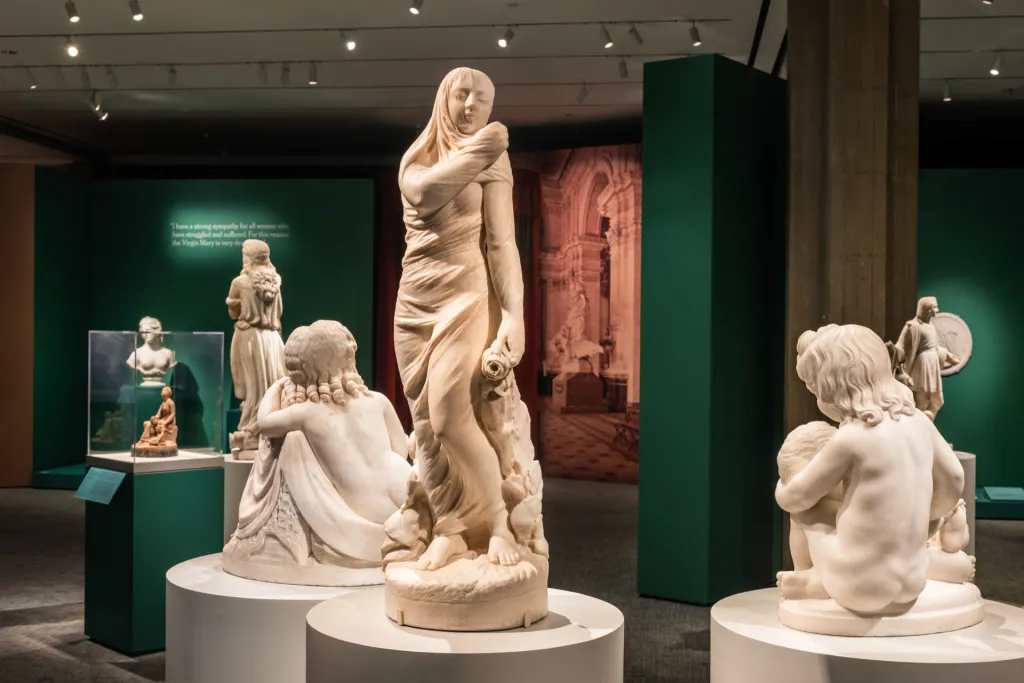
The Edmonia Lewis exhibition “Said in Stone,” currently at the Peabody Essex Museum, marks the first time that the tremendous late 19th-century sculptor has been featured in a comprehensive show of her own. More than a hundred years after unformed marble passed through her hands and into human form, her works are at long last assembled together to speak as a kind of family. As such, the museum serves as a space of historical vindication for an artist who struggled, rock hammer in hand, against mountainous odds. The show brims with stories that once chiseled their way out of one determined Black, Indigenous woman’s heart and hands.
I’m only a poet who stumbled upon her story a little over a decade ago. I’d read about the artist, also named Wildfire, who reached inside the earth to grapple and grind with her own understanding of history and consequence. The girl who grew up with Ojibwe family weaving, her mother’s traditional patterns traced into her consciousness. The young woman who sojourned to Oberlin College, where she was wrongfully accused of poisoning her classmates and beaten half to death, who raised her hands in defense of herself, then went on to grip clay and rock and chisel to re-create visions of justice. Today, finally, those who have read of her tenacious, vibrant work and life story can gather to stand among her body of work, her family of sculptures, her diasporic nation of stone imagination and historic figures reunited under one roof.
As I wander through the museum, I catch notice of her triumphant Forever Free (1867), a work that represents, as far as we know, the first formal visual representation of emancipation by a Black American artist. I can only imagine what she must have felt constructing this work. Standing for the first time free of coffles on his feet, a man holds his broken chain aloft in a gesture that predates the Black Power fist that would become popular a century after this sculpture was hewn from rock. Kneeling beside him is a young woman with hands clasped in prayer in this moment of freedom. I find this sculpture especially moving in its seeming simplicity and in the way it echoes through time. I have come to think of it as a gravestone for chattel slavery in America. The statue is her representation of freed Black folks who can see themselves as living grave markers for the bondage that had held them captive.
The sheer magnitude of her work comes vividly alive in the exhibition. I imagine the sculptures talking with each other, sharing their origin stories, whispering to each other through their polish and pose, all bearing witness to Edmonia’s remarkable mission.
Two warriors gleam in the midst of Indian Combat (1868) and continue their brawl to the death, one knife-edge away from mortality. Hiawatha (1868) appears as if he is about to recite his own tale in his own tongue beyond the words of Longfellow (1871), whose bust also resides in silent contemplation of his graven peers. Around another corner is Hagar in the Wilderness (1875), still inhabiting the wasteland around her after being scorned by Abraham. But here in this exhibition she is also among her kin, the inheritance of Edmonia, and thus the searching in her eyes feels more seen and less alone.
Another witness is Colonel Robert Gould Shaw (1864), resurrected from his resting place among the Black soldiers of the 54th Massachusetts Infantry. Here he bears double witness to the mastery of Edmonia and to the sacrifice of the brothers who gave their lives to fight against bondage. In another corner, an Anishinaabe weaving seems to foretell Edmonia’s ability to weave between cultures and continents. The weaving testifies to her ability, like her mother’s, to take from tradition and make it speak anew to her own circumstances.
The many works in this exhibition invite speculation. What would have happened if Edmonia had felt the freedom to create expansively within the borders of the US and had not decided to roam to Rome? What were her feelings about being an expatriate in the years after the Civil War? How did she develop such a complex understanding of her craft under such dire conditions? How did she feel when she finally wiped a cloth over the finishing touches of her work? How, indeed, did it ever occur to this small, brown woman born in a time of enslavement that she had the calling to excavate the earth and shape visions that would be witnessed through the centuries?
There is a word that I had not thought much about before truly discovering the legacy of Edmonia Lewis—provenance. According to the dictionary, this word means a record of ownership. Who owns what? Who and where did they get it from? How often has it changed hands? It seems to me that Edmonia was deeply concerned with this concept as she toiled over stone after stone, sculpting face after face; as she inscribed her very self into each millimeter of marble. Not only was she writing her name into the stone, she was claiming ownership over history and myth, clawing her people’s stories out of the side of mountains, hauling them across oceans, and displaying them in front of audiences that would generally have no compulsion to listen to anything that came from a Black and Native woman’s mouth.
Thankfully, this exhibition is a long overdue opportunity to witness Edmonia’s provenance speaking for her, to assemble sculptures together in a shimmering, chiseled chorus. I only wish I had known about the legacy of Wildfire earlier in life when I was growing up. I am immensely glad that new generations will be able to share the wondrousness of this display as it travels to the Georgia Museum of Art in the fall and to the North Carolina Museum of Art next spring. To walk through the galleries of her works is to witness the battle for the provenance of a nation’s story, a people’s progress. This grand procession of Edmonia’s work is an act of reclamation—a gathering in her name that shouts through stone and into the eons.
