


The politician behind the proposal to charge overseas visitors to national museums in England has discussed the controversial topic in detail in the UK parliament, explaining she thinks that digital ID checks would need to be implemented first.
The Labour peer Margaret Hodge published her review of the UK public funding body Arts Council England last December which, she said, provided “a clear path, with a range of new initiatives that cover everything from new funding models to fundamental systems reform”.
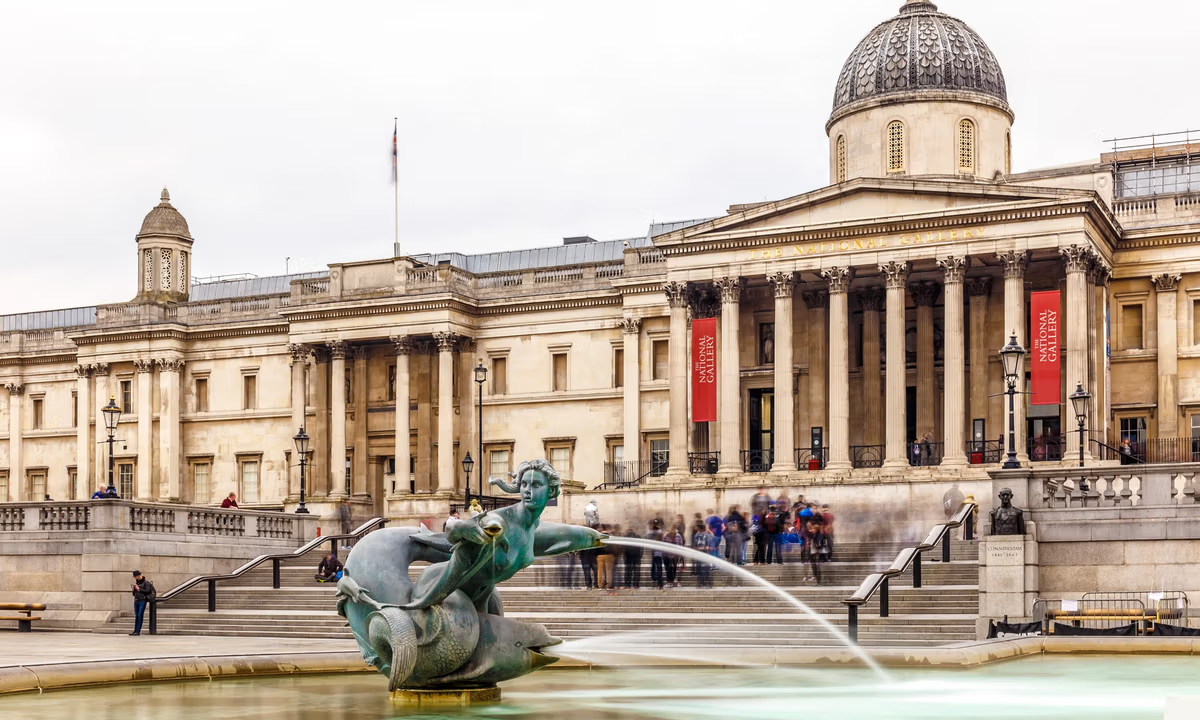
The proposal that has garnered most attention centres on possible admission fees for tourists at national museums in England which, the UK government says, could “provide significant benefits”. In a recent address, Hodge suggested that such a measure would however require digital ID checks at museums entrances.
As first reported by the Museums Association, Hodge told the Communications and Digital Select Committee (14 April): “I would be totally opposed to us doing anything about charging for museums until we have that universal system [of digital ID].
“Just think about it: a Black kid comes up and the person on the desk says, ‘Are you a foreigner?’ There’s implications that you could have from that which would be completely against the spirit of everything that we want to achieve as a community in terms of cohesion… So we should not do it until we have universal ID cards.”
Digital ID has been the subject of renewed debate in the UK recently, with concerns raised over whether personal data will be kept secure.
Hodge said that introducing entrance fees at English national museums, would “bring in less than ten million [pounds]. She added: “It’s not worth doing it, and the hassle for it, and the unfairness, if you don’t have a clear way of identifying who’s who”
She also highlighted the “measly” pot of money available for arts spending, compared to that in other countries. “Berlin spends 525 million, pounds or euros, on arts and culture—one place; if you look at Arts Council on its NPO [National Portfolio Organisations] programme, it spends £458m,” she said. “And the Mayor of London spends £18.7m… we are pretty miserly [on arts spending].”
The proposal to introduce fees has drawn criticism from major figures cultural sector. Maria Balshaw, the outgoing director of the Tate, said in March: “What does it say to people from the rest of the world if we say, ‘We’ve got your stuff, but we’re going to charge you to come in’? I don’t like that idea.”
An ‘arm’s length principle’
In its long-awaited response published last month, the government said it “strongly agrees” with Baroness Hodge that there must be a national Arts Council, and that the “arm’s length principle”—the principle that ensures Arts Council England’s individual funding decisions are taken outside of political interference from all levels of government—must be protected.
The government also backs Hodge’s ideas for overhauling the model for National Portfolio Organisations which receive regular funding from ACE.
“[NPO reform] would be the first thing that I would grasp, particularly because we’re embarking on a new round, and I hope that some of some of my recommendations into that reform can be adopted quickly,” Hodge told the committee.
Hodge also said that philanthropy should be encouraged. “I’m very keen for totally pragmatic reasons that we should encourage more philanthropic giving. If you look at the public finances, much as I would love to think we could double the amount of money the Arts Council [gives]… that’s unrealistic over the next [parliamentary] period,” she said. Hodge also said philanthropy must be encouraged outside London and says that “a differentiated tax relief [scheme]” might be “worth a try”.
She added that “if you look at the French system, I think individuals get about 66% tax relief, corporations get a 60% tax relief, and the increase there on the amount of money…. in 2004 a billion [euros] went into arts and culture, by 2018, when [the Aillagon] law was in, it was four billion.” Under the Aillagon law in France, which came into force in 2003, companies that invest in culture can claim up to 60% in tax breaks for cultural philanthropy. For individuals in France, a gift to a charity or a charitable organisation is eligible for a tax reduction of 66%.
Hodge was also critical of so-called cancel culture. “This is a really, really difficult issue,” she said. “What I do think is the Arts Council, if it got back to its development agency role, because it’s supposed to be the organisation that thinks about the future and tackles the difficult issues, I think [it] ought to develop a protocol, because the cancelling has got too much and too wide and it’s scary… certainly for corporations, it has been a real turn off for putting money into the arts.”
