


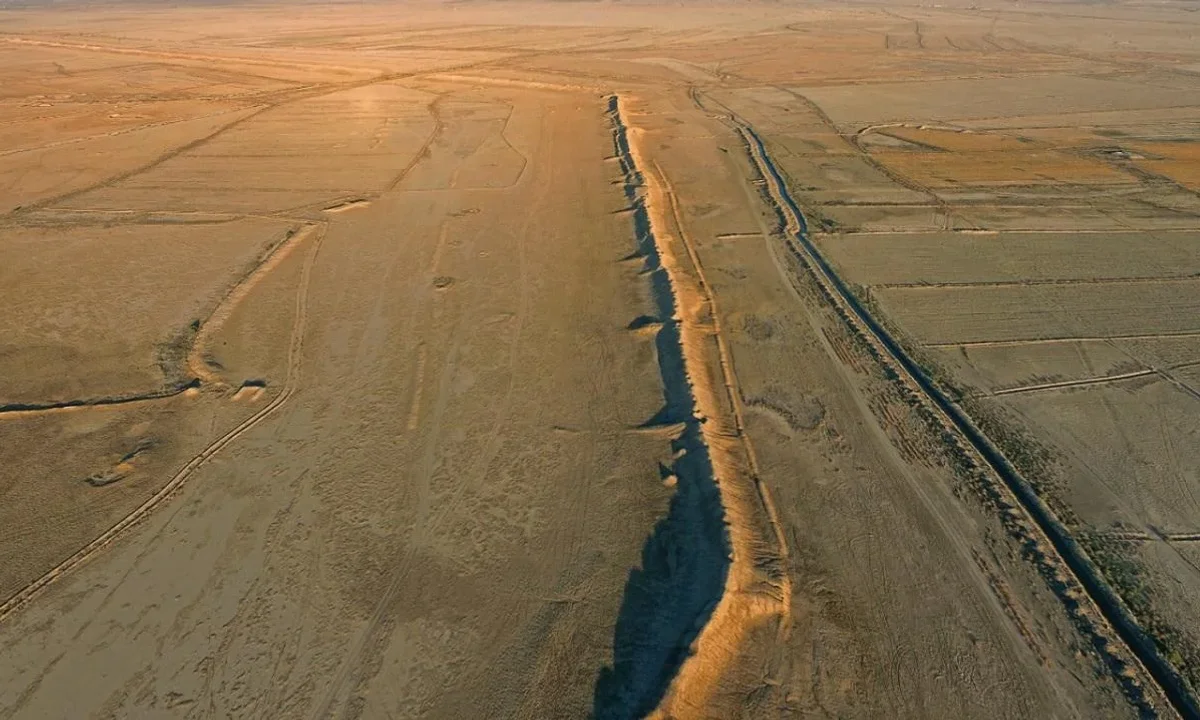
Excavations at an ancient “lost” city in Iraq recently rediscovered by archaeologists have been postponed due to the ongoing war in the region, Stefan Hauser, an archaeology professor at the University of Konstanz in Germany, tells The Art Newspaper. The city, named Alexandria on the Tigris—located near Basra, close to the border with Iran—was founded by Alexander the Great, the king of the ancient Greek kingdom of Macedon, in 324 BC. The results of recent research on the site were published by the University of Konstanz in January.
Hauser calls the “ill-advised” Israeli and US attack on Iran “a complete catastrophe” in many respects. “The Iraqi airspace is closed and there is hardly any other way to enter or leave the country. We were planning a campaign of geophysical work which had to be postponed. If we are lucky, we can apply again for autumn,” he says.
Given the geography of the site itself—flat, with the ruins below ground—the potential for the remains to be damaged in any conflict is low. However, the site was formerly used as a military camp and its wall as part of the second defensive line in the Iran-Iraq War (1980-89), Hauser says. “Mary Shepperson did a great study on this in which she documented 2,000 changes to the site’s surface due to trenches [and] tank protection,” he adds.
The University of Baghdad and the Iraqi Antiquities Authority had been planning a major conference for the end of March, the 71st Rencontre assyriologique internationale, which has now been cancelled due to the “security situation”, according to its website. During the current conflict, at least 82 people have been killed in Iraq and dozens injured, according to Iraqi health authorities.
Alexandria on the Tigris
Drone imagery and geophysical surveys have revealed that Alexandria on the Tigris was a key regional trade hub. Subsequent analysis using a cesium magnetometer—an instrument capable of non-invasively detecting anomalies in the Earth’s magnetic field caused by buried structures—identified four main civic areas of what turned out to be a giant metropolis across some 500 sq. km: a residential district, a palace, a river port with workshops and an agricultural irrigation system.
Abandoned in the third century when the Tigris River changed its course and sedimentation restricted port access, Alexandria on the Tigris was also known as Antiocheia in Susiana and subsequently Charax Spasinou (the rampart of Hyspaosines) after its re-establishment by a local ruler. The city languished in the desert until the mid-20th century when the researcher John Hansman reviewed aerial photographs and connected vestigial structures in an area known as Jebel Khayyaber, near Basra, and a description of Alexandria on the Tigris written in the first century by the Roman author Pliny the Elder.
Columns from a palace on the site of Alexandria on the Tigris
© Charax Spasinou Project 2022 (Robert Killick)
Ongoing political and security issues, especially the Iran-Iraq War, made further research difficult. Then in 2014, the British researchers Jane Moon, Robert Killick and Stuart Campbell were allowed to access the site, albeit under tight security. They invited Hauser—one of the few experts in post-cuneiform Near Eastern archaeology—to join them.
A long history of neglect around the study of this historic period has compounded accessibility issues, according to Hauser, who is leading the Alexandria on the Tigris project. “When the various academic disciplines developed, the period between the end of cuneiform—more or less mid-first millennium BC and the advent of Islam—was sidelined,” he explains.
Hauser says this has changed in recent years, with a growing interest in post-cuneiform Near Eastern archaeology globally. However, he believes that the Arsacid (or “Parthian”) empire—which lasted from 250 BC-226 AD and was “the eastern equivalent/partner/sometimes enemy to Rome between 140 BC and 226 AD”—has often been misinterpreted as having poor internal organisation. Excavating Alexandria on the Tigris, the capital of one of its core provinces, will “help to validate its structure”, Hauser tells The Art Newspaper.
It is hoped that when further work in Alexandria on the Tigris is able to resume it “can and should help to rebalance our historical perspective” on the Arsacid Empire, Hauser says. “As a kind of reality test, it helps to demonstrate the might and organisation of the Arsacid Empire (the great unknown in the history of the Near East) and illustrates the intense connectivity of long-distance trade in antiquity—which, indeed, was the reason for Alexander to found this city in the first place.”
