


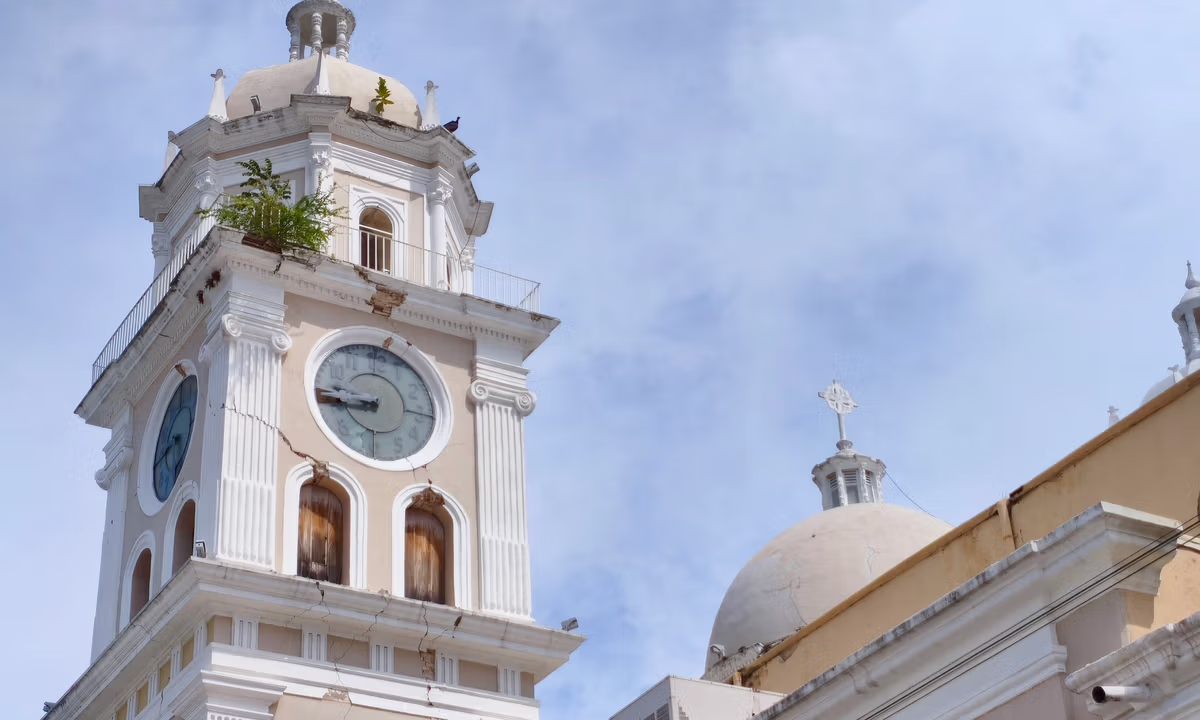
Venezuela is still reeling from the death of more than 3,000 people caused by the two major earthquakes that struck on 24 June. In addition to the devastating human toll, the country’s architectural heritage has been greatly affected. Among the more than 58,000 buildings destroyed, including vital infrastructure and hospitals, are many national monuments.
According to the archaeologist José Miguel Pérez-Gómez, an associate researcher at the Simón Bolívar University, the most affected areas appear to be Caracas and the nearby city of La Guaira. The narrow strip of coastline between the sea and the mountains that comprises La Guaira was particularly vulnerable because, as Pérez-Gómez tells The Art Newspaper, “when the earthquakes hit, the seismic waves bounced back and forth from the Caribbean to the mountains”.
La Guaira, with its remarkable collection of colonial buildings, was added to the Unesco World Heritage tentative list in 1999. The city was founded in the late 16th century as the port of Caracas and connected to the capital by road. It was fortified in the 18th century to protect the city from pirates. In 1812, La Guaira was hit by an earthquake. As a result, several houses were rebuilt in the colonial style, including Casa Guipuzcoana—the old headquarters of the Spanish company that first established a trade monopoly in 1728.
Casa Guipuzcoana, a national monument and symbol of Venezuelan patrimony, “should be included in the post-earthquake emergency inventory as a priority for inspection”, Pérez-Gómez says, “to verify cracks, roof movement, damage to timber components, wall displacement and risk to collections or archival materials. Immediate technical inspection is essential for historic and religious structures already weakened by age, humidity, previous deterioration and lack of maintenance.”
Reports from Catholic relief organisations and Vatican News indicate that the San Pedro Apóstol Diocesan Seminary in La Guaira suffered major structural damage, including the collapse of many of its walls, forcing clergy and seminarians to evacuate.
Other architectural casualties include the near-total collapse of the façade of the San Sebastián de Maiquetía Church and structural damage to the San Pedro Apóstol Cathedral and the Ermita del Carmen in La Guaira, as well as Nuestra Señora de la Candelaria Church in Tarmas (a national monument). Additionally, there was a partial collapse of the Hotel Miramar in Macuto (once a symbol of Beaux Arts glamour and a national monument) and the destruction of the Gran Hotel Palmar in Caraballeda (a former icon of mid-century tourism), structural damage to the Quinta Azuleja in Macuto, and the partial destruction of La Cuchilla fort (built in 1770 to protect against piracy).
“In La Guaira, colonial and ecclesiastical heritage remains highly vulnerable to further aftershocks, rain and instability”, Pérez-Gómez says. At the same time, he adds, little is known about the fate of the city of Coro and its port, a Unesco World Heritage site close to the earthquakes’ epicentre.
In Caracas, the Metropolitan Cathedral was damaged and a dozen other parishes in the earthquake zone were affected. The roof of the right nave of the Church of San José de Ñauralí collapsed, as did the Church and Parish House of Pagüita.
Sadly, like many of the newer buildings that collapsed as a result of shoddy workmanship and a lack of seismic upgrading, much of this destruction was preventable. According to a newspaper article that has gone viral in Latin America, Japanese earthquake experts warned then-president Hugo Chávez more than 20 years ago of the vulnerability of Caracas and La Guaira.
The anthropologist Abílio José De Oliveira Simao (the president of the Ibero-American Institute of Advanced Studies in Heritage, Tourism and Environment) laments the lack of foresight. “Although any building can suffer damage during an earthquake, there are ways to minimise the risk and reduce the impact,” he says. “Unfortunately, Venezuela does not currently have an effective public policy for the protection of cultural heritage.”
Despite existing heritage laws, Oliveira adds, there are no consistent state policies to ensure their implementation. As a result, there is a lack of both trained professionals to monitor and protect cultural heritage and resources that could be used in emergencies. This pertains not only to structural conservation but to broader issues related to environmental impact and preventive measures.
“The lack of resources directly affects the country’s ability to respond,” Oliveira says. “It also highlights the urgent need to create a dedicated fund for the protection and emergency care of cultural heritage assets, as well as the establishment of appropriate technical standards and protocols for their preservation. The limited institutional intervention, the absence of clear public policies, the lack of a strong governing body, the shortage of resources and the insufficient number of specialised professionals all contribute to the deterioration of cultural heritage. The consequences are precisely what we are seeing today.”
