


For a city as iconic in the global imaginary as Hong Kong, there are surprisingly few broad histories of its art. Filling that gap is Oscar Ho Hing-kay’s Hong Kong Art: A Curator’s History (1987-2004). More curatorial memoir than conventional survey, the book focuses largely on the years around the UK’s 1997 handover of Hong Kong to China, though in introducing the earlier artists, movements and debates that shaped the city’s visual culture, the book offers up one of the most accessible introductions to a history that is surprisingly little known.
This curator’s history gets going in earnest with Ho’s return from graduate studies in California in the 1980s to a Hong Kong where contemporary artists “remained a minority who existed on the fringes of the local art scene, their ideas and works often not appreciated or accepted by the city’s mainstream art establishments”. The book is at its most vivid when Ho’s first-person account captures the frictions of this period: for instance, when the senior Modernist sculptor Van Lau declared works by Ho and Ricky Yeung Sau Churk—filled with soil, twigs and asphalt—not to be “sculpture” at all (thankfully, the curator Michael Chen disagreed). Or when the artist Chan Ching Wah spray-painted her own painting black at an opening in protest at the selection criteria of the Hong Kong Art Biennial Exhibition. Here was a scene struggling to accommodate artistic experimentation.
Promoting new practices
If these disputes revealed the limits of Hong Kong’s art institutions, the 1987 exhibition Out of Context revealed what lay beyond them. One of the first exhibitions Ho discusses in detail, it brought together artists working in installation, performance and photography—practices largely absent from the mainstream institutions. Among the most memorable works was a two-day performance by Ricky Yeung, who chained himself inside a bamboo cage, half-naked and covered in blood-red paint, crawling and howling in a reflection on both the monotony of office life and the anxieties surrounding Hong Kong’s future. More important, however, was what the exhibition revealed about the scene itself. As Ho recalls, the title referred to artists “displaced in a cultural climate that is often indifferent to their activities”; even the art historian David Clarke reportedly remarked that he had no idea such a group of artists existed in the city.
The bulk of Hong Kong Art: A Curator’s History, however, focuses on the exhibitions Ho organised as the artistic director of the Hong Kong Arts Centre between 1988 and 2001, where he aimed to demonstrate that Hong Kong possessed a culture worth taking seriously. This may sound like an odd proposition today in a city with institutions such as M+, Tai Kwun, Asia Art Archive and Para Site, among others. Yet Hong Kong long occupied an uneasy, marginal position: looking simultaneously towards China and the West—and slurred as a “cultural desert”—while struggling to recognise its own cultural specificity. As the homegrown theorist Ackbar Abbas observed, colonial Hong Kong tended to regard culture as something that came from elsewhere. In such a context, exhibitions became one of the few places where a cultural narrative about Hong Kong itself could be assembled.
Broadening boundaries
At the Hong Kong Arts Centre, Ho set about broadening what counted as art—pushing back against aesthetic standards shaped by seniority and master-disciple hierarchies—and whose stories it could tell. His first exhibition, Living with Art (1988), dispensed with the jury system then prevalent in official institutions, allowing anyone to exhibit. Other examples included Hong Kong Sixties: Designing Identity, which treated design, popular culture and everyday visual life as worthy of serious attention, while Art in the Camps expanded that inquiry to Vietnamese refugees living in Hong Kong’s detention camps.
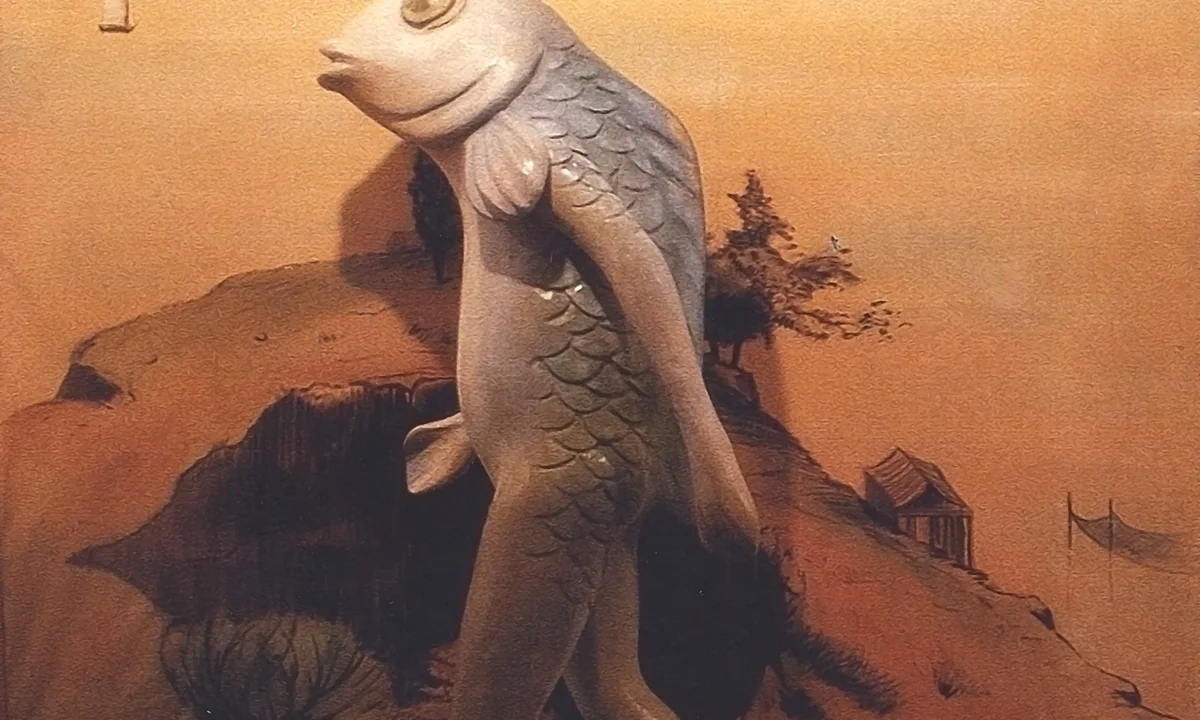
If many of Ho’s exhibitions sought to broaden the boundaries of Hong Kong culture, the looming handover gave such questions a new urgency. The countdown to 1997—and the anxieties intensified by the Tiananmen Square crackdown of 1989—prompted artists and intellectuals alike to ask what Hong Kong was, and what it might become. Against this backdrop, Ho’s most influential curatorial intervention dealt with the legend of Lo Ting, a half-human, half-fish creature said to inhabit the city’s Lantau Island. Ho transformed the myth into a series of pseudo-historical exhibitions, combining archival materials, works by contemporary artists, and fabricated evidence that deliberately blurred fact and fiction. By appropriating the authority of the museum itself, the exhibition challenged who gets to define history and identity. In the process, Lo Ting became a powerful metaphor for Hong Kong: a place searching for its origins while confronting an uncertain future.
Hong Kong Art: A Curator’s History is necessarily partial. Readers may wish for more on, for example, the Oil Street Artist Village, or the controversies surrounding the West Kowloon Cultural District. Rather than a definitive history, it offers something more personal and, at times, more revealing: a poignant account of one curator’s attempt to make sense of a place grappling with profound historical change—and to ensure that a crucial chapter of its artistic life is not forgotten in this “city of disappearance”.
• Oscar Ho Hing-kay, Hong Kong Art: A Curator’s History (1987–2004), Rizzoli, 288pp, 200 col. illust., $65 (hb), published 8 September
• Daniel Szehin Ho is the executive editor of CONG, a journal of ideas, art and the urban imagination in Asia
