


South Asian modern art is having a very good run. Auction sales topped $100 million last year, records have tumbled, and Christie’s and Sotheby’s have both made a show of the category in London this summer.
There is, however, a problem with all that new money: forgeries.
Dealers and specialists say forgeries are proliferating as prices for artists including S.H. Raza, M.F. Husain and Sadequain have climbed, according to the Financial Times. Dadiba Pundole, whose Mumbai gallery represented several leading Indian modernists during their lifetimes, estimates that as many as one in 10 modern artworks sold privately in India could be fake. “There have always been some fakes, but in the last 15 years values have gone up, so there’s been a spurt,” Pundole told the FT. “It’s become a real menace.”
Charles Moore, of London’s Grosvenor Gallery, said he is offered a likely fake by private sellers “every couple of weeks.” Once, the obvious targets were the biggest names. Now, he said, prices have risen enough that “it pays to forge the middle-market artists too.”
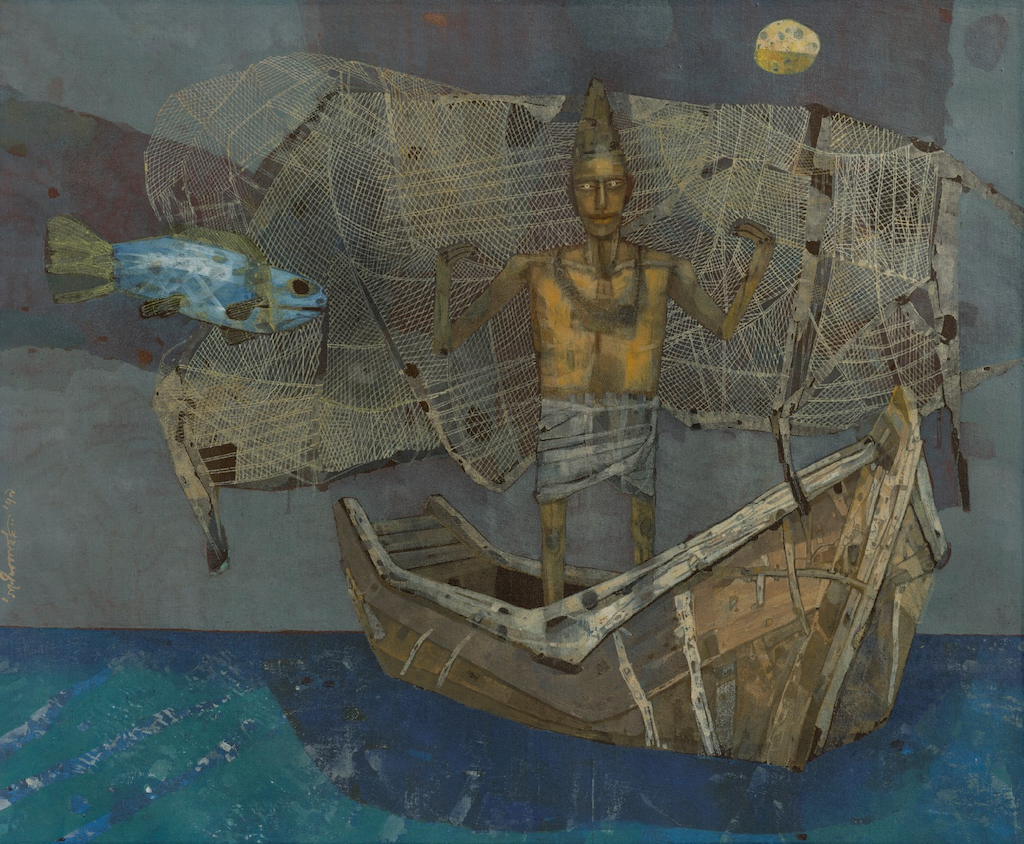
The numbers help explain the temptation. As mentioned, South Asian modern art exceeded $100 million in auction sales in 2025, capping several years of increasingly muscular results. In June, Christie’s first dedicated London auction of South Asian art since 2019 brought in $25.5 million, with all 93 lots finding buyers. Ganesh Pyne’s The Fisherman, estimated at $340,000 to $476,000, sold for $5.22 million and set an auction record for the artist.
The forgery problem is not isolated to India. In Pakistan, Lahore-based artist and academic Salima Hashmi estimates that she sees images of 60 to 70 forged modern works offered for sale over WhatsApp each year. Most will be spotted by experienced buyers. The worry is what happens to the ones that aren’t.
Sadequain, the celebrated Pakistani modernist whose paintings have fetched six figures, provides a useful warning. Specialists told the FT that an influx of forgeries has already cooled his market. “When people can’t tell any more whether they are dealing with the real McCoy, why would they pay premium prices?” collector Hameed Haroon told the paper.
The fakes themselves have improved, too. Haroon said early examples were often crude, produced cheaply by struggling artists working for unscrupulous dealers. Today, some are convincing enough to fool experts, helped along by a market where documentation is scarce and comprehensive catalogs and archives are rare. That leaves a great deal to the eyes and memories of dealers, collectors, and specialists.
Another tricky spot: saying publicly that something is fake can be risky. Criminal defamation laws in India and Pakistan can make experts reluctant to challenge questionable works openly. “You can’t say anything publicly,” veteran Mumbai dealer Shireen Gandhy told the FT. “But if you know someone, privately you can say ‘Don’t touch it’.”
Auction houses have their own defenses. Manjari Sihare-Sutin, who heads Sotheby’s South Asian Modern and Contemporary department, said her team rejects an average of two works ahead of every sale because of authenticity concerns. When a work arrives without adequate documentation, Sotheby’s can turn to outside specialists, artists’ families, and an archive of unpublished material the department has assembled over the years. There is also the less scientific tool that has always mattered in the art trade: looking at a lot of art.
“The eye is trained by having seen so many works over the years,” Sihare-Sutin said. If the answer still isn’t clear, “we simply don’t offer it.”
The broader market is harder to police. Online sales accounted for 15 percent of the global art market last year, and collectors can increasingly buy from smaller auction houses halfway around the world based on catalogue photographs. That has removed one of the art trade’s established filters: the dealer who knows what he or she is looking at.
South Asia is hardly alone in confronting the problem. Last month, two former managers of Shanghai Jiahe Auction Co. were sentenced to 14-and-a-half and 12 years in prison for a fraud scheme that led a collector to spend roughly $74 million on more than 40 objects, many of them later found to be counterfeit or grossly overvalued.
One example was almost comically extreme. A vase sold as an 18th-century Qianlong-era work for $247,000 was later appraised as a modern reproduction worth about $37.
Japan, meanwhile, has spent the past several years untangling another mess. Works linked to notorious German forger Wolfgang Beltracchi have turned up in museum, corporate and gallery collections there. Last year, ARTnews reported that a painting long considered a Moïse Kisling masterwork in the collection of Japan’s Yamada Bee Company Group had been linked to Beltracchi. Suspected works by the forger had already surfaced in Japanese museums, including a supposed Heinrich Campendonk purchased by the Museum of Art, Kochi, in 1996.
For South Asian art, the timing is particularly awkward. The category is enjoying precisely the sort of international attention dealers and collectors have spent decades trying to build. New buyers are arriving. Prices are rising. And the more valuable the art becomes, the more worthwhile it becomes to fake it.
Pundole thinks the danger is bigger than any individual bad painting. “It just takes one scandal,” he said, to knock confidence in an artist—or an entire corner of the market.
