


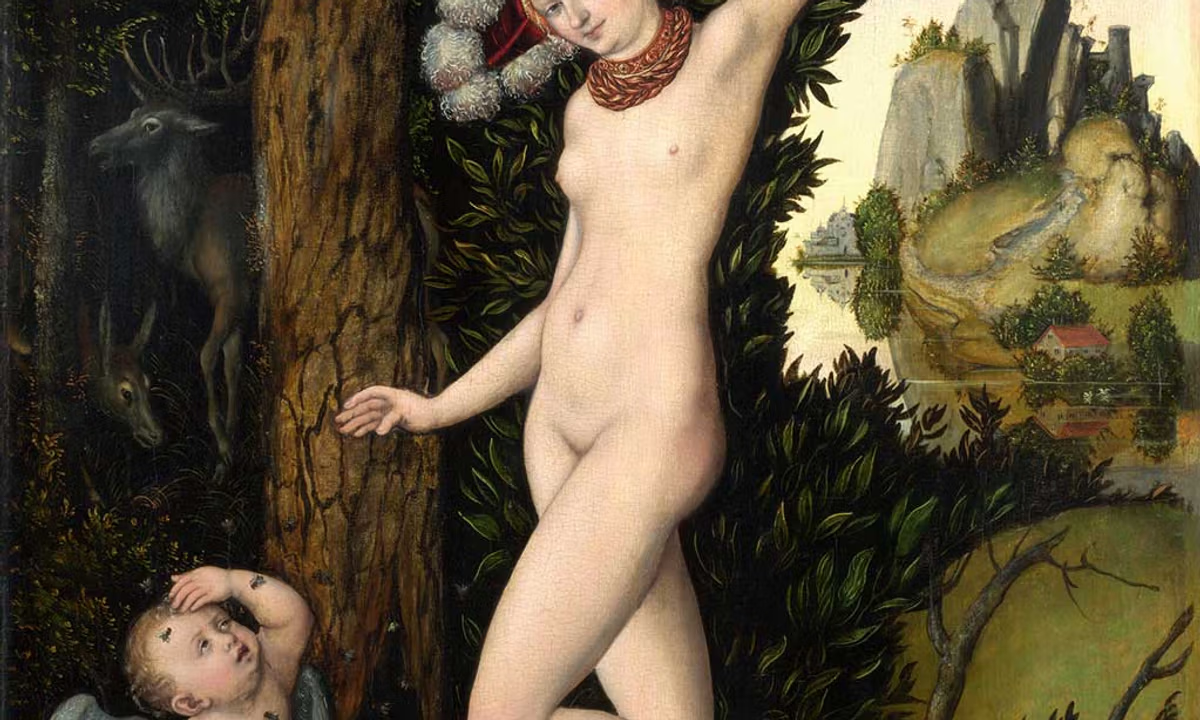
A National Gallery masterpiece by Lucas Cranach the Elder once hung in Adolf Hitler’s private apartment in Munich. We are reproducing an early 1940s photograph revealing that the Führer placed Cupid complaining to Venus (1526-27) in his sitting room. This is the first time that the photograph has appeared in an English-language publication. (It was previously published in Germany by Birgit Schwarz, an expert on Nazi-era provenance.).
In 1963, the National Gallery bought the Cranach painting in good faith from E. and A. Silberman Galleries in New York. According to the National Gallery’s recently retired curator Susan Foister, the dealer had provided “a false provenance”.
Abris Silberman, the dealer’s co-founder, had written to the National Gallery that the Cranach had sold at auction in 1909 and then “through inheritance the painting became the possession of the party from whom we obtained this picture”. This was untrue. Silberman had bought the painting from an American former war correspondent who had acquired it in the most bizarre circumstances.
My mother was told she could go into the warehouse and pick out whichever piece she wanted. She then smuggled the painting into the United States.
In 1945 Patricia Lochridge, then a 29-year-old journalist writing from Germany for the magazine Woman’s Home Companion, was invited to participate in what was effectively a stunt. For one day in late May or early June, the commander of American forces in Germany’s Berchtesgaden area appointed her burgermeister (mayor). Berchtesgaden, very close to the Austrian border, was where Hitler had established his Alpine redoubt.
Hand-picked painting
On her day in power, Lochridge was taken to a storehouse of recovered art and told by American forces that she could choose a painting to take home. Lochridge selected the Cranach. Her son Jay Hartwell explained to the National Gallery in 2004: “My mother was told she could go into the warehouse and pick out whichever piece she wanted. She then smuggled the painting into the United States.”
In this early 1940s photograph, later published in a 1978 furniture auction catalogue, the Cranach painting is just to the right of the door Auktionskatalog Hermann Historica, Munich
The National Gallery has since 1999 been completely open and transparent about the Cranach’s lack of a proper provenance for the Nazi period (1933-45). A spokesperson tells The Art Newspaper: “We continue to welcome any further information relating to the painting as part of this ongoing and longstanding research.”
The key questions are: Who was the owner of Cupid complaining to Venus in the 1930s before it appeared on Hitler’s wall? And was the painting seized from a Jewish collector or the subject of a “forced” sale?
We can now at least establish which year Hitler probably acquired the work, although its source remains a mystery. Cupid complaining to Venus appears in a slightly blurred early 1940s snapshot of the interior of Hitler’s Munich apartment at 16 Prinzregentenplatz. The photographer is unknown.
The photograph emerged in an unexpected place, published in a furniture auction catalogue, where it was reproduced in order to authenticate a set of shelves that was being sold with a Hitler provenance. This was in Munich’s Hermann Historica auction of 10-11 November 1978. It went unnoticed at the time that the Cranach appeared in the photograph, in the corner of the sitting room.
Schwarz, a specialist who is writing a book on Hitler’s personal art collection, later cleverly spotted the Cranach. She published her detailed findings in German in Kunstchronik (December 2023).
Clues from Fascist sympathiser
A contemporaneous written reference to the Cranach in Hitler’s apartment appears in a 1937 book by the British journalist and fascist sympathiser George Ward Price. In I Know These Dictators he reported having visited the home of Hitler, who had “recently acquired a Cranach and two Bruegels for his Munich flat”. Price had interviewed Hitler in Munich in March 1936, which suggests that Cupid complaining to Venus may have been acquired in 1935.
Hitler owned an extensive private art collection and by the early 1940s had access to the several thousand works that had been acquired for his projected Führermuseum in Linz. The fact that he chose the Cranach for his sitting room suggests that he felt a particular personal affinity for Cupid complaining to Venus. It was in this room that Hitler often entertained his mistress, Eva Braun.
In 2006, Schwarz discovered an album, at the US Library of Congress, of photographs of individual paintings in Hitler’s collection. The Cranach was included. But the sitting room photograph establishes an even closer link to the Führer, since the picture was hung in his private apartment.
The only certain fact about the earlier provenance of Cupid complaining to Venus is that it had been auctioned in Berlin in 1909, when it was bought by an unidentified dealer. It is possible that it is a Cranach of the same subject that was sold in 1935 by the Chemnitz-based collector Hans Hermann Vogel to a Berlin buyer whose surname is recorded as Allmer, although this painting was recorded as having slightly larger dimensions.
Cupid complaining to Venus could have been acquired by Hitler in 1935 at a fair market price, but by that time it is much more likely that it was seized from a Jewish collector or sold in a “forced” sale. So far, no descendants of the pre-1935 owner have come forward. Sadly, this could mean that an entire family was wiped out in the Holocaust.
The Cranach painting depicts the winged figure of Cupid, who is complaining to Venus, the naked goddess of love, that he has been stung by bees. He holds the honeycomb that he has taken from them.
One wonders whether Hitler—who enjoyed what was probably a stolen masterpiece—noticed the short text the artist had inscribed in the upper-right-hand corner of the painting. (It is now barely visible in reproductions.) Cranach’s text explains that Cupid was stung because he had been “stealing” honey from a beehive.
Mayor for a day
The extraordinary story of Cupid complaining to Venus began to unravel in 2006, when The Art Newspaper reported Patricia Lochridge’s account of how she had been appointed the mayor of Berchtesgaden for a day in 1945. She had begun her report in Woman’s Home Companion (July 1945) with an explanation: “Suppose you had the job of governing Hitler’s hometown of Berchtesgaden. How would you meet the problems of a wrecked German town? I tried it for a day.” As something of an escapade, the young female journalist had been appointed by lieutenant Robert S. Smith, the head of the military government for the area.
Lochridge then went on to discuss looted art: “As governor, I found I was also responsible for the safety of Göring’s [Hitler’s deputy] $100m worth of stolen art.” She visited the secure store in the nearby village of Unterstein, which held 1,375 paintings, including five Rembrandts, along with works by Van Dyck, Rubens and Canaletto. On being allowed to take one painting, Lochridge chose the Cranach.
After the war, Lochridge worked for Unicef in New York. She married and then used her husband’s surname, Hartwell. Although she may have had her suspicions about the origin of the Cranach, she would never have known that it had once hung in Hitler’s sitting room. In New York, it was in her own sitting room.
In 1962, the Hartwells offered to sell the work to New York’s Metropolitan Museum of Art, but a sale never went ahead. The following year, the painting was sold to London’s National Gallery. Lochridge died in Hawaii in 1998.
- This article appeared in the May 2026 issue of The Art Newspaper
