

Close Menu
  • News
  • Stocks
  • Bonds
  • Commodities
  • Collectables
    • Art
    • Classic Cars
    • Whiskey
    • Wine
  • Trading
  • Alternative Investment
  • Markets
  • More
    • Economy
    • Money
    • Business
    • Personal Finance
    • Investing
    • Financial Planning
    • ETFs
    • Equities
    • Funds

Subscribe to Updates

Get the latest markets and assets news and updates directly to your inbox.

Trending Now

Malo Chapuy’s Neo-Medieval Paintings Conjure Apocalyptic Visions

August 3, 2026

Unesco urged to investigate after Israeli forces trigger explosions near Lebanon’s World Heritage-listed Beaufort Castle – The Art Newspaper

August 3, 2026

Michelle Grabner Donates More Than 2,000 Artworks to Wisconsin’s Kohler Arts Center, Now the Most Comprehensive Repository of Her Work

August 3, 2026
Facebook X (Twitter) Instagram
The Asset ObserverThe Asset Observer
Newsletter
LIVE MARKET DATA
  • News
  • Stocks
  • Bonds
  • Commodities
  • Collectables
    • Art
    • Classic Cars
    • Whiskey
    • Wine
  • Trading
  • Alternative Investment
  • Markets
  • More
    • Economy
    • Money
    • Business
    • Personal Finance
    • Investing
    • Financial Planning
    • ETFs
    • Equities
    • Funds
The Asset ObserverThe Asset Observer
Home»Art Market
Art Market

Female Pharaoh’s Erasure From Memory Was Not Revenge, Researcher Says

News RoomBy News RoomMarch 25, 2026
Share
Facebook Twitter LinkedIn Pinterest Email

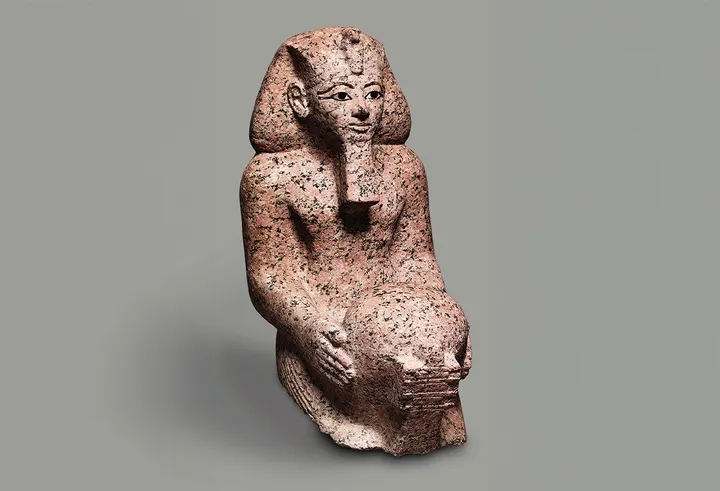
Hatshepsut (ca. 1505–1458 BCE), the most powerful of ancient Egypt’s female rulers, was also one of the most successful, notable for reopening old trade routes, commissioning massive building projects—including her own mortuary temple at Deir el-Bahri—and ushering in an era of political stability, economic growth, and artistic innovation. Her rise to the throne began when, after the death of her husband Thutmose II, she appointed herself regent for her young stepson, Thutmose III; some years into her regency, she claimed the title of pharaoh, fashioning herself as a living god.

Yet as archeologists discovered when excavating Deir el-Barhri in the early 20th century, all physical reminders of Hatshepsut and her 20-year reign seemed to have been subjected to systematic destruction after her death, with her cartouches hacked from walls and obelisks and sculptures of her broken into pieces. Scholars once assumed that the defacement was carried out by a vengeful Thutmose III, who finally succeeded her. More recent theories have proposed less dramatic reasons for her erasure, including the need to legitimize a male heir (or delegitimize a powerful woman).

In an article published in the journal Antiquity last June, however, Jun Yi Wong, a doctoral candidate in Egyptology at the University of Toronto, lays out a more nuanced explanation for the damage. Reassessing excavation records, he writes that although Thutmose III was responsible for the removal of Hatshepsut’s name and image from temple walls, his motivations for doing so remain contentious.

On the other hand, in Wong’s view, the damage to sculptures of Hatshepsut did not have a single cause. While deliberate breakage of her statues at the neck, waist, and knees indicate what he calls a ritualistic “deactivation” of Hatshepsut’s spiritual power by Thutmose III, Wong suggests that much subsequent damage may have derived from the repurposing of deactivated sculptures as raw building material or construction fill.

Wong concludes that while Hatshepsut did suffer a greater degree of persecution after her death than other rulers, Thutmose III’s actions—largely confined to major temples—were likely driven by ritual necessity rather than animosity, with much of the damage to her images incidental rather than deliberate.

“The remainder of the attacks to her figure and name were essentially a scrubbing or re-ascription of her male kingship, and her earlier queenly portrayals were rarely touched,” Peter F. Dorman, an emeritus professor of Egyptology and Near Eastern Languages and Civilizations at the University of Chicago, told the New York Times, which reported on Wong and his research yesterday. “Such niceties are critical in interpreting the political context of ancient history.”

Share. Facebook Twitter Pinterest LinkedIn Tumblr Email

Keep Reading

Malo Chapuy’s Neo-Medieval Paintings Conjure Apocalyptic Visions

Unesco urged to investigate after Israeli forces trigger explosions near Lebanon’s World Heritage-listed Beaufort Castle – The Art Newspaper

Michelle Grabner Donates More Than 2,000 Artworks to Wisconsin’s Kohler Arts Center, Now the Most Comprehensive Repository of Her Work

At Venice’s Palazzo Cavanis, VCUarts Qatar Rethinks How Art and Tech Is Taught

‘It would represent an irreversible loss to Scotland’s cultural record’: potential sale of Glasgow art centre’s archive sparks outcry – The Art Newspaper

Royal Museums Greenwich workers vote to strike over pay and working conditions – The Art Newspaper

In New York Court, Dealer Yves Bouvier Seeks Sotheby’s Records as Part of New French Criminal Case

Archaeologists Uncover Ancient Egyptian Grave Markers Carved with Human Figures

6 Books We’re Looking Forward to in August

Recent Posts
  • Malo Chapuy’s Neo-Medieval Paintings Conjure Apocalyptic Visions
  • Unesco urged to investigate after Israeli forces trigger explosions near Lebanon’s World Heritage-listed Beaufort Castle – The Art Newspaper
  • Michelle Grabner Donates More Than 2,000 Artworks to Wisconsin’s Kohler Arts Center, Now the Most Comprehensive Repository of Her Work
  • American manufacturers grow at fastest clip in 4 years due to AI boom — but all is not well
  • At Venice’s Palazzo Cavanis, VCUarts Qatar Rethinks How Art and Tech Is Taught

Subscribe to Newsletter

Get the latest markets and assets news and updates directly to your inbox.

Editors Picks

Unesco urged to investigate after Israeli forces trigger explosions near Lebanon’s World Heritage-listed Beaufort Castle – The Art Newspaper

August 3, 2026

Michelle Grabner Donates More Than 2,000 Artworks to Wisconsin’s Kohler Arts Center, Now the Most Comprehensive Repository of Her Work

August 3, 2026

American manufacturers grow at fastest clip in 4 years due to AI boom — but all is not well

August 3, 2026

At Venice’s Palazzo Cavanis, VCUarts Qatar Rethinks How Art and Tech Is Taught

August 3, 2026

‘It would represent an irreversible loss to Scotland’s cultural record’: potential sale of Glasgow art centre’s archive sparks outcry – The Art Newspaper

August 3, 2026
Facebook X (Twitter) Instagram
© 2026 The Asset Observer. All Rights Reserved.
  • Privacy Policy
  • Terms
  • Press Release
  • Advertise
  • Contact

Type above and press Enter to search. Press Esc to cancel.