


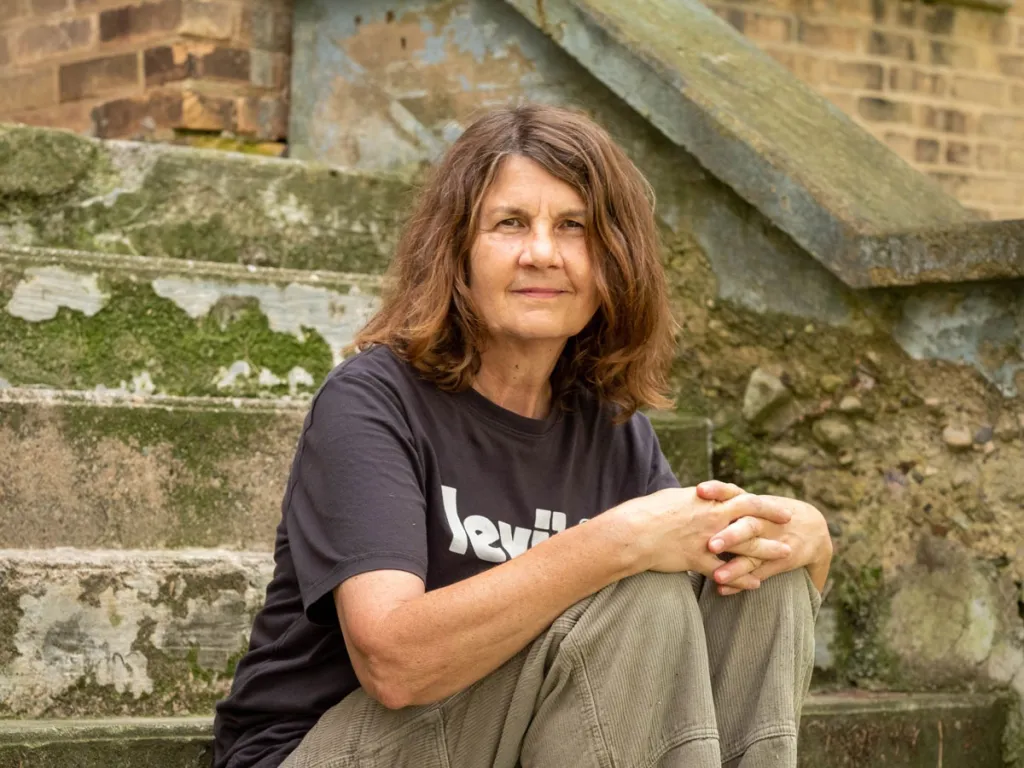
Artist Michelle Grabner will donate more than 2,000 artworks to the John Michael Kohler Arts Center (JMKAC) in Sheboygan, Wisconsin, making the institution the most comprehensive repository of her work.
Comprising 700 paintings, 200 sculptures, and 1,200 prints, Grabner’s gift spans the arc of her career, so far, with pieces made in the early 1990s to ones made in the past few years. Her gift also includes 300 works from her personal art collection, amassed via a combination of trades, gifts, and purchases, as well as her teaching materials and syllabi from her three-decade tenure at the School of the Art Institute of Chicago.
Grabner was born in Wisconsin in 1962, and she said growing up she was aware of the work being done at the JMKAC, which between 1972 and 2016 was led by Ruth DeYoung Kohler II. “Ruth was doing some amazing things there,” Grabner said, but when she was starting out as an artist in the 1980s, “what Ruth was doing was not what was compelling me.” Instead, she was looking to the art scenes in New York and Chicago, and “I wasn’t appreciating what was in my own backyard.”
Beginning with DeYoung Kohler, JMKAC, Grabner said, has “an exceptional history of taking on artists’ environments that they collect, and they collect in mass, where the truth of an artist’s arc, their life, can be represented. They don’t just need the best Michelle Grabner. They have the resources to take on the full arc of the work, including archives, and that is exceptional.”
Michelle Grabner, untitled, 2023.
Photo Matthew Herrmann/©2026 Michelle Grabner/Courtesy the artist and Norr Cohan, New York
That opportunity was exciting to Grabner as most museums are often focused on acquiring a single representative work from a specific moment in her career as opposed to having a more in-depth approach, especially for a mid-career artist like herself. Her work is held in a number of institutional collections, including the Art Institute of Chicago, the Walker Art Center, the Dallas Museum of Art, the Smithsonian American Art Museum, and the Victoria and Albert Museum, London. But now, the JMKAC “will become the principal institutional home for Grabner’s work and teaching archives,” as a press release put it.
The breadth of the gift grew out of several conversations with the JMKAC team, including executive director Amy Horst and chief curator Jodi Throckmorton. “The Arts Center was trying to think about how they could support me in this gift, and I said, ‘You would be supporting me by taking on my material mass,” she said, noting that she told them, “What you are giving me is an opportunity not to spend the last part of my life being an administrator of my own work.”
She continued, “I don’t have to worry about that. I can keep making work. I can keep making opportunities for other artists. I can keep that momentum going instead of arresting myself to thinking about, what is the value of these works? Where should they go?”

Michelle Grabner, Patterns and Practicalities (continuation), 2020–21.
Courtesy John Michael Kohler Arts Center
“That Grabner is a Wisconsin artist with international significance makes this gift especially meaningful—it ensures that a practice with global reach remains rooted in the place that shaped it,” Throckmorton said in a statement, noting that the gift, which will now be accessible to the public, “allows us to work directly with Grabner to shape how her legacy is presented—how the work is shown, contextualized, and understood for years to come.”
Though she still maintains a residence in Chicago, Grabner moved back to Milwaukee in 2015 and soon entered the Kohler orbit. She was invited to participate in Kohler Co.’s three-month Arts/Industry residency in 2017, curated an exhibition at the JMKAC in 2018, and in 2021 was commissioned to make a functional washroom for the JMKAC’s Art Preserve. In 2025, she participated in the Kohler MakerSpace residency program, where she made work in vitreous china. She currently serves as a curator for the Kohler Co.’s Arts/Industry Collection.
Grabner said that her time as an Arts/Industry fellow was especially impactful on her practice. “It’s an exceptional residency—a super labor-intensive residency,” she said, noting it gets artists “to start thinking about both the idea that any variation from a Kohler line of products is a problem, but for artists, variation is interesting, so that works against it. It’s interesting to measure oneself against kind of industrial processes of sameness and efficiency [since] artists often talk about originality or variation in our work, so to deal with that on a daily basis while you’re working your ass off [is] exciting, quite draining, but also intellectually fascinating.”
Michelle Grabner, untitled, 2023.
Photo Matthew Herrmann/©2026 Michelle Grabner/Courtesy the artist and Norr Cohan, New York
Grabner received her MFA from Northwestern University in 1990 and, since 1996, she has taught at the School of the Art Institute of Chicago (SAIC), where she is now chair of the Department of Painting and Sculpture. She sees the gift of her teaching materials as complementary to the JMKAC’s recent acquisition of the Roger Brown Study Collection, a semiprivate home museum made up of some 2,000 artworks by Chicago Imagists and other artists. Brown, who died in 1997, was a predecessor of Grabner’s on the SAIC faculty. The JMKAC collection also includes substantial holdings of the work of Barbara Rossi and Ray Yoshida, both of whom Grabner taught alongside at SAIC.
Taken together, her gift and the JMKAC’s existing holdings of SAIC faculty, Grabner said, in a way shows the trajectory of the school’s Painting and Drawing Department and “how it was marked not only in pedagogy but also in aesthetic shifts in Chicago and what the sources of those artists were.”
“This gift is so much more than the transfer of a remarkable body of work. It is an expression of trust built over years of relationship,” Horst said in a statement. “At the Arts Center, we’ve always believed that lasting partnerships with artists are at the heart of our mission and seeing that commitment returned in such a profound way is deeply moving. To be chosen as the permanent home for an artist’s life’s work is an honor and a reflection of our mission.”
